Physical 100: Italy Review 2026 Tv Show Series Cast Crew Online
Physical 100: Italy, officially titled Physical Italia: da 100 a 1, brings the internationally successful Korean survival-competition format into an unmistakably Italian setting, combining elite athletes, entertainers, internet personalities, and specialists from unconventional sporting disciplines in a demanding contest where physical ability is only part of the equation. Released on Netflix in September 2026, the eight-episode series follows one hundred contestants as they enter a monumental arena and face increasingly difficult challenges designed to test strength, endurance, balance, speed, teamwork, strategy, and mental resilience. Produced by Endemol Shine Italy and directed by Alessio Pollacci, the show attempts to preserve the intensity and visual scale of the original while adding a distinctly local identity through its casting, personalities, and presentation.
The central appeal of Physical 100: Italy is its simple but effective premise: one hundred people begin the competition, but only one can ultimately remain. The format immediately creates a sense of urgency because fame, previous achievements, and reputation offer no guaranteed protection once the contestants enter the arena. Olympic medals, professional sporting careers, television fame, and social-media popularity may attract attention, but the challenges demand immediate performance rather than relying on past accomplishments. This concept gives the series a democratic quality, at least within the rules of reality television. A famous athlete can struggle, while a relatively unknown competitor can become one of the most impressive figures in the competition. The contrast between expectation and performance is one of the show’s most entertaining features.
The Italian adaptation benefits considerably from its varied cast. Among the recognizable names are Olympic swimming champion Federica Pellegrini, diving champion Tania Cagnotto, gymnast Jury Chechi, former rugby international Mirco Bergamasco, Elisabetta Canalis, Alvise Rigo, and content creator Luis Sal. Their presence gives the series an immediate mainstream appeal, but the show is not built exclusively around celebrities. The inclusion of competitors from disciplines such as CrossFit, judo, calisthenics, triathlon, skeleton, American football, wrestling, Hyrox, and Calcio Storico Fiorentino expands the physical and cultural range of the cast. This mixture is important because it prevents the competition from becoming merely a parade of famous people. Instead, it becomes a meeting point between different definitions of athleticism.
One of the strongest aspects of the series is the way it challenges the idea that there is a single definition of physical superiority. A swimmer may possess extraordinary endurance but lack the explosive strength required for another task. A gymnast may have balance and body control but struggle in a heavy-load challenge. A rugby player may dominate in a contest based on power, while a smaller athlete may succeed through agility and efficiency. This variety makes the competition more unpredictable and gives the audience reasons to support contestants beyond their celebrity status. The show understands that physical excellence is highly specialized, and its challenges are most interesting when they expose the difference between being outstanding in one discipline and being adaptable across many.
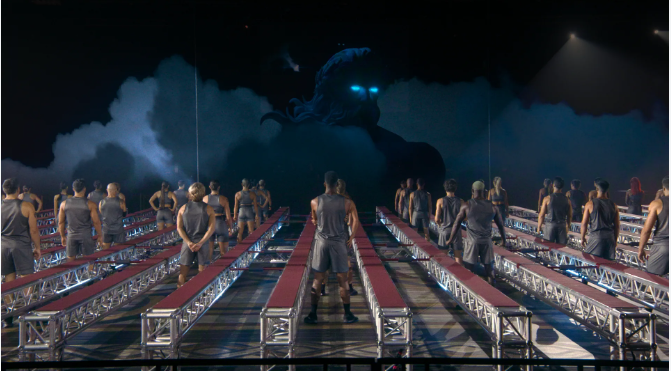
The setting also contributes to the program’s appeal. The competition takes place in a large arena constructed at Turin’s Lingotto, transformed into a theatrical environment that resembles a modern gladiatorial battleground. The scale of the location gives the series a cinematic atmosphere, while the “Sala dei Busti,” where contestants encounter sculpted representations of their bodies, reinforces the show’s central obsession with the human form. The production design is dramatic without being entirely distracting, and the arena provides a consistent visual identity throughout the season. Rather than presenting the competition as a conventional television game show, the series frames it as an epic physical trial.
The challenges are the heart of Physical 100: Italy, and the early episodes establish the tone effectively. Contestants are placed in situations that test how long they can maintain control under discomfort, fatigue, and uncertainty. The opening elimination process, involving participants suspended above a pool, immediately communicates that the series is not simply about looking strong or having an impressive résumé. It is about remaining composed when the body begins to fail. These challenges work because they are easy for viewers to understand even when the competitors possess abilities far beyond those of ordinary people. The audience may not be able to perform the tasks, but it can understand the struggle to hold on, continue moving, maintain balance, or resist exhaustion.
Another strength is the psychological dimension of the format. Although the title emphasizes the physical body, the competition repeatedly demonstrates that mental endurance is equally important. Contestants must decide when to conserve energy, when to take risks, whether to trust teammates, and how to respond after failure. Some challenges reward individual power, while others expose communication problems and leadership weaknesses. The result is a show that becomes more interesting when it moves beyond straightforward strength contests. The competitors are not simply machines performing exercises; they are people making decisions under pressure, often with incomplete information about what awaits them next.
The Italian identity of the show is most visible in the personalities and interactions among the contestants. The cast includes people from very different professional and social backgrounds, and that creates a lively mixture of competitive seriousness, humor, insecurity, confidence, and national pride. The presence of familiar Italian public figures makes the early episodes accessible, but the format gradually shifts attention toward the lesser-known participants who prove unexpectedly capable. This is essential for the show’s credibility. If the entire season were dominated by celebrity recognition, it would feel more like a promotional event than a serious athletic competition. Fortunately, the structure allows the competition itself to become the main attraction.
At the same time, the celebrity casting creates one of the adaptation’s potential weaknesses. Viewers familiar with the original Physical: 100 may expect a competition centered almost entirely on athletes and physical specialists. The Italian edition includes a broader entertainment component, which can make certain moments feel more like conventional reality television. Famous contestants naturally receive more attention, and editing choices may encourage viewers to follow recognizable personalities even when other competitors are equally compelling. This is not necessarily a major flaw, but it does create tension between the sporting credibility of the format and the demands of celebrity-driven television.
The pacing is another important factor. Netflix has released the season in stages rather than dropping every episode at once: the first three episodes arrived on September 11, followed by episodes four and five on September 18, episodes six and seven on September 25, and the finale on October 2. This weekly rollout encourages discussion and anticipation, which suits a competition series built around cliffhangers and eliminations. However, it also means that the viewing experience depends on how effectively each episode balances challenge footage, contestant introductions, emotional backstories, and strategic developments. Too much emphasis on introductions can slow the momentum, while too much focus on the physical tasks can make contestants feel interchangeable. The format works best when the show gives enough context to make the audience care about who survives.
Visually, the production appears designed to compete with the grand scale associated with the franchise. The arena, lighting, sound design, and dramatic editing all emphasize the physical stakes. The contestants’ bodies are presented almost as symbols of discipline, sacrifice, and personal identity. Yet the show is most effective when it avoids treating appearance as the same thing as ability. The entire premise challenges the assumption that the most muscular or visibly powerful person must be the strongest competitor. Endurance, technique, patience, and intelligence often matter just as much. This distinction gives the series more depth than a simple contest based on body size.
The show’s emotional impact comes from watching competitors confront their own limitations. Reality competition programs often depend on exaggerated conflict, but Physical 100: Italy can generate tension without manufacturing interpersonal drama. A contestant struggling to continue a task, a team trying to carry an impossible load, or an experienced athlete realizing that reputation cannot help them creates naturally compelling television. The strongest moments are likely to be those in which contestants show respect for one another after difficult challenges. In a format built around elimination, mutual admiration becomes an important counterbalance to rivalry.
There is also a broader cultural interest in seeing how Italy defines athletic excellence. The cast brings together traditional sporting heroes, modern fitness personalities, entertainers, and people from regional or specialized disciplines. This gives the series an opportunity to present a wider image of Italian physical culture than viewers might expect from a conventional sports program. The inclusion of Calcio Storico Fiorentino, for example, connects the competition to a historic and physically demanding tradition, while the presence of Olympic champions connects it to international sporting achievement. The result is a portrait of athletic Italy that is diverse rather than narrowly focused on football or famous national teams.
Nevertheless, the show is not likely to escape the limitations of the format it inherits. The central structure remains familiar: contestants enter, challenges eliminate participants, emotional stories are introduced, and the field narrows toward a final champion. For viewers who have already watched several versions of Physical: 100, some elements may feel repetitive. The surprise depends heavily on the creativity of the individual challenges and the personalities of the competitors. If the tasks are too similar to previous editions, the Italian version may struggle to establish a separate identity. Its greatest opportunity is therefore not to reinvent the format completely, but to use its local cast and setting to make familiar mechanics feel fresh.
The series is also best understood as entertainment rather than a scientifically precise measurement of overall fitness. Reality competitions are shaped by rules, editing, challenge design, fatigue, team dynamics, and the specific physical attributes required in each event. Winning does not necessarily mean that one contestant is objectively the strongest human being in the country. It means that the person was able to perform most effectively across the particular sequence of challenges presented by the program. This distinction does not diminish the achievement, but it helps explain why the competition is compelling: it tests adaptability under artificial but demanding circumstances.
Overall, Physical 100: Italy appears to be a confident national adaptation that understands why the original format became popular. Its greatest strengths are the diversity of the cast, the impressive arena, the range of physical challenges, and the contrast between celebrity expectations and actual performance. Its weaker points are the inevitable familiarity of the franchise formula and the possibility that celebrity-focused editing may occasionally distract from the athletic competition itself. Even so, the Italian edition offers enough personality and variety to stand as more than a simple copy. It presents physical strength as a combination of endurance, technique, courage, strategy, and emotional control, while giving audiences a broad selection of contestants to follow.
For viewers who enjoy reality competitions, sports documentaries, survival challenges, or personality-driven unscripted television, Physical 100: Italy is an engaging addition to Netflix’s growing international franchise. It is dramatic without requiring a fictional storyline, intense without depending entirely on manufactured arguments, and accessible even to viewers who know little about professional sport. The show’s central question is straightforward but consistently effective: when reputation disappears and everyone faces the same challenge, who can continue when the body and mind are pushed beyond their comfort zone? That question gives Physical 100: Italy its energy, and it is the reason the series remains watchable even for audiences already familiar with the format.