Hot Ones: Extra Heat Review 2026 Tv Show Series Cast Crew Online
Hot Ones: Extra Heat arrives on Netflix as an expanded version of one of the internet’s most recognizable interview formats, bringing Sean Evans, celebrity guests, and increasingly dangerous chicken wings into larger, more promotional, and more event-driven environments. Rather than replacing the original Hot Ones, this 2026 spin-off attempts to give the familiar concept a broader television identity while preserving the central appeal: famous people trying to answer thoughtful questions as the food steadily destroys their composure. The result is an entertaining but somewhat uneven extension of the brand, one that proves the format remains remarkably durable while also revealing why the intimacy of the original studio setting was such an important part of its success.
The basic premise remains almost unchanged. Guests eat wings covered in progressively hotter sauces while Evans interviews them, creating a strange combination of celebrity conversation, endurance challenge, comedy, and psychological experiment. What made the original series so compelling was not simply the spectacle of watching celebrities suffer. It was the way the heat gradually weakened their media-trained defenses. Performers who normally arrive with polished anecdotes and carefully prepared promotional answers often become more spontaneous, vulnerable, absurd, or honest as the wings become harder to tolerate. Extra Heat understands that this remains the foundation of the show’s appeal, and it wisely avoids reinventing the interview structure too aggressively.
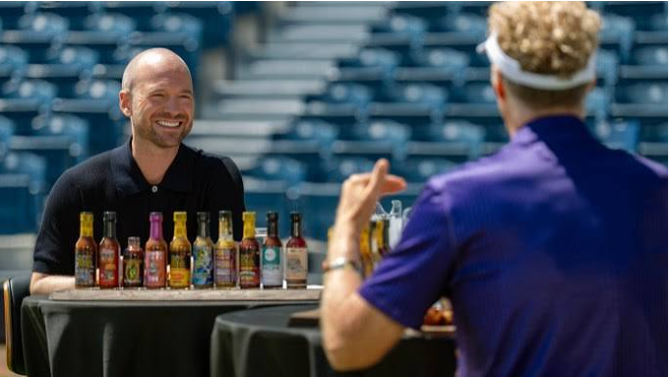
The biggest change is the setting. Instead of remaining inside the famous minimalist studio, Extra Heat moves the action into locations connected to Netflix events, sports coverage, and promotional occasions. The first special, released in July 2026, featured Will Ferrell, Fortune Feimster, and Jimmy Tatro in a baseball-stadium environment connected to the promotion of The Hawk and Netflix’s Home Run Derby programming. This gives the show a more energetic and event-like atmosphere, but it also changes its visual personality. The original Hot Ones benefited from its stripped-down design: a table, two chairs, a row of sauces, and nowhere for the guest to hide. The emptiness focused attention entirely on the conversation. Extra Heat is livelier and more colorful, yet occasionally feels as though it is trying to prove that the format has become important enough to occupy a bigger stage.
That larger scale is both the show’s principal novelty and its most obvious limitation. There is something amusing about seeing the familiar wings challenge transplanted into a stadium or another themed location, especially when the environment is used for playful physical activities. In the premiere, the guests participate in additional sports-related segments, including hitting golf balls at a scoreboard and dealing with ice cream in unusual serving containers. These moments provide visual variety and help distinguish the special from a standard YouTube episode. However, they do not fundamentally deepen the concept. They function more as promotional decorations than as meaningful additions to the interview. The strongest moments still occur when Evans asks a good question and the guest struggles to respond while attempting to survive the next sauce.
Sean Evans remains the essential ingredient. His calm, precise, almost unnervingly composed interviewing style continues to contrast beautifully with the chaos happening across the table. He never needs to become excessively loud or theatrical because the sauces create their own drama. Evans’ strength lies in treating unusual questions with complete seriousness and allowing guests enough room to reveal something unexpected. Even after years of hosting the format, he maintains the impression that he is genuinely interested in the answers rather than simply waiting for the next reaction shot. That balance is crucial. If the host treated the wings only as a prank, the series would quickly become repetitive. Evans instead continues to frame the experience as a real interview that happens to involve an increasingly punishing meal.
The premiere’s guest combination is particularly effective because it creates contrasting personalities rather than relying on one celebrity to carry the entire episode. Will Ferrell brings his familiar comic unpredictability, but the format also allows him to show a more reflective and sincere side. Fortune Feimster supplies energetic reactions and an instinctive ability to turn discomfort into a joke, while Jimmy Tatro contributes a determined, competitive presence that gives the challenge an extra layer of tension. The group dynamic is different from the traditional one-guest format, where every question is designed around a single personality. With three guests, the conversation becomes more spontaneous and competitive, as each person reacts not only to Evans but also to the suffering and confidence of the others.
This ensemble approach is one of the more promising ideas in Extra Heat. A group can create a livelier rhythm than a conventional interview because jokes develop organically between the guests. One person’s reaction becomes another person’s punchline, and the pressure of the wings encourages playful teasing. At the same time, the group format can reduce the depth of the conversation. Evans has less time to explore an individual guest’s career, personal experiences, or unusual stories. The original show often became fascinating when a single question opened into a long, unexpectedly revealing answer. In a three-person setting, the episode has to keep moving, which means some potentially interesting discussions are interrupted before they fully develop.
The show’s relationship with celebrity promotion is also worth examining. Hot Ones has always had a promotional function, but its unusual structure often made it feel less like a conventional publicity stop. Guests came to promote a film, album, television series, or event, yet the interview could become more memorable than the project itself. Extra Heat makes that promotional connection more visible. The location-based specials are directly tied to Netflix programming and major events, so the viewer is more conscious of the machinery surrounding the episode. The first special’s connection to The Hawk is not subtle, and the sports setting reinforces the sense that this is a branded entertainment package rather than simply an intimate interview. That does not automatically make the show ineffective, but it does reduce some of the original format’s sense of discovery.
Visually, the spin-off is polished and energetic. The outdoor environments offer more movement, wider shots, and a stronger sense of occasion than the dark studio. The production design is clearly intended to make the show feel like a television event rather than a web series transferred unchanged to a streaming platform. Yet the visual upgrade sometimes works against the central idea. The original Hot Ones was powerful partly because it looked so simple. Its controlled composition made every facial expression meaningful. In Extra Heat, the wider spaces and additional activities can distract from the key event happening at the table. The show becomes more visually expensive without necessarily becoming more emotionally engaging.
The humor remains reliable, although viewers familiar with the original series may experience diminishing returns. There is an undeniable physical comedy to watching confident celebrities lose their rhythm, sweat through their clothes, search desperately for milk, or insist that they are handling the heat better than they actually are. The sauces create a built-in escalation system that naturally produces laughter. However, the format is now so familiar that the audience knows the basic trajectory before the first wing is served. The guest will begin confidently, the questions will become more revealing, the sauces will become painful, and the final round will produce some combination of panic, denial, and triumph. The challenge for the show is therefore not inventing a new structure but finding guests whose personalities can make that structure feel fresh.
This is where Extra Heat succeeds more often than it fails. The best episodes are not dependent on the novelty of the wings; they depend on the chemistry between Evans and the guests. When the participants are naturally funny, willing to be embarrassed, and capable of responding thoughtfully under pressure, the format still works exceptionally well. When the guests seem overly cautious or too aware of the performance they are giving, the show becomes little more than a celebrity obstacle course. The spin-off cannot solve that problem through bigger locations or extra activities. Its success still depends on casting and interviewing.
Another important question is whether Extra Heat offers anything essential to longtime fans. The answer is complicated. For viewers who already watch the YouTube series, the Netflix specials are unlikely to feel revolutionary. The fundamental interview mechanics remain the same, and the extra segments do not radically expand the format. Yet the show is not really trying to replace the original. It is designed as a companion version, offering shorter, event-based installments that can attract casual viewers who may not regularly seek out online episodes. For that audience, the accessible structure and recognizable celebrity guests make the series easy to enjoy without prior knowledge.
The second episode, featuring WWE superstar CM Punk, suggests that the format can also work through more personality-driven casting. A guest associated with wrestling brings a different kind of public persona to the table: toughness, competitiveness, performance, and a willingness to endure discomfort are already part of the character. That creates an interesting tension because the wings challenge tests whether the guest’s public image can survive a situation that cannot be controlled through athletic skill or stage presence. The concept remains simple, but the cultural background of each guest changes how the challenge plays.
One of the show’s greatest strengths is its ability to humanize celebrities without pretending that the interview is completely unmediated. Of course, the guests are still performing, the production is edited, and the appearances are usually connected to promotional campaigns. Nevertheless, the physical discomfort introduces unpredictability. A famous actor, comedian, athlete, or musician may suddenly become visibly ordinary when faced with a sauce that is too hot. That contrast remains the central pleasure of the franchise. Extra Heat occasionally reminds viewers that the original formula was already strong enough; it did not necessarily need a larger stage.
The pacing is generally brisk, which suits the half-hour special format. There is little room for the conversation to become stagnant, and the escalation of the sauces gives the episode a clear narrative shape. Still, the compressed runtime can make the experience feel more like a highlight package than a fully developed interview. The best original episodes often allowed enough time for the guest’s personality to unfold gradually. Here, the need to balance interview questions, food reactions, location-based games, promotional material, and multiple guests means the episode sometimes feels crowded. The show has plenty happening, but not every element is equally memorable.
As a television spin-off, Hot Ones: Extra Heat is therefore more successful as a celebration of an established format than as a bold reinvention. It understands what audiences love about Hot Ones: the escalating sauces, Sean Evans’ measured questioning, the awkwardness of celebrity vulnerability, and the unpredictable comedy produced by genuine discomfort. Its attempts to add spectacle are occasionally entertaining, but they also reveal how difficult it is to improve upon a concept whose greatest strength was its simplicity. The bigger setting makes the series feel more like an event, but the smaller human moments remain the reason to watch.
Ultimately, Hot Ones: Extra Heat is a fun, watchable, and commercially sensible extension of the franchise, though not a transformational one. It works best when it trusts the chemistry between Evans and his guests, and it is less effective when it leans too heavily on promotional staging or unnecessary side activities. Fans of the original will likely find enough familiar pleasure to justify watching, while newcomers may appreciate the polished Netflix presentation and accessible format. The spin-off demonstrates that the Hot Ones formula still has considerable life left in it, but it also confirms that the show’s true magic was never the stadium, the branding, or even the wings themselves. It was the carefully constructed interview that made celebrities forget, for a few painful minutes, how carefully they normally present themselves.