Moria Review 2026 Tv Show Series Cast Crew Online
Moria is one of the more unusual biographical dramas to arrive on Netflix in 2026 because it does not simply tell the story of its central figure from an objective distance. Instead, the series allows Argentine entertainment icon Moria Casán to participate in shaping the story itself, turning her life into a deliberately theatrical, subjective, and sometimes surreal piece of television. Released globally on Netflix on August 14, 2026, the eight-episode Argentine series explores Casán’s rise from a young woman in the late 1960s to one of the most recognizable figures in Argentine popular culture. Sofia Gala Castiglione, Griselda Siciliani, and Cecilia Roth portray Moria at different stages of her life, while Casán herself also appears as the older version of her character. Netflix describes the project as a fictionalized interpretation in which Casán effectively becomes the puppeteer of her own story, revisiting her past, present, and even imagined future. That approach immediately makes Moria different from a conventional celebrity biography, and while the series is not always as emotionally deep as it could be, its extravagant style, charismatic central character, and unconventional storytelling make it a fascinating watch.
At the center of the series is Moria Casán, a performer whose career has stretched across theatre, film, television, comedy, and popular entertainment for decades. For viewers outside Argentina, one of the biggest challenges may be understanding just how significant Casán’s cultural presence has been. The series therefore has two jobs: it must tell the story of a remarkable woman while also explaining why she became such an enduring public figure. Moria approaches this challenge by focusing less on conventional historical detail and more on personality. It is not interested in presenting Casán as a distant icon whose life can be neatly summarized through dates and achievements. Instead, it presents her as someone who constantly reinvented herself, controlled her public image, challenged expectations, and turned controversy into part of her identity. That makes the show particularly compelling when it allows Casán’s personality to dominate the screen.
The series begins with Moria celebrating her 80th birthday, immediately establishing the idea that this is not simply a story about the past. The older Moria looks back at the person she once was and effectively takes control of the narrative. From there, the story moves back to 1968, when the young woman, then known as Ana María Casanova, was studying law and had not yet become the famous performer the public would eventually know. According to the early episodes, a chance encounter with the world of revue theatre changes the direction of her life. She becomes fascinated by performance and eventually chooses entertainment over her previous path. This setup gives the series a classic rise-to-fame structure, but the way it is presented is much stranger and more theatrical than a conventional biopic.
Sofia Gala Castiglione is particularly well suited to the role because she brings a personal connection to the story as Moria Casán’s daughter. Her performance does not simply imitate her mother; instead, she captures the confidence, humor, sensuality, and rebelliousness that define the younger Moria. She has to portray a woman who is discovering her identity at the same time that she is constructing a public persona, and that combination requires considerable energy. Castiglione makes the transformation believable, especially during the early stages when Moria begins to understand that her appearance, sexuality, humor, and intelligence can all become tools for controlling her career.
Griselda Siciliani and Cecilia Roth take over the role at later points in Moria’s life, and the decision to use three actresses is one of the series’ most interesting creative choices. Rather than relying on heavy digital effects or attempting to make one performer play every age, the production treats the different versions of Moria almost like different manifestations of the same personality. With costumes, wigs, makeup, and performance style connecting them, the actresses create a surprisingly coherent character. Their physical similarities to Casán also make the transitions convincing. A recent review specifically highlighted how closely the three actresses resemble Casán through the production’s makeup and styling.
The performances are important because Moria is fundamentally a character-driven series. The supporting characters often exist primarily in relation to Moria, which can occasionally make them feel underdeveloped. Her romantic relationships, professional partnerships, and conflicts are important to the story, but the series repeatedly returns the spotlight to Moria herself. This is both the show’s greatest strength and one of its biggest weaknesses. Because the central character is so charismatic, it is easy to watch her dominate the narrative. However, because the surrounding characters receive less emotional development, some dramatic moments do not have as much impact as they could.
The first episodes portray Moria’s entrance into revue theatre as a turning point. She recognizes the power of the stage and quickly understands that she does not want merely to participate in someone else’s production. She wants control. That ambition becomes one of the defining themes of the series. Moria is not portrayed as someone who passively becomes famous because circumstances happen to favor her. She actively creates the persona that will eventually make her a cultural icon. When producers attempt to define what she should be, she pushes back and looks for ways to establish her own terms. This emphasis on agency is central to the show’s interpretation of her life.
Sexuality is also an important part of the story, and Moria does not shy away from the provocative elements of Casán’s career. The series contains nudity, sexual situations, and frank discussions of sex, particularly in its depiction of her early career in revue theatre. However, the show generally treats sexuality as part of Moria’s relationship with power and public identity rather than simply using it for shock value. Her body becomes part of her performance, but the series repeatedly emphasizes that she wants to determine how that body is presented and who is allowed access to it.
This is where Moria becomes more interesting than a simple celebrity success story. The series is fascinated by the difference between being looked at and controlling the gaze of others. Moria understands that audiences will objectify performers, but she attempts to turn that dynamic into a source of power. Her career becomes a negotiation between public attention and personal control. The show does not always analyze this contradiction deeply enough, but it recognizes that it is central to her story.
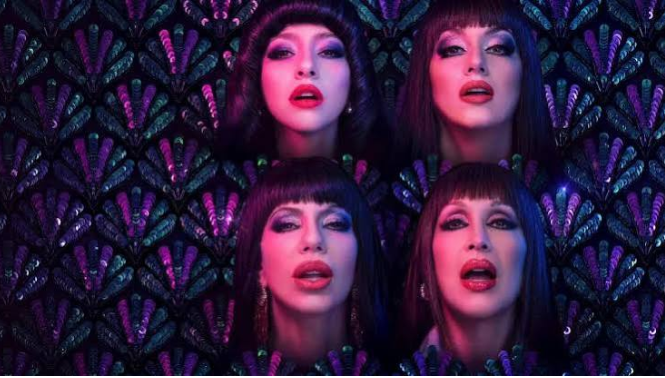
The visual style is arguably the most distinctive feature of Moria. This is not a restrained, realistic period drama. The series embraces theatricality, bright presentation, extravagant costumes, performance spaces, and an intentionally heightened atmosphere. A contemporary review described it as highly stylized and emphasized that the show reflects Casán’s own subjective version of events. Another review characterized the series as a campy, almost cosmic portrait of the Argentine icon, emphasizing how the production uses mainstream entertainment forms in deliberately disruptive ways.
That visual approach makes sense because Moria herself is inseparable from spectacle. A realistic biography might actually have felt less truthful to the spirit of her career. She has spent decades turning herself into a larger-than-life public character, so the series mirrors that behavior. The world of Moria often feels like a stage because Moria has spent much of her life treating the world as one.
The show also plays with the idea of truth. Traditional biographical dramas usually ask viewers to believe that what they are watching represents what really happened. Moria complicates that relationship from the beginning. The older Moria effectively acknowledges that she is telling her own version of events. That means the viewer is encouraged to question whether a particular moment should be interpreted as historical fact, personal memory, exaggeration, fantasy, or some combination of all four. Netflix’s description specifically emphasizes that Casán opens the doors to her own fiction and participates in constructing the narrative.
This is an excellent concept because celebrity biographies are always shaped by perspective. A person’s public image is rarely identical to their private life, and Moria makes that tension the foundation of the series. Instead of pretending to deliver an entirely objective account, the show openly admits that it is presenting Moria’s version of Moria. That self-awareness gives the series a playful quality and allows it to exaggerate reality without necessarily feeling dishonest.
At the same time, this narrative approach creates a significant problem: there is not always enough conflict. Because Moria is involved in shaping the story, the series sometimes feels more like a celebration than an investigation. A biography becomes dramatically powerful when it allows the subject to fail, make mistakes, experience consequences, and confront uncomfortable truths. Moria does explore difficult periods of her life and career, including controversies and moments when she loses her freedom, but much of the emphasis remains on her ability to overcome obstacles. The production itself describes the journey as one in which Moria confronts adversity but repeatedly defeats it through her distinctive logic.
That can make the show feel slightly too flattering. The audience is often encouraged to admire Moria rather than question her. For fans, this will probably be part of the appeal. For viewers expecting a more complicated psychological portrait, however, the series may feel superficial at times. The biggest question is whether the show is willing to look beyond the legend and examine the person underneath it.
The answer is sometimes yes, particularly when the story moves toward Moria’s family relationships and more difficult chapters. The series reportedly explores her relationship with her daughter as well as controversial episodes in her career. These elements have the potential to give the character greater emotional depth because they show that being powerful and successful does not eliminate vulnerability. Unfortunately, the supporting characters are not always developed enough for these relationships to have the emotional weight they deserve.
The pacing is another mixed element. With eight episodes, Moria has enough room to cover several decades of an extraordinary career, but that also means it must move quickly. Important events can sometimes feel like they are being introduced and then immediately replaced by the next chapter. Viewers unfamiliar with Argentine entertainment history may occasionally feel that they are missing context. This is particularly noticeable when the show assumes that certain public controversies or professional milestones carry enormous significance.
Nevertheless, the pacing keeps the series energetic. There is very little danger of Moria becoming dull. Every episode has a new costume, controversy, performance, relationship, or transformation. The show reflects the restless nature of its protagonist. Moria is always moving forward, reinventing herself, or finding another way to remain relevant. That constant momentum is one reason the series remains entertaining even when its emotional storytelling is uneven.
The humor is also an important part of the experience. Moria is not presented as a solemn historical figure. She is witty, provocative, self-aware, and often deliberately outrageous. The series understands that comedy was one of the tools she used to build her identity. Her humor allows her to control uncomfortable situations and maintain power even when others attempt to diminish her. This gives the character an appealing unpredictability.
Another major strength is the production’s sense of Argentine popular culture. Even international viewers who know little about Moria Casán may come away with an appreciation of how deeply connected she is to the country’s entertainment history. The series does not treat her career as an isolated celebrity story. It presents her as part of a broader culture of theatre, television, celebrity, controversy, and reinvention. That cultural context gives the show more importance than a standard rise-and-fall celebrity biography.
The title Moria is therefore appropriate because the series is less interested in separating the woman from the myth than in showing how the two became inseparable. Moria Casán created a public identity so powerful that it became its own character. The Netflix series then takes that idea one step further by allowing multiple actresses to embody the different versions of her. Young Moria, middle-aged Moria, and older Moria become almost like separate characters who are nevertheless connected by the same voice and personality.
For viewers who enjoy traditional historical dramas, this approach may initially be confusing. Those expecting a straightforward chronological biography may find the show too stylized and self-conscious. But viewers willing to accept its theatrical approach will probably find much more to appreciate. Moria works best when it stops pretending to be an objective biography and embraces its identity as a fictionalized portrait constructed around a larger-than-life performer.
The series is also helped enormously by the commitment of its lead actresses. Castiglione, Siciliani, and Roth do not simply reproduce Casán’s appearance; they each attempt to capture different dimensions of her personality. Their performances create continuity across decades while allowing each stage of Moria’s life to feel distinct. Casán’s own presence adds another layer because she is effectively watching, controlling, and participating in the dramatization of her life.
Ultimately, Moria is more entertaining than profound, more stylish than psychologically detailed, and more celebratory than critical. Those qualities may frustrate some viewers, but they also make the show unique. It understands that Moria Casán is not simply a celebrity whose life can be translated into a conventional biography. She is a performer who spent decades turning her own existence into a spectacle. A conventional approach would therefore have missed the essence of the subject.
For international audiences, Moria is also an intriguing introduction to a figure who may be far less familiar outside Argentina than other global entertainment icons. The series provides a window into a very specific cultural history while maintaining universal themes of ambition, identity, fame, sexuality, independence, reinvention, and the complicated relationship between public image and private life. Even when the show assumes too much knowledge from its audience, the central character is compelling enough to keep the story moving.
As a Netflix drama, Moria will probably appeal most to viewers who enjoy unconventional biographical series rather than straightforward historical recreations. It has some similarities to other fictionalized celebrity biographies, but its willingness to let the subject participate in the construction of her own mythology makes it particularly distinctive. IMDb lists the series as an Argentine Spanish-language biography drama released on August 14, 2026, with one season currently consisting of eight episodes.
In the end, Moria is an extravagant and fascinating portrait of a woman who refused to remain confined to a single definition of herself. Its greatest strength is its central personality, while its biggest weakness is that almost everyone else exists in her shadow. The series does not always provide the complexity or dramatic conflict that a more conventional biography might offer, but it compensates with style, humor, bold performances, and a fascinating approach to truth and memory. It is not a neutral biography of Moria Casán, and viewers should not expect one. It is Moria’s story filtered through Moria’s mythology, performed by three actresses and occasionally narrated from the perspective of the woman herself. That makes it imperfect, but also makes it memorable. For viewers interested in celebrity biographies, Argentine pop culture, or visually distinctive dramas, Moria is worth watching. It may not provide the definitive answer to who Moria Casán really is, but perhaps that is exactly the point: after decades of reinvention, even Moria herself remains partly a performance, and this series understands that the most entertaining version of the truth may be the one she chooses to tell.