Wayward Review 2025 Tv Show Series Cast Crew Online
It’s funny to hear Toni Collette, as quirky camp counselor/sadistic prison warden Evelyn Wade, mention “fixing the problem of adolescence” just a few days before another Netflix series is set to be hailed as the year’s crowning achievement in television. At Netflix, there is no problem with “Adolescence” (unless you count its truncated episode count), even if “Adolescence” is very aware of the problems faced by youths watching Netflix.
Still, the “problem” Evelyn refers to isn’t the one facing Jamie Miller, and what it is, exactly, forms the knotty little question at the heart of “Wayward.” Creator Mae Martin’s eight-episode mystery-thriller is certainly concerned about our teens, but the dedication to those worries ebbs and flows much like the tone shifts from detached to sympathetic. The thrills are there, but muted. The mystery is functional, but short on “wow” moments. Martin’s first stab at the genre can’t help but feel like a comedian’s interpretation — commenting from the outside looking in, rather than investing wholeheartedly. As a result, “Wayward” works better when seen from a remove than at the edge of your seat, which is fine, so long as you adjust your posture to make space for its handful of allegorical interpretations.
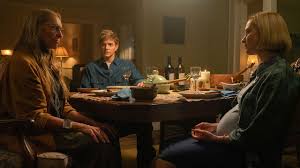
Told from two primary perspectives, “Wayward” follows Alex Dempsey (Martin), a cop from Detroit who moves to his wife’s (fictional) hometown of Tall Pines, Virginia. Laura (Sarah Gadon) is pregnant, Alex is looking for a fresh start, and together they’ve been gifted a spacious house in the country by the unofficial local leader, Evelyn Wade (Collette). Turns out Laura used to be a student at Evelyn’s academy, a local boarding school for “troubled teens,” and the two have maintained a familial connection ever since.
Their candid yet testy relationship is the first clue Alex gets that there may be things he doesn’t know about his wife’s upbringing, and “Wayward” strings those clues out a little past their limits. Still, the vibes are immediately unsettling, thanks to how quickly everyone in town knows who they are, where they’re from, and all about the baby they’re having. Or it could be the bloody kid who comes bursting out of the woods to kick off Alex’s first shift on the force.
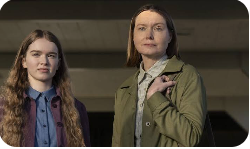
From there, Alex can’t help but look into Evelyn’s operation — his job demands it (even if his fellow officers show little interest), and Laura’s past proves too personally tantalizing to leave buried — but our clearest view of the isolated institution comes from our two other leads, Abbie (Sydney Topliffe) and Leila (Alyvia Alyn Lind). Best friends at their Toronto high school, the teens soon end up in Tall Pines by avenues best left unspoiled, but they’re both determined to escape as soon as they arrive.
Why? Well, for one, the go-to induction method is being roused from your bed in the middle of the night, hog-tied, and tossed in a van. Once your supervised shower is over and you’ve donned the denim-blue uniform reminiscent of old prison garb, there’s the dehumanizing nomenclature to contend with: Staff members are referred to by animal names, like “Rabbit” and “Mule.” Inmates Students aren’t allowed to touch each other, with ugly exceptions: Guards can manhandle you as much as they want, but a friend’s comforting hug or pat on the back means you have to spend the night on the concrete floor. Ratting out your roommates — or any fellow kids — is strongly encouraged.
Then there are the therapy sessions themselves, but those needn’t be spoiled either. “Wayward” is filled with curious details that help establish a consistently creepy atmosphere, even if it falls short of evoking a grounded reality (to better criticize the billion-dollar teen trauma industry) or a more heightened horror story (to better satisfy genre fans looking for big thrills). Instead, it falls somewhere in the middle, setting aside any biting commentary or shocking frights in favor of accessible, varied interpretations.
Martin has been open about the “ton[s] of metaphor” infused in their second Netflix series (following the searing, semi-autobiographical comedy “Feel Good”), and different viewers will likely latch onto different readings. There’s a rather straightforward application in how we move from adolescence to adulthood, what (and who) we take with us, and what we choose (or are forced) to leave behind — themes that have long resonated in Martin’s work. “Wayward” also serves as an allegory for gender transition (Martin is non-binary, while their character, Alex, is a trans man), and it also demonstrates the dangers of isolationism and the healing influence of community. One could even argue there’s a repudiation of authoritarianism and totalitarianism, though only in the broadest strokes.
It can be fun to chew on whatever ideas come to mind as “Wayward” moves through its sometimes perfunctory plotting, just as certain moments, scenes, and episodes are elevated above their predictable progressions by enticing choices. A local cop’s enthusiastic obsession with the dullest tasks makes for a strange and silly running joke. Episode 6, “Mirror,” is like a mini-“Lord of the Flies” crossed with a Big Flashback Episode. The students are delightfully distinct, as is Collette, who once again distinguishes a new intimidating matriarch from all her others. While it may not go down as one of the stronger cult stories sweeping television, “Wayward” has fewer problems than peculiarities. Just keep an open mind.