The Great Flood 2025 Movie Review
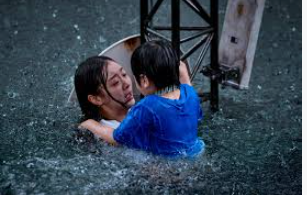
Anna (Kim D-mi) lives in an apartment building with her six-year-old son, Ja In (Kwon Eun-sung). One day, the world begins to flood after a comet collapses into Australia, causing water levels to rise everywhere. As the building slowly disappears under water, Anna and her son try to escape. Outside, they are guided by Hee-jo (Park Hae-jo), a man who claims a helicopter is waiting on the roof.
During their desperate climb upward, Anna witnesses fragments of humanity at its most vulnerable: two men looting abandoned homes, an elderly couple calmly waiting for death, a little girl trapped in an elevator and a woman about to give birth with her husband by her side. The water keeps rising, tension escalates and then Anna loses sight of Ja In. Ironically, Ja In, who dreams of becoming a diver, experiences his dream in the most terrifying way imaginable.
Visually, The Great Flood is stunning. The confined setting of a single apartment complex makes the disaster feel intimate and realistic. The simplicity of the locations works in the film’s favor, turning the rising water into a constant, suffocating threat rather than relying on large-scale spectacle.
Where the film becomes challenging is its narrative ambition. Anna, a scientist, is prioritized for evacuation over her own son, a decision that immediately raises uncomfortable moral questions. About halfway through the film, when it feels like the story should be reaching its conclusion, it unexpectedly resets. What began as a survival thriller turns into a search narrative in which Anna relives the same day over and over again with Hee-jo.
This shift, reminiscent of Groundhog Day or Edge of Tomorrow, is intriguing but also confusing. At times, it feels as if Hee-jo might be a future version of Ja In. He shares similar emotional wounds, including abandonment by his mother, which mirrors the fear Anna has of failing her son. The film strongly hints at this connection but never fully commits to it, leaving the audience unsure whether this parallel is symbolic or literal.
That uncertainty becomes the film’s biggest weakness. The repetition of the day, the people Anna keeps encountering and the mechanics behind this time loop are never clearly explained. Were these encounters meant to test her humanity? Her guilt? Her priorities as a mother versus her value to the world? The film raises these questions but doesn’t provide satisfying answers. As a result, The Great Flood feels both beautiful and messy.
The acting is solid across the board and emotionally the film often works on a moment-to-moment basis. The tension, the visuals and the moral dilemmas keep you engaged. But when the credits roll, it’s unclear what the film ultimately wanted to say. Is it about motherhood, sacrifice, fate, or humanity in crisis? Perhaps all of them but without focus, the message gets diluted.
Still, despite its narrative confusion, The Great Flood remains an intense and visually impressive experience. It may not fully come together thematically, but it’s gripping enough to make the journey worthwhile.