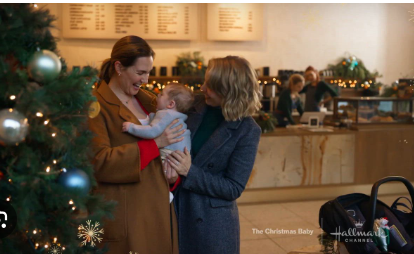
The Christmas Baby 2025 Movie Review
The Christmas Baby (2025) arrives on the Hallmark Channel’s annual holiday slate as one of the most talked-about seasonal films of the year, not simply because it fits snugly into the familiar genre of feel-good Christmas fare, but because it stands out in meaningful and emotionally engaging ways that transcend the usual formula. At its heart, this film tells the story of Erin (played with heartfelt warmth by Ali Liebert) and Kelly (brought to life by Katherine Barrell), a happily married couple whose lives are upended just days before Christmas when a baby boy named Nicholas is mysteriously left on their doorstep with only an anonymous note asking them to care for him. From that simple, almost fairy-tale premise — love unexpectedly appearing at the threshold — unfolds an intricate, deeply human narrative that explores what it really means to build a family, the courage it takes to embrace change, and the beauty of love arriving in ways you never anticipated.
The film’s narrative arc is deceptively simple: Erin and Kelly begin the foster-to-adopt journey amid holiday hustle and bustle, juggling their careers, Christmas preparations, and their own evolving personal aspirations. But what feels refreshing is how the screenplay, penned by Topher Payne, treats these familiar holiday tropes with an added layer of emotional complexity and authenticity. Rather than resorting to predictable sitcom-like chaos or sentimental clichés, The Christmas Baby thoughtfully portrays the couple’s internal and relational transformations, giving space to doubt, joy, fear, and ultimately, hope. Erin quietly harbors a longing for motherhood that she has never fully articulated, while Kelly is more reticent, cautious about how parenthood might reshape their lives and identities. This contrast in their characters’ emotional landscapes forms the backbone of the film’s dramatic tension, and both Liebert and Barrell rise to the occasion with performances rich in nuance.
Their chemistry feels lived-in and sincere — a critical anchor in a story that hinges on the audience’s investment in their bond and the authenticity of their reactions to extraordinary circumstances. Critics and early viewers alike have praised this dynamic, noting that the depth of feeling and maturity exhibited by the actors gives the movie more emotional weight than most of Hallmark’s holiday offerings receive in a single season. Indeed, posts from audiences on social platforms suggest that many viewers consider The Christmas Baby one of the best entries in Hallmark’s “Countdown to Christmas” roster in years, with some even ranking it among their top holiday films of 2025. The way Erin and Kelly navigate their community’s reactions — including the good-hearted support of friends and family and the occasional skeptical neighbor — adds texture to the story, reminding viewers that real life is rarely just decorative lights and mistletoe, but a tapestry woven from diverse personalities, opinions, and lived experiences.
One of the most remarkable aspects of the film is its representation: it’s not merely inclusive in intent, but it integrates that inclusivity into the emotional core of the narrative, allowing queer audiences to see reflections of themselves in a genre that has historically centered on heteronormative stories. This dimension isn’t treated as an afterthought or a token gesture; rather, it’s integral to the story’s exploration of how love and family are defined and redefined, how societal expectations can be gently questioned, and how happiness doesn’t always follow the straightest or most predictable path — it often finds us when we’re open to being changed by it. The way the film handles the foster-to-adopt process — rarely depicted in holiday movies with such sensitivity — further elevates its emotional resonance. Viewers witness Erin and Kelly grappling with the bureaucratic, logistical, and deeply personal challenges of caring for Nicholas, all while trying to maintain their professional lives and holiday traditions. This realism doesn’t detract from the Christmas magic; instead, it enriches it, grounding the story in situations many families can recognize — late-night decisions, difficult conversations about the future, and the continual negotiation between who we are and who we hope to become.
The supporting cast, including performances by Barbara Niven as a Department of Youth and Families employee and the presence of close friends and relatives who help shoulder the practicalities of new parenthood, contributes to a sense of community that feels both comforting and necessary. The sets and cinematography reinforce the film’s warm, winter palette — snow-dusted streets, cozy interiors lit by the glow of Christmas lights, and intimate moments captured with a softness that evokes nostalgia without feeling saccharine. Even the film’s pacing, often a challenge in holiday-themed fare where every scene must balance exposition with heartfelt beats, feels measured and attentive: there are scenes that make you smile, others that might make you tear up, and a handful that will likely linger with you long after the credits roll. One of the film’s greatest strengths lies in its refusal to skim over the hard parts of love and decision-making.
There are moments of conflict rooted not in melodrama but in the very real questions that face anyone contemplating parenthood: Will we be good enough? What sacrifices must we make? How do we reconcile our individual dreams with the needs of another life? These questions are buried in scenes that feel intimate rather than preachy, allowing the emotional truth of the characters to guide the audience without overt moralizing. And yet, despite these heavier themes, The Christmas Baby does not lose sight of joy — there are moments of unabashed laughter, tender glances that speak volumes, and a palpable sense of wonder as the couple and their community embrace Nicholas and the possibilities he symbolizes.
The film doesn’t rush its resolution, and its conclusion — heartfelt, hopeful, and thoughtfully earned — offers a satisfying and uplifting sense of closure, even as it acknowledges that the journey of family, love, and identity is ongoing. Critics have noted that while the movie undeniably wears its heart on its sleeve, it does so with an honesty and sincerity that feels earned rather than formulaic, and such praise underscores the film’s achievement in capturing the spirit of the season without reducing it to mere ornamentation. In a year crowded with holiday content — some more experimental, others more commercially driven — The Christmas Baby distinguishes itself not by rejecting genre conventions but by enriching them, infusing the familiar structure of a Christmas movie with a depth of feeling and a modernity of perspective that resonates with a broad audience. It’s a film that invites repeat viewings and thoughtful conversation — about what family means, how love reshapes us, and why the unexpected often brings the most profound gifts. Whether you’re someone who watches Hallmark movies religiously or a viewer who typically approaches holiday films with skepticism, The Christmas Baby offers an experience that feels both classic and refreshingly new, wrapped in the universal themes of hope, vulnerability, and the enduring power of opening your heart when life presents its surprises.