Son-in-Law 2026 Movie Review
It all starts in prison. The narrative, at least. It actually starts in 2019, when we see Jose Sanchez (Vazquez) planting a gun in the hand of a man who’s rather quickly bleeding out inside a car, having been executed by about 1,000 bullets. Then again, maybe it all started in 1985, when Jose was an idiot teenager in San Diego who tries to buy one single little ecstasy pill from a dealer, gets talked into selling a variety of illicit wares at a party, then gets nothing for them when the girl he likes passes the drugs out to all her friends thinking Jose brought them for that reason. Then Jose avoids trouble by moving to Mexico to live with his uncle, who barely moves from his chair in front of the TV. By 2005, Jose is a ponytailed law student who’s schtupping his best pal’s sister Lucia (Veronica Bravo), whose parents are rich and well-connected politically – and it’s a bit of a scandal when he knocks her up.
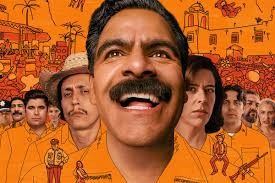
TEN YEARS LATER reads a big title card, and no, we’re still not done leaping around on the timeline, because we’ll jump back to the present-day prison situation on the regular. However, at this TEN YEARS LATER point, Jose has settled in and just, well, settled. Ponytail’s gone, pushbroom mustache is present and hovering about 18 inches over his paunch. He and Lucia are married with two kids. Nice house, since she comes from dough. He’s the executive vice president at his in-laws’ transportation company, a cushy nepo-adjacent job that, from the looks of things, is 90 percent title, 10 percent busy work and zero percent agency or influence. The guy looks bored as hell.
Remember the drug guy from the 1985 scene? Well, a parallel character turns up in the TEN YEARS LATER (that would be 2015 if my math is accurate) piece of the timeline. That character is “The Air Conditioning Guy,” scare quotes absolutely necessary, because he’s clearly no HVAC expert. Jose’s even warned to not mess with the guy known as El Lobo (Jero Medina), which is an invitation for him to fire up a conversation that results in a handshake that results in a smash cut to Present Day Jose in an orange jumpsuit, needing a shave, while we piece together that El Lobo is the dead guy in the car at the beginning of the film. Present Day Jose meets with a petroleum-coated lawyer (hired by the in-laws, it seems) who intends to get his client out of the clink by framing him as a “very minor player,” a phrase that makes Jose bristle. He was trying NOT to be a very minor player, and maybe that’s the hill he’ll die on. If he’s principled – and I’m not sure he is; in fact, he may not know the word even exists – he’ll stay in prison like the very unminor big shot he wanted to be. I mean, he was the attorney general of Albacruz, and was eyeing running for mayor. Minor, his ass! Is this a conundrum for him? Hard to tell. He’s kinda impenetrable. I’m not sure we know what he truly wants – possibly because he may not know what he truly wants.
Honestly, I found Son-in-Law baffling. It’s slippery and challenging likely by design, and feels like inside baseball on Mexican politics (and as an American, I’m watching the game from outside the stadium). Audiences can usually get past some of those details and grok the broader strokes, but those, too, are difficult. What motivates Jose to make the decisions he does, beyond a vague yearning to acquire power and influence? What’s going on inside his head? The mercurial nature of the guy is equal parts alluring and frustrating – and again, that feels intentional, perhaps to reflect the humanist folly of social and political climbers.
Directing a screenplay by James Schamus, Alexandro Aldrete and Gabriel Nuncio, Naranjo steadfastly and pointedly avoids peddling easy laughs or emotional beats. (There’s a death in the film The narrative follows Jose as he half-unintentionally weasels his way into a family that likely considers him to be a loser, half-intentionally gets involved in politics, half-assedly backs into involvement with drug cartels, half-successfully negotiates peace among three cartels at war, half-haphazardly becomes a notorious figure known as El Serpiente and half-accidentally ends up in the clink. The story rides on the notion that Jose only has to be half-corrupt because the system is corrupt for him. Of course, the part of the system that’s partway (that’s less than halfway, I’d like to point out) functional also put him in prison, but the system also seems likely to get him out as long as he’s willing to make a personal compromise and admit that he’s barely done anything even though he likes to think he’s done lots of things.
Bewildered? That’s the point, to watch as an opportunist dimbulb like Jose chases his tail for 100 minutes. The screenplay is structured as a series of knotted convolutions that feel somewhat haphazardly arranged, as if to reflect the ridiculous manner in which our protag rises and falls, and how the combined social, legal and governmental systems enable him to be a privileged idiot. It feels episodic at times, like it could be more satisfyingly fleshed-out in a miniseries. And it’s hard to judge, because it’s frustrating and confusing – again, by design it seems – but with clear intent to satirize the ins, outs and what-have-yous of Mexican power structures. It’s a choice made by the filmmakers to have us stand at some remove from Jose, and just shake our heads at this guy and all the madness around him.