Paradise Lost 2026 Movie Review
Paradise Lost is a haunting South Korean psychological thriller that explores grief, memory, artificial intelligence, and the unsettling distance between the people we remember and the people they become. Directed by Yeon Sang-ho, the film follows Ryu So-young, a mother whose young son disappeared nine years earlier when a school bus carrying children vanished. Unable to accept the uncertainty surrounding his fate, So-young finds comfort in an augmented-reality program that recreates her son as a child. Then, unexpectedly, the real Sun-woo returns—alive, grown, scarred, and almost unrecognizable. The reunion that should feel like a miracle instead becomes the beginning of a deeply disturbing mystery.
The premise gives Paradise Lost an immediate emotional hook. A parent’s longing for a missing child is already a powerful subject, but Yeon adds a contemporary technological dimension that makes the story especially unsettling. So-young has spent years speaking to an AI reconstruction of her son, preserving the child she remembers in a form that never grows older. When the real Sun-woo comes home, she must confront the difference between the comforting image she has maintained and the young man standing before her. The film’s central question is both intimate and philosophical: if memory can be recreated, does that mean grief can be resolved—or merely postponed?
Kim Hyun-joo plays So-young, and her performance provides the film’s emotional anchor. So-young is not simply a grieving mother waiting for her life to return to normal. She has developed a routine around the virtual version of her child, allowing technology to become part of her private process of mourning. Kim portrays this attachment with tenderness, but also with the quiet desperation of someone who has learned to live inside an emotional compromise. The arrival of her real son forces her to question the coping mechanism that has sustained her for nearly a decade.
So-young’s emotional journey is particularly compelling because her grief is not presented as a single dramatic event. It has become part of her daily life, shaping her habits, her expectations, and her understanding of the future. The AI version of Sun-woo offers her a kind of stability: he remains the boy she remembers, capable of conversation and affection without the unpredictable changes of real life. The return of the adult Sun-woo disrupts that stability, making her face not only the mystery of his disappearance but also the years she has spent emotionally attached to a digital representation.
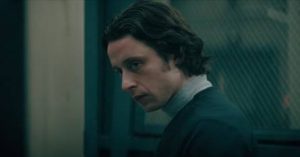
Bae Hyun-sung plays the returned Sun-woo, whose presence introduces a very different kind of tension. He is not the innocent child So-young remembers. His body bears scars, his manner is cold, and his behaviour can become threatening. Bae’s performance appears designed to keep the audience uncertain about Sun-woo’s intentions. He is simultaneously a son who has endured something terrible and a stranger whose actions make it difficult for his mother to feel safe. That ambiguity is central to the film’s psychological suspense.
The contrast between the virtual child and the adult Sun-woo is one of the film’s most effective ideas. The AI version represents memory in its most comforting form: familiar, preserved, and responsive. The real Sun-woo represents everything memory cannot control—change, trauma, anger, and the possibility that a loved one may return as someone we no longer understand. The film asks whether So-young is prepared to love the person who has come back, rather than the child she has spent years trying to preserve.
Yeon Sang-ho has built a career around genre stories that use extraordinary situations to examine human behaviour. With Train to Busan, he placed family relationships inside a zombie crisis; with Hellbound, he explored fear, belief, and social power through supernatural events. Paradise Lost turns toward a more intimate form of horror, using AI and a missing-child mystery to examine the emotional consequences of grief. Its science-fiction premise is not merely a futuristic gimmick. It becomes a way to ask what happens when technology offers a version of emotional closure that reality cannot provide.
The AI program, called Children of Paradise, is particularly intriguing because it does not simply function as a recording or a static image. It allows parents to interact with reconstructed versions of their missing children through augmented-reality glasses. The technology creates the impression of an ongoing relationship, even though the children remain frozen at the age they were when they disappeared. The concept raises questions about memory, identity, and the ethics of creating digital versions of people who can no longer speak for themselves.
The film’s strongest ideas emerge from the tension between comfort and illusion. So-young’s virtual son may offer genuine emotional relief, but that relief depends on a carefully maintained separation from reality. The program allows her to continue experiencing motherhood in a familiar form, yet it also raises the possibility that she has become attached to an idealized version of her child. When Sun-woo returns, she is forced to decide whether the virtual relationship is helping her move forward or preventing her from accepting the uncertainty of the past.
This dilemma gives the film a timely connection to contemporary debates about artificial intelligence. As digital tools become increasingly capable of reproducing voices, images, and conversational patterns, the line between remembrance and simulation grows more complicated. Paradise Lost does not need to predict the exact future of AI to make its point. Its concern is emotional: people may willingly accept a convincing simulation if it allows them to avoid a painful truth. The technology becomes unsettling not because it is inherently malicious, but because it can satisfy a human need in ways that may complicate healing.
The psychological thriller elements begin to intensify when Sun-woo’s return coincides with further troubling incidents. His behaviour unsettles So-young and the people around her, while questions about what happened during the missing nine years remain unanswered. The mystery creates an atmosphere of suspicion, but the film’s real interest lies in the emotional uncertainty beneath it. So-young wants to believe that her son has returned, yet she cannot ignore the evidence that the person before her may be deeply changed by experiences she does not understand.
The mining-town setting contributes significantly to the film’s mood. The community feels isolated, worn down, and marked by the original tragedy. Its atmosphere contrasts with the polished world of the technology company behind Children of Paradise, creating a visual distinction between the messy reality of grief and the sleek promise of technological solutions. The setting reinforces the sense that So-young’s life has been suspended between two worlds: the physical place where loss occurred and the virtual space where she has tried to keep her son alive.
Yeon’s direction uses this contrast to build unease. The film does not rely solely on sudden shocks or conventional horror imagery. Instead, it creates discomfort through familiar spaces that no longer feel safe, conversations that carry hidden tensions, and the growing sense that So-young’s understanding of her own family may be incomplete. The result is a thriller whose atmosphere is more psychological than supernatural, even when its premise feels close to speculative horror.
The screenplay, co-written by Yeon Sang-ho and Ryu Yong-jae and based on Oh Seong-eun’s novel Black Inferno, attempts to combine several themes: maternal grief, AI ethics, childhood trauma, identity, and the darker aspects of human nature. These ideas are individually compelling, and the film’s ambition is admirable. However, some critical responses have argued that the story spreads itself too thin, introducing so many questions that it does not fully explore all of them.
That concern affects the film’s emotional rhythm. So-young’s grief and her relationship with Sun-woo are powerful enough to sustain a focused drama, but the thriller plot repeatedly introduces new complications. Some developments deepen the mystery, while others risk pulling attention away from the central mother-son relationship. The film is most effective when its suspense grows naturally from the emotional situation, rather than when it appears to be adding another twist simply to keep the audience guessing.
The story’s treatment of Sun-woo’s missing years is another potential weakness. His return is the event that drives the narrative, yet the details of what happened to him remain largely concealed for much of the film. Mystery can be an effective storytelling tool, especially when it reflects a character’s inability to understand the past. But withholding too much information can also make a character’s behaviour feel more like a plot device than a psychologically convincing response to trauma. Some reviewers have specifically criticized the limited explanation of Sun-woo’s experiences during his disappearance.
Even so, Bae’s performance gives Sun-woo a compelling sense of unpredictability. His anger and distance can be disturbing, but the film also suggests that his behaviour may be connected to experiences that have fundamentally changed him. The audience is left trying to reconcile the child So-young remembers with the adult who has returned. That uncertainty is central to the film’s emotional design, even if the screenplay does not always provide enough detail to make every aspect of his character fully convincing.
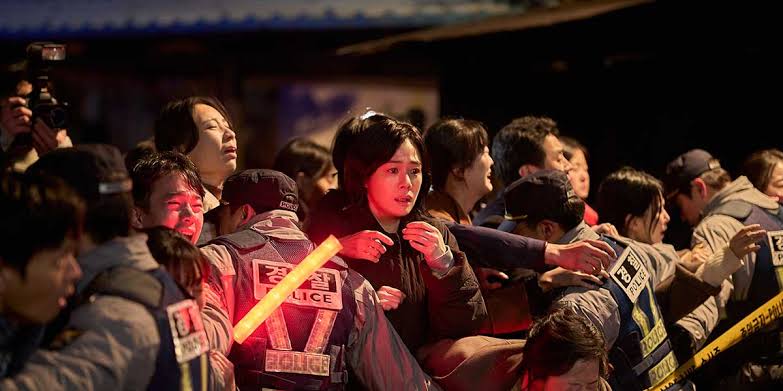
The supporting characters help widen the film’s perspective, though So-young and Sun-woo remain its central focus. The people around them respond to the reunion with a mixture of fascination, fear, and curiosity. Their reactions reflect the public appetite for extraordinary stories, especially when a tragedy appears to have been reversed. Yet the film is more interested in the private consequences of the event than in the public celebration of a miracle. The return of a missing child may be newsworthy, but for So-young it is a deeply personal disruption that cannot be resolved through headlines or public sympathy.
The film’s visual effects are used in service of its augmented-reality concept rather than as a large-scale spectacle. The virtual child must feel familiar and emotionally accessible, but also subtly artificial. The distinction between the digital and physical versions of Sun-woo becomes a visual expression of the film’s central conflict. When the virtual child appears in a comforting environment and the real Sun-woo is associated with darker imagery, the contrast communicates So-young’s emotional division. Some critics have questioned whether this visual symbolism is too direct, but it reinforces the film’s interest in how perception shapes grief.
The sound design and score also contribute to the film’s uneasy atmosphere. Rather than constantly announcing danger, the music can create a sense of emotional instability beneath apparently ordinary scenes. The sound of the AI environment, the quietness of the town, and the tension of domestic spaces help maintain the feeling that So-young’s world is becoming increasingly difficult to trust. In a thriller built around uncertainty, restraint can be more effective than overwhelming intensity.
At its heart, Paradise Lost is a story about motherhood and the limits of love. So-young wants to protect her son, but she must also confront the possibility that the child she has been protecting in her imagination no longer exists in the same form. Her love is sincere, yet it is shaped by memory and the desire to recover what was lost. The film asks whether love means preserving the past or accepting the person who has returned, even when that person is difficult to recognize.
The film also explores the difference between closure and acceptance. So-young’s use of AI may appear to offer a way to continue her relationship with her son, but the real Sun-woo’s return reveals that grief cannot be solved by recreating a familiar image. The past remains incomplete, and the present may be painful. The story’s emotional challenge is whether So-young can accept uncertainty without abandoning her son or the memories that have sustained her.
Overall, Paradise Lost is an ambitious psychological thriller with a provocative premise and a strong central performance from Kim Hyun-joo. Yeon Sang-ho uses AI not simply as a futuristic threat, but as a lens through which to examine grief, memory, identity, and the complicated bond between a mother and her child. Bae Hyun-sung adds unsettling intensity as the returned Sun-woo, while the film’s atmosphere and visual contrast help sustain its mystery. Its biggest weakness is that it introduces more ideas and plot complications than it can fully develop, leaving some emotional and psychological questions insufficiently explored. Still, Paradise Lost offers a memorable and uncomfortable cinematic experience, especially for viewers drawn to Korean thrillers that combine speculative concepts with intimate human drama. Its most haunting idea is that the person we long for may return—but the years of loss may have changed both them and us beyond recognition.