My Dearest Assassin 2026 Movie Review
It’s called “aurum blood.” In this reality, it’s the rarest blood type in the world, so rich and powerful people with aurum blood need other aurum blood-havers as a backup supply the likes of which can’t be obtained at the local hospital. We will watch scenes in which aurum blood transfusions seemingly function to save lives, lifting people with horrible gunshot or stab wounds from near death to ripe ‘n’ ready in a matter of hours, but whether or not it has some higher-functioning super-healing capabilities isn’t clear. Maybe it’s just the movie cheating a bit, using narrative shorthand. If I’m not explaining this well, let it be known that the movie doesn’t explain it well either.
Anyway. A young Vietnamese girl, Lhan, sees her parents murdered as one nasty gang tries to kidnap her for their aurum-blood boss. But they’re thwarted by another group, led by Po (Chartayodom Hiranyasthiti), who bring her back Bangkok for reasons that aren’t divulged apparently because none of the characters, unlike us in the audience, feels compelled to ask. But this group is a secret assassin squad known as House 89, using a secondhand furniture warehouse as a front for their training and work. Years go by and still no one asks a basic question as Lhan grows to adulthood, played by Luevisadpaibul. She’s “taken care of” by Po’s son Pran (Leeratanakachorn) and another foundling, M (Adulsuttikul), both of whom are hunky young lads. Somehow, she knows nothing of House 89’s real business, and has never been allowed to leave the premises. The three young adults play and splash around in a downpour then go inside and sit in a vertical row toweling each other off, with Lhan in the middle. That visual – hoo boy.
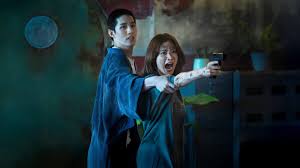
As Lhan and Pran make damp eyes at each other and paint each other’s nails while M watches forlornly from a distance, the nasty gang that failed to snatch her regroups. They’re led by Phurek (Toni Rakkaen), who allies with a flamboyant killer, Chaba (Chanudom Suksatit). Eventually, Lhan learns the true mission of House 89 isn’t just to turn one man’s junk end table into another man’s treasure. The squad takes M on a mission that looks like it’s gonna be a hard-hitting action set piece but fizzles out with nary a headshot, and while everyone’s gone, Pran takes Lhan on a date in the outside world. Bad idea: While they’re out at a carnival making cutesyrookins faces at each other, coincidence puts them in Phurek’s purview. The couple decides to run away except Phurek puts the kibosh on the plan when he and an endless supply of sub-ninja thugs attack the furniture shop. Eventually, Lhan grows weary of being the helpless damsel and trains to become an assassin too, and you know, I never realized you can’t learn how to kill without pointing out the vulnerable parts of the human anatomy on your romantic lead’s body. I have to say, these are the sexiest lessons in lethal combat I’ve ever seen.
Problem is, those sexy lessons aren’t sexy enough. They’re tepid and ineffective, because My Dearest Assassin shows little interest in developing its characters beyond base archetypes. Even the love triangle, ostensibly simple to develop due to its broad emotional beats, functions like it sat out in a monsoon for days. The film struggles to maintain any romantic or dramatic tension through a lengthy string of dull sequences, and takes far too long to deliver on its promise of romance and action. And when it finally does, the kissyface stuff is drowned in schmaltzy luv-shakk vocoder pop music, and the action is executed with equal parts overwrought slo-mo and nerve-wracking jitter-cam cinematography. Wantha shows a capability of delivering gun-fu and hand-to-hand thrills through sturdy fight choreography and sharp editing, and while the result is exhilarating in fits and starts, it never differentiates itself from many other films of its ilk.
Additionally disappointing is the movie’s disinterest in developing some compelling subtext: First is the implication that Lhan’s desire for bodily autonomy – she demands to be trained in the ways of warriors so she can attain independence and defend herself from bad actors lusting for her blood – could function as an allegorical representation of the harsh realities of human trafficking, abortion rights and other real-world feminist issues. And second, the potential symbolism of Pran and Lhan’s shall we say unusual initial exchange of bodily fluids. Both are ideas left to wither and fade by a film that’s too timid to provoke us with anything too political or sexual, instead choosing to lean heavily into wearisome, mile-wide/inch-deep melodrama. It has no qualms with showing us human heads and bodies getting smashed or blown up, though – the sex-and-violence double standard stands ever so tall in My Dearest Assassin.