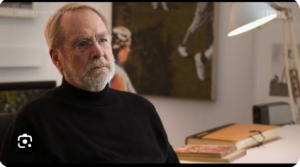
Lefter: The Story of the Ordinarius 2025 Movie Review
Lefter: The Story of the Ordinarius arrives in 2025 as one of the most unusual and quietly ambitious films of the year—a character-driven drama that merges elements of magical realism with the texture of an intimate biographical portrait. Though not a biography in the traditional sense, it behaves like one: it traces the life of Lefter, an unassuming archivist in a sprawling bureaucratic city-state, whose strange capacity for noticing the details everyone else overlooks becomes both his burden and his gift. What begins as a muted study of monotony gradually unfolds into a tale about perception, purpose, and the quiet heroism embedded in ordinary lives. What makes the film hypnotic is not simply its narrative but the way it frames ordinariness as something extraordinary without romanticizing it, inviting viewers to sit with silence, subtlety, and the understated emotional textures that many contemporary films rush past. Director Maurizio Danezzi crafts the story with the patience of a novelist, giving the camera permission to linger on gestures, glances, routines, and the unspoken truths that accumulate in the corners of everyday existence.
The film opens with Lefter’s morning commute, depicted in a sequence that establishes its central visual language: muted palettes, horizontal frames, and a near-symphonic layering of small sounds—footsteps, rustling coats, distant traffic—forming an almost meditative rhythm. The city around him is huge but never overwhelming; instead, it is captured as a place of quiet repetition, humming with invisible lives and unseen histories. Lefter, portrayed with exceptional nuance by Ion Pavel, is introduced not as a rebel or a dreamer but as an ordinary worker with a deeply ordered inner world. His job at the Department of Ordinance Preservation—where he catalogues forgotten artifacts, incorrect records, and anomalies in past laws—might sound tedious, yet the film renders it strangely mesmerizing. Through Lefter’s eyes, a misfiled document becomes a mystery; a wrongly stamped date becomes the thread of a story; an overlooked ordinance becomes an entry point into understanding the city’s fractured memory. The movie takes advantage of this premise to explore how institutions remember and forget, and how one person’s quiet persistence can uncover truths that the system would prefer to bury.
The central conflict arrives slowly, almost imperceptibly. Lefter stumbles upon an ordinance labeled Ordinarius, written decades earlier but never enacted, its text smudged and incomplete. The film refuses to reveal its meaning early on; instead, it follows Lefter as he becomes gently, almost reluctantly consumed by curiosity. What is this ordinance? Why was it hidden? Why does no one else seem to care? The brilliance of the script lies in its refusal to let the mystery pull the movie into conventional thriller terrain. Instead, it uses the discovery to open up Lefter’s inner life. We watch him pore over old records at night, take winding walks through forgotten districts of the city, and visit retired bureaucrats in cramped apartments. His pursuit is not driven by obsession in the typical cinematic sense, but by a tender sense of responsibility—to history, to accuracy, to the idea that small things matter because they are the building blocks of truth. The film’s emotional weight accumulates in these tiny moments: Lefter hesitating before knocking on a stranger’s door, Lefter sitting alone with a stack of contradictory records, Lefter making tea while staring at the enigmatic ordinance on his table as though it were a living presence.
Ion Pavel’s performance deserves particular praise. He conveys Lefter’s inner world through minimal gestures: the way he adjusts his glasses when uncertain, the brief flicker of amusement when he uncovers a forgotten detail, the subtle tightening of his posture when confronted by the indifference of his superiors. There is a soft-spoken dignity in the way he moves, as though he has spent a lifetime trying not to take up space, yet the film slowly reveals the quiet intensity beneath his surface. This is a man who feels deeply but has never been taught how to express it, and the movie allows that emotional vocabulary to form gradually. Watching Lefter evolve is less like witnessing transformation and more like watching something long dormant begin to breathe. Pavel’s restrained acting makes the smallest emotional shift feel seismic.
Visually, the film is stunning in its understatement. Cinematographer Élodie Roussel uses natural light and unembellished compositions to evoke the tactile textures of Lefter’s world. Offices feel cold but lived-in; archives are dusty but strangely sacred; street corners glow with the melancholy warmth of sodium lamps. The camera rarely cuts quickly. Instead, it observes. This observational style reinforces the movie’s fascination with the ordinary, urging the audience to slow down and see what Lefter sees. In an era of fast-paced editing and flashy spectacle, the film is refreshingly unhurried. Yet it never drags; its pacing is purposeful, inviting contemplation rather than demanding attention.
The narrative’s emotional core deepens when Lefter meets Ana, a retired ordinance drafter who becomes both a mentor figure and an emotional counterpart. Their conversations—quiet, meandering, philosophical—form the film’s most beautiful scenes. Ana, played with serene vulnerability by Iulia Radeanu, represents a past generation of idealistic bureaucrats who believed their work could shape society. Through her, the film reflects on the erosion of collective memory and the gradual decay of civic responsibility. Their relationship never veers into romance, and that restraint is one of the film’s strengths. Instead, it offers companionship grounded in mutual recognition: two lonely souls who understand the weight of unseen work. Their dynamic gives the movie its emotional anchor, and their scenes provide delicate insights into questions of legacy, purpose, and the value of preserving stories others deem insignificant.
As Lefter inches closer to deciphering the Ordinarius, the film navigates thematic terrain that blends social commentary with existential meditation. The ordinance itself ultimately symbolizes the forgotten values that once shaped the city—ideas about public accountability, transparency, the dignity of labor, and the recognition of ordinary citizens as the backbone of civic life. When Lefter finally uncovers its meaning, the revelation is not explosive but quietly devastating. The ordinance was meant to formalize the importance of small contributions, to ensure that every mundane task, every anonymous worker, every overlooked detail was acknowledged as vital to the functioning of the society. But it was buried because, as Ana reveals, celebrating ordinariness threatened those who relied on invisibility and neglect to consolidate power. The movie resists turning this into a conspiracy; instead, it presents it as the inertia of a system that values efficiency over humanity.
The final third of the film is its most poignant. Lefter, having uncovered the truth, must decide what to do with it. Rather than constructing a grand conflict, the film allows his struggle to remain internal: Should he publish the ordinance? Should he confront his superiors? Should he accept that some truths remain buried? The power of the climax lies in its refusal of spectacle. Lefter makes a choice that is simultaneously modest and profound—he restores the ordinance to the public archive, ensuring it can be discovered by those who seek it, while understanding that he cannot single-handedly transform the city. Yet in doing so, he changes his own relationship to his work. He reenters daily life with a deeper sense of purpose, his world unchanged yet fundamentally transformed. The movie ends with a simple image: Lefter walking to work, the city no longer muted but quietly radiant. It is a triumphant moment rendered without fanfare, and precisely because of that, it resonates powerfully.
What elevates Lefter: The Story of the Ordinarius beyond a character study is its ability to speak to a universal truth: that the world is built not by heroes but by ordinary people doing small, often unnoticed things with care. In an age dominated by noise, speed, and spectacle, the movie’s insistence on slowness feels almost radical. It refuses cynicism. It affirms the value of attentiveness. It invites audiences to reconsider the meaning of significance. And it does all this without preaching, relying instead on the gentle honesty of its storytelling.
In the end, the film lingers not because of a shocking twist or dramatic confrontation, but because of the quiet emotional imprint it leaves. It is a movie that asks viewers to look closely, to listen carefully, to honor the beauty of unnoticed details. Many films celebrate extraordinary lives; this one celebrates the depth and richness of an ordinary one. Lefter may not change the world, but his story reminds us that paying attention—truly paying attention—is an act of resistance, a form of love, and a way of keeping history alive. It is a deeply humane film, and in its subtle, contemplative way, one of the most memorable of the year.