Jimmy 2026 Movie Review
Jimmy arrives with the ambitious task of revisiting the life of one of Hollywood’s most beloved stars while revealing a chapter that many viewers may know only vaguely. Directed by Aaron Burns and starring K.J. Apa as James “Jimmy” Stewart, the biographical drama focuses on the period when Stewart stepped away from a successful acting career to serve in the United States Army Air Corps during World War II. The film follows his journey from winning an Academy Award for The Philadelphia Story to becoming a combat pilot, returning home deeply affected by war, and eventually finding a new purpose through It’s a Wonderful Life. Rather than presenting Stewart’s life as a straightforward celebration of fame, Jimmy appears interested in the personal cost of duty and the difficult path toward hope after trauma.
The central appeal of the film lies in the contrast between Stewart’s familiar screen persona and the experiences that shaped the man behind it. For generations, audiences have associated him with warmth, sincerity, moral conviction, and an unmistakable voice. His performances often made ordinary characters feel quietly heroic, but Jimmy explores the real-life courage and vulnerability behind that image. The film’s premise suggests that Stewart’s greatest transformation did not occur on a soundstage, but during a period when he was confronted with the realities of war and the responsibilities of leadership.
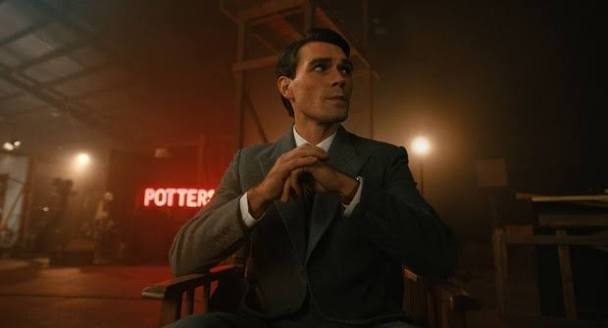
K.J. Apa takes on the demanding role of James Stewart, a figure whose legacy is so familiar that even a small performance choice could invite comparison with the original. Apa’s challenge is not simply to reproduce Stewart’s distinctive voice or mannerisms. He must communicate the uncertainty, discipline, fear, and emotional restraint of a young actor whose life changes dramatically when he enters military service. Early coverage indicates that Apa approached the role as an interpretation rather than an impersonation, with Stewart’s family expressing appreciation for the way he captured the actor’s spirit.
That approach is important because a biographical performance can easily become a collection of recognizable gestures. The audience may expect the familiar voice, the modest smile, or the characteristic hesitation, but those details matter only when they emerge naturally from the character’s emotional life. Apa’s performance will be most effective if it allows viewers to see Stewart as a person still discovering who he is, rather than as a finished cultural icon. The role offers an opportunity to explore the difference between the public image of a star and the private struggles that image can conceal.
The film’s early narrative centers on a pivotal transition. Stewart had already achieved considerable success in Hollywood before the United States entered World War II. His decision to enlist meant putting a flourishing career on hold at a time when many actors might have been expected to remain safely within the entertainment industry. The movie presents this choice as an expression of service and conviction, while also recognizing that it placed Stewart in situations far removed from the controlled environment of filmmaking.
Stewart’s military experience gives Jimmy its dramatic weight. According to the film’s synopsis, he flew twenty missions over Europe and eventually rose to the rank of colonel. Those achievements are remarkable, but the more compelling question is how such experiences affected him emotionally. A war story can become focused on missions, aircraft, and battlefield danger, yet the lasting impact of combat often appears in quieter moments: a difficult conversation, a sudden silence, or the struggle to return to ordinary life. The film’s premise suggests that it intends to explore those consequences rather than treating military service as a simple heroic interlude.
The return home is therefore one of the most significant parts of the story. Stewart comes back to a country that remembers him as a successful actor, but he is no longer the same person who left. The familiar world of studios, scripts, publicity, and professional expectations may seem distant from the experiences he has endured. This contrast creates a potentially powerful emotional conflict. Stewart must find a way to reconnect with his former life while carrying memories that cannot easily be explained to people who have not shared them.
The film’s relationship with It’s a Wonderful Life is especially intriguing. The classic movie is now widely regarded as one of Stewart’s defining performances, but Jimmy frames the role of George Bailey as something that arrived at a crucial moment in the actor’s life. The character’s despair, isolation, and eventual rediscovery of meaning create an emotional parallel with Stewart’s own return from war. The biopic’s title may refer to the actor himself, but the story also appears to ask how a fictional character can help someone understand his own life.
Recreating scenes from a celebrated classic presents a considerable filmmaking challenge. Viewers know the original performance intimately, and any attempt to reproduce it too precisely could feel like imitation. The film reportedly revisits the famous moment in which George Bailey desperately prays in a bar, but director Aaron Burns encouraged Apa to interpret the scene in his own way. That decision could help the sequence function as part of Stewart’s personal journey rather than merely as a nostalgic recreation.
Aaron Burns’ direction will be central to the film’s balance between historical biography and emotional drama. A story spanning Hollywood, military service, and postwar recovery contains several distinct worlds, each with its own visual and narrative language. The director must make those transitions feel connected by Stewart’s character rather than allowing the film to become a series of loosely linked episodes. The most effective biographical films find a clear emotional thread that gives the events meaning beyond their historical importance.
The supporting cast brings a substantial collection of recognizable figures from Stewart’s professional and personal life into the story. Max Casella plays filmmaker Frank Capra, while Jason Alexander portrays MGM executive Louis B. Mayer. Christopher McDonald appears as Lionel Barrymore, and Sarah Drew plays influential columnist Hedda Hopper. Neal McDonough portrays Stewart’s father, Alexander, while Jen Lilley plays Gloria Stewart. These characters provide different perspectives on the actor’s career, family life, and place within Hollywood.
The presence of Stewart’s father is particularly significant because family relationships can offer a more intimate view of a public figure than professional achievements alone. A biopic focused exclusively on a celebrated career risks making its subject seem defined by awards and famous roles. Personal relationships can reveal the values, doubts, and emotional habits that shaped the individual before and after fame. If the film gives these relationships enough room, they could help ground its larger themes of faith, responsibility, and resilience.
The historical setting also offers opportunities for strong production design. The film moves between the world of classic Hollywood and the realities of wartime aviation, requiring distinct visual textures. Studio offices, film sets, military facilities, and aircraft should feel like environments inhabited by people rather than decorative recreations. The period detail will be most convincing when it supports the characters’ experiences and makes the contrast between Hollywood glamour and military danger tangible.
The aerial and military sequences are likely to be among the film’s most demanding technical elements. Stewart’s service was not symbolic; he participated in combat missions and held positions of responsibility. The film therefore has to convey the seriousness of his military experience without reducing it to a handful of action scenes. Its strongest war sequences would be those that communicate the pressure of decision-making, the uncertainty of survival, and the responsibility Stewart felt toward the men serving alongside him.
Music and sound will also play an important role in establishing the film’s emotional atmosphere. A biographical drama about a celebrated actor must be careful not to rely too heavily on familiar musical cues or nostalgic references. The score should support the movement between public triumph and private struggle, allowing quieter scenes to carry emotional weight. Sound design can be particularly effective in military sequences, where the noise and intensity of combat may contrast sharply with the silence of Stewart’s return home.
The film’s themes of service and faith appear to be central to its identity. Stewart’s story can be understood as a conflict between personal ambition and a sense of responsibility beyond himself. His decision to leave Hollywood for military service, followed by his effort to rebuild his life afterward, gives the narrative a foundation that extends beyond celebrity biography. The film’s official description emphasizes sacrifice, faith, and hope, suggesting that it intends to present Stewart’s journey as both a personal story and an example of moral commitment.
That thematic focus may also shape the film’s tone. Jimmy appears designed as an uplifting drama, but the subject matter contains genuine pain and uncertainty. If the movie moves too quickly from trauma toward inspiration, it could simplify the emotional complexity of Stewart’s experience. A more convincing approach would allow recovery to remain gradual and imperfect, showing that hope does not erase suffering but can help people find a way to live with it.
Early critical responses suggest that the film has strengths as well as limitations. Some reviewers have praised Apa’s performance and the film’s exploration of Stewart’s lesser-known military experience, while other responses have been less enthusiastic. The available reviews are still limited, so a definitive critical consensus has not formed. That mixed early picture makes it difficult to judge the film’s overall success before its wider release, but it points to the central question audiences may consider: does Jimmy reveal a genuinely compelling human story, or does its admiration for Stewart sometimes make the drama feel too reverential?
The danger for any film about a beloved public figure is that respect can become a substitute for complexity. Stewart’s life offers plenty of material for an emotionally rich story, but the film must allow him to be uncertain, conflicted, and vulnerable. His courage becomes more meaningful when the audience understands what he feared and what he struggled to overcome. The movie will be strongest if it honors his legacy without making him seem untouchable.
Overall, Jimmy has the foundation for a moving biographical drama about a Hollywood icon whose most defining experiences extended far beyond the screen. K.J. Apa faces the challenge of portraying a familiar figure while uncovering the private emotional journey behind his public image. Aaron Burns’ direction, the supporting cast, and the story’s connection to It’s a Wonderful Life give the film several promising elements. Its greatest strength may be the contrast between Stewart’s fame and his experience of war, while its main challenge will be maintaining emotional complexity without slipping into overly polished tribute. As it approaches its November 6, 2026 theatrical release, Jimmy looks like a film with the potential to introduce a new generation to the remarkable life of James Stewart—not only as a legendary actor, but as a person shaped by service, loss, faith, and the difficult work of finding hope again.