Inside the Circle Review 2026 Tv Show Series Cast Crew Online
Another strength of the series is its exploration of political corruption and the influence of powerful institutions. Rather than presenting corruption as an abstract problem, Inside the Circle connects it to ordinary decisions made by people who want to protect their positions. Amelia must balance her political ambitions with the uncomfortable possibility that the people around her are involved in wrongdoing. Jaime faces the consequences of having business interests closely connected to government power, while Tomás must decide how far he should go to expose information that could endanger his friends. These conflicts give the narrative a relevant social dimension. The show suggests that corruption does not survive only because of obviously evil individuals; it also survives because other people remain silent, look away, or convince themselves that protecting their interests is more important than challenging injustice. This theme gives the series greater substance than a conventional murder mystery, even when the storytelling occasionally becomes unnecessarily complicated.
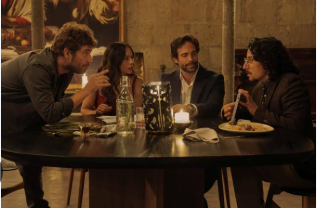
The performances are generally effective, particularly when the characters are forced to confront conflicting loyalties. Michel Brown gives Tomás a determined but vulnerable quality, presenting him as a journalist who wants to uncover the truth but does not always fully understand the consequences of his actions. His character becomes more interesting when professional responsibility clashes with personal safety. Zuria Vega’s portrayal of Amelia adds another dimension to the story because she must navigate a political environment in which even an apparently reasonable decision can damage her career. Amelia is one of the more engaging characters because her position requires her to understand both the public consequences of a scandal and the private compromises that allow political institutions to function. Osvaldo Benavides brings an air of confidence and ambiguity to Jaime, while Raúl Briones provides Mario with a more grounded presence. The contrast among the four performers helps establish the different personalities within the group, although the script does not always give every character enough room to develop fully.
The friendship between these characters is central to the series, but it is also one of its weaknesses. The show frequently reminds viewers that the four protagonists have known one another since childhood, using flashbacks to illustrate their shared history and early insecurities. In principle, these scenes should make their adult conflicts more emotionally powerful. When people have spent years trusting one another, betrayal should feel more devastating than an ordinary disagreement. However, the flashbacks sometimes explain the friendship without allowing audiences to experience enough of its emotional complexity. As a result, viewers may understand why the characters describe themselves as close friends without always feeling the full weight of that bond. The story becomes more compelling when their different professional interests directly affect their relationships, but some quieter moments could have benefited from more detailed dialogue and stronger emotional development.
Pacing is another important element of Inside the Circle. The eight-episode first season moves through an assortment of political confrontations, suspicious encounters, investigations, threats, and personal revelations. This approach creates a steady sense of movement, and several action sequences provide welcome bursts of excitement. Pursuits and confrontations help communicate the physical danger surrounding Tomás and his companions, while the investigation keeps the central mystery alive. The series understands that a political thriller needs more than conversations in offices and government buildings to maintain momentum. It uses danger and uncertainty to make the characters’ choices feel urgent. Nevertheless, the constant introduction of new developments can occasionally work against the drama. Instead of allowing one revelation to produce meaningful consequences, the narrative sometimes rushes toward another twist before the previous one has been fully explored. The result is an entertaining but uneven viewing experience in which suspense can become more important than coherence.
The supporting storylines add both variety and unnecessary complexity. Mario’s family, particularly his daughter Viridiana, becomes involved in the unfolding crisis, while younger characters and their technological connections introduce elements of online investigation and hacking. These developments reflect a contemporary world in which information can spread rapidly and private material can become a powerful instrument of pressure. They also broaden the story beyond the experiences of the four central friends. However, the additional characters and subplots compete for limited screen time. Some receive enough attention to become relevant to the main investigation, while others feel as though they have been introduced mainly to create another complication. A more selective approach would have allowed the series to explore its strongest relationships in greater depth. The political mystery is already sufficiently rich to sustain the season, and it does not always need another secondary conflict to remain interesting.
Visually, Inside the Circle creates an atmosphere appropriate to its subject matter. Its dramatic settings, tense confrontations, and emphasis on surveillance and secrecy reinforce the impression that the characters are moving through a world where information can be dangerous. The direction helps the action scenes maintain energy, while the more intimate scenes focus attention on suspicion and emotional discomfort. The series also uses music and flashbacks to distinguish the characters’ earlier lives from their increasingly threatening present. These stylistic choices are not especially revolutionary, but they support the overall mood. The production’s greatest visual strength lies in its ability to make political power feel intimidating without relying exclusively on grand government buildings or dramatic speeches. The danger becomes more personal when it reaches the characters’ homes, workplaces, and friendships.
The writing is more inconsistent. The basic premise is strong, and the connection between Pamela’s death and the political establishment provides a clear reason for the investigation to expand. The central characters also have believable reasons to disagree about how to respond to the scandal. However, some developments depend on coincidences, convenient information, or behaviour that seems designed to move the plot forward rather than arise naturally from the characters. Certain twists are effective because they change the audience’s understanding of an earlier event, while others simply add more names, accusations, and complications to an already crowded narrative. This distinction matters because a successful mystery should make viewers reconsider the evidence without leaving them confused about the basic relationships between events. Inside the Circle occasionally sacrifices clarity for surprise, weakening the impact of revelations that might otherwise have been more powerful.
The series’ treatment of media and public opinion is particularly relevant in 2026. Tomás’s decision to publish the video demonstrates how quickly an individual piece of information can become a national controversy. Yet the existence of footage does not automatically establish the complete truth, and the story raises questions about verification, responsibility, and the consequences of publishing information before every detail has been confirmed. In a world where social media can transform an allegation into a public spectacle within minutes, these questions feel especially timely. The series also examines how influential people attempt to control the narrative surrounding a scandal. Public statements, private pressure, political alliances, and personal intimidation become competing methods of shaping what people believe. Although these themes could have been explored with greater nuance, they give the thriller a contemporary relevance that extends beyond its murder mystery.
Ultimately, Inside the Circle is more successful as an entertaining conspiracy thriller than as a deeply developed character drama. Its greatest strengths are the intriguing premise, the contrasting professional lives of the four friends, the tense action sequences, and the questions it raises about loyalty and political power. Its weaknesses include uneven character development, an overcrowded collection of subplots, and occasional twists that prioritise surprise over believable storytelling. Viewers who enjoy fast-moving mysteries may find the constant uncertainty appealing, while those who prefer carefully developed relationships and tightly constructed investigations may become frustrated by the narrative’s tendency to introduce more complications than it can satisfactorily explore. The series has enough strong ideas to remain engaging, but it does not consistently turn those ideas into the emotional and dramatic impact it promises.
In conclusion, Inside the Circle (2026) is a worthwhile choice for viewers who enjoy Mexican crime dramas, political conspiracies, and stories about friendships threatened by ambition and secrets. It offers an engaging central mystery and a capable ensemble, even though its storytelling sometimes becomes tangled in its own twists. The most interesting idea is that the greatest danger may not come from powerful strangers but from people who know one another well enough to exploit their weaknesses. That concept gives the series its strongest moments and makes its examination of trust more compelling than its political mechanics alone. Despite its shortcomings, the show provides a suspenseful viewing experience with several thought-provoking themes. Final rating: 3 out of 5 stars. It is recommended for fans of political thrillers who value suspense and betrayal, provided they are willing to overlook some narrative inconsistencies and underdeveloped subplots.