The Lowdown Review 2025 Tv Show Series Cast Crew Online
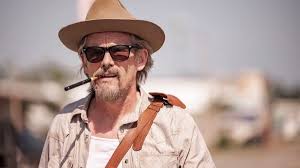
Lee Raybon, Ethan Hawke’s self-proclaimed “truthstorian” at the center of Sterlin Harjo’s swirling Southern noir, is so often bruised, bloodied, or bandaged that when friends and family express concern over his disheveled state, their dismay is almost as shocking as his beatings. Isn’t he… always like this? Doesn’t he saddle up next to scoundrals and pick a fight? Isn’t that part of his roguish, renegade charm?
Answering in reverse order, it is, he does, and he’s not. The shock shown by those closest to Lee reminds us that while he may be our bullheaded, behatted hero — sifting through seedy criminals and seedier authorities to find the cold, plain truth, no matter the cost — he’s also just a guy. A writer. A citizen. A father. Within “The Lowdown,” Lee regularly has to be reminded of these facts, of his own mortality, or risk losing his mind (and maybe his life) to his own mythology.
How Harjo and Hawke dance between those two extremes — building the legend of Lee even as they cherish his fundamental humanity — makes their modern mystery a crackling genre story and a captivating saga unto itself. Brimming with daydreamy peculiarities yet grounded in the details of the daily grind, “The Lowdown” is a crowd-pleaser and weirdo’s delight all at once.
It starts, as these tales tend to, with a dead body. One lonely night, Dale Washberg (Tim Blake Nelson) sits in his den, glances over his shoulder out the back window, and ends up with a bullet to the brain. The coroner rules it a suicide (and we’re not shown how, exactly, the fatal wound came to be), but Lee isn’t buying it. Of course, he wouldn’t. Lee just wrote an exposé on the Washberg family, and it was none too kind. Some even blame Lee for Dale’s suicide — a notion his brother, Donald (Kyle MacLachlan), is happy to encourage. He’s preparing to run for governor, and skeletons springing from closets don’t tend to attract votes. It’s better (and easier) to discredit a wayward writer than address the accusations in Lee’s unflattering family portrait.
Still, Dale’s passing does seem a little… convenient. He was the black sheep of the family — long-believed to be gay despite his wife-turned-widow, Betty Jo (Jeanne Tripplehorn) — Dale always threw up road blocks to the Washbergs’ financial plans. With him out of the way, Donald’s path to power is clear, along with a few other frontage roads the old-money brood is happy to cruise down.
So Lee does what he does best: He starts poking around. Among the disturbed parties, there’s Marty (Keith David), a private investigator who frequents the same diner as Lee; Frank Martin (Tracy Letts), the owner of a construction company Lee accuses of illegally undercutting the competition (and running Black business owners out of Tulsa); Allen Murphy (Scott Shepherd), Frank’s right-hand man who specializes in keeping his boss’ hands clean; and a couple of skinheads upset over Lee including their names in a story about burning down a synagogue.
Lee doesn’t just have enemies, though. His gregarious personality endears him well enough to an ample personal community, starting with his daughter, Francis (Ryan Kiera Armstrong). The teenager loves and admires her father, offering to help with his work often at the expense of her own (home)work, and Lee is usually happy to have an encouraging second-in-command. Her mother, Samantha (Kaniehtiio Horn), knows Lee better than anyone, though, and keeps an eye on just how involved their child gets in his typically reckless adventures.
Lee also owns a bookstore, Hoot Owl Books, and employs a desk clerk named Deidra (Siena East) to keep the lights on while he’s running around, writing up stories. Still, he’s around often enough to sustain amicable relationships with his neighbors at the record store, attorney’s office, and aforementioned diner. (Shout-out to production designer Brandon Tonner-Connolly.) They keep an eye out for each other, as does the more distant antiques dealer, Ray (Michael Hitchcock), and the editor of Tulsa Beat, a local crime newspaper, Cyrus (Michael “Killer Mike” Render).
The buzzing sound of people sharing their lives is one of “The Lowdown’s” greatest strengths (kept in keen harmony with JD McPherson’s spirited score). Lee is surrounded with big and small, yet always distinct, personalities. (MacLachlan’s shrewd two-faced turn combined with the sporadic rural settings and strange ethereal interludes are bound to elicit Lynchian comparisons, although this series is much more straightforward than “Twin Peaks.”) The Tulsa townies can be comforting or intimidating, but they’re always there, and Harjo utilizes their collective presence beautifully across the first five episodes to paint an inviting, dynamic vision of the city, clearly established to support many future mysteries across many forthcoming seasons. (There better be, at least.)
Hawke is the North Star. In his only previous TV outing as an executive producer and star, Showtime’s magnificent adaptation of James McBride’s “The Good Lord Bird,” Hawke played John Brown, the fiery abolitionist who refused to back down from his principles, even when they put him at odds with a literal army of opposition. Here, Hawke is once again fueled by an unshakable conviction, and he’s once again faced with considerable resistance. Rather than crusading to put an end to slavery (his mission from God), he’s a “truthstorian,” fighting the good fight to keep people informed. “I read stuff, I research stuff, I drive around and I find stuff. Then, I write about stuff,” he says, by way of defining his chosen moniker. “Some people care, some people don’t. I’m chronically unemployed, always broke, but let’s just say that I am obsessed with the truth.”
That obsession gives Hawke plenty of opportunities to strut his fervent stuff, much like he did throughout “The Good Lord Bird” (and built to in another exemplary 21st century performance about a man’s sacrificial embrace of his guiding purpose, “First Reformed”). Those scenes are a transfixing treat, with the passionate actor letting loose to best convey his character’s sound moral character, but “The Letdown” also offers Hawke a chance to flex his chameleonic charisma.
Lee is quick to recognize what his audience needs to hear. If he’s talking to the worried mother of a white supremacist, he’ll growl terse tales of how her son helped him through a tough prison stint. If he’s bargaining with a heartbroken fisherman who may or may not be harboring homicidal tendencies, he’ll lay out his own story of woe with such explicit detail there’s no doubting the two men see themselves in each other. If he needs to connect with a woman desperate for a wild night on the town, well, he can damn sure do that, too.
Whether you call it adaptability, versatility, or just plain lying, it’s a key attribute for many TV detectives, and the best ones are realized by actors who know how to find the line between acting within their character and turning their character into an actor. Hawke never breaks from Lee. He never uses those scenes as an opportunity to show off. He never even betrays the character’s core tenet of truth at all costs.