The Crystal Cuckoo Review 2025 Tv Show Series Cast Crew Online
In every country with a more or less active audiovisual industry, Netflix seems to have a resident author—someone with whom the platform has signed a long-term, first-look deal, ensuring a constant flow of adaptations. Harlan Coben is the most obvious example, with dozens of versions scattered across various countries. In Spain, one of the writers who fills that role is Javier Castillo, a young and prolific novelist who broke out with The Snow Girl, later adapted by Netflix and followed by its sequel, The Soul Game. This new series based on Castillo’s work is not a continuation but an entirely separate narrative, even if it revisits some familiar themes and motifs.
The first curious thing about the series is that it takes place in Spain. Why is that noteworthy? Well, because the original novel was set in the United States. And that shift—something already seen in previous adaptations of Castillo’s work—suggests a kind of strange globalization of this type of story, one that could unfold almost anywhere without major differences.
The main protagonist—at least in one of the two timelines the show juggles—is Clara Melo (Catalina Sopelana, The Neighbor), a doctor who suffers a heart attack at work and wakes up from an induced coma a month later to learn she has received a heart transplant. The young physician becomes obsessed with discovering the identity of her donor and, skirting the legal limitations of the matter through online sleuthing, concludes that the heart belonged to Carlos (Roque Ruiz), a young man from a small rural town in Spain who died in a car crash.
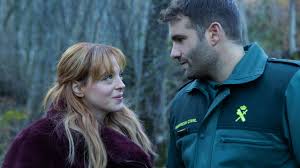
Clara decides to call his family and, after some initial mistrust, Carlos’s grieving mother Marta (Itziar Ituño, Money Heist) invites her to visit the town so they can talk and share their stories. Just as Clara arrives, a baby mysteriously disappears—the town has a long history of “mysterious disappearances”—triggering a search that soon unleashes a chain of revelations tied to the community’s past, most of them connected in one way or another to gender-based violence and other monstrous behaviors.
Like the novel, the series jumps back and forth in time, establishing a parallel thread set in 2004, whose events may be tied to the present-day case. Disappearances, burned houses, suspicious deaths, violent husbands, and an investigation headed by Miguel (Alex García, El Inmortal)—Marta’s husband and the father of young Carlos—shape the past storyline. Carlos was born with a congenital bone disease, a detail to which the title of the series alludes. Miguel is already dead in the present timeline, and understanding how past and present connect becomes part of the mystery, alongside the many other odd characters orbiting the story.
El cuco de cristal embraces the conventions of the small-town mystery, full of secrets, mixed with the structural expectations of contemporary streaming thrillers, which demand a twist at the end of every episode. The narration across two timelines separated by nineteen years (2004 and 2023, mainly) can be confusing at first: the shifts are constant and, beyond a title card announcing the year, the visual differences are minimal. The biggest distinction is that the “investigator” in the present is Clara—motivated by personal reasons—while in the past it’s the local policeman. It’s also worth noting that, at key moments in her investigation, Clara’s heartbeat accelerates, as if that transplanted organ were mysteriously capable of reliving past traumas.
The six episodes, directed by Laura Alvea and Juan Miguel del Castillo, move along with a certain agility, even though the plot is filled with coincidences and somewhat overused genre routines (mysterious objects, papers with coded markings, eerie local traditions) whose main purpose is to create atmosphere or lead the viewer down the wrong path. Still, the narrative remains fairly focused on a central thread involving past family traumas and secrets, and the impact they have on later generations.
What may feel a bit forced is the concept—more metaphorical than literal—of a heart that continues to experience past traumas even after being transplanted into another body. If one accepts that touch of quasi–magical realism, the show’s logic becomes easier to embrace. Otherwise, one can’t help asking why Clara—who is not a police officer, a detective, or a family member—doesn’t simply leave the town once she realizes how dark, violent, and unnerving everything around her is and always was. But thrillers of this sort operate under the assumption that viewers won’t ask too many practical questions and will allow themselves to be pulled along by the script’s misdirections. Here, that spell works only occasionally.