The Chair Company Review 2025 Tv Show Series Cast Crew Online
In 2025, Tim Robinson may be the only middle-aged white guy anyone actually wants to hear shouting. The former “SNL” writer and “Detroiters” star became an icon for the exasperated on “I Think You Should Leave,” a Netflix sketch series (co-created with longtime collaborator Zach Kanin) that summons huge laughs from a bizarro universe of semi-universal characters who are innately disagreeable, hopelessly confused, or reasonably vexed. Robinson plays many of these misunderstood or misunderstanding men, and the unassuming actor’s bellowing exclamations — in response to losing his favorite TV show, holding people accountable, and banishing demonic intruders — often feel like the only method in which to properly process modern society.
With “The Chair Company,” Robinson is still shouting, but he also distills many of his favorite, seemingly disparate traits into a single unified person.
Ron Trosper is another frustrated, stupefied, and cantankerous everyman — someone who would spend his last dime at Dan Flashes or sneak into a lunch-hour meeting with a hot dog up his sleeve — but he’s also judiciously relatable even when he’s not embodying our collective fury. Met by a parade of crackpots whenever he flees the comforts of his core family, Ron’s straining tether to the best version of himself is the source of anxiety-inducing suspense (lest it snaps) and the foundation of an HBO comedy that won’t stop getting weirder. You care for Ron — enough to hope he escapes the rabbit hole he’s dug for himself… and enough to hope he gets to the bottom, just so we can see it, too.
In a series about how easy it is to get lost when you’re desperate to be seen, Ron is a middle-manager at a retail development firm named Fisher Robay. He’s just been promoted — leading the design and construction of a shopping mall in Canton, Ohio — and his family couldn’t be prouder. His wife, Barb (Lake Bell), daughter Natalie (Sophia Lillis), and son Seth (Will Price) take him out for dinner to celebrate, and Barb even offers a toast to her hubby’s hard-earned success.
Naturally, that’s when the wheels start to fall off.
In the moment, Barb’s generous toast gets interrupted — notably, just before she transitions from admiring Ron’s perseverance into highlighting his actual attributes — but the minor kerfuffle at dinner doubles as foreshadowing for the next day’s big presentation at work, which climaxes with the series’ inciting incident. Usually when a network claims a show’s premise is also a spoiler, it’s an annoying overreaction. But in this case it makes sense. They’re protecting a damn good joke. So without tipping it, I’ll just say the fuck-up is pitch-perfect: enough to push a certain someone over the edge, but not enough to warrant the ensuing insanity.
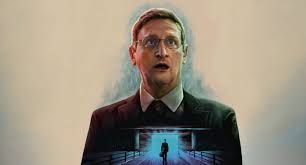
As a trade-off for withholding what some may view as a critical piece of information, HBO’s poster for “The Chair Company” includes a key piece of text: “There’s a whole world under the surface, and only Ron has any idea about it. And sometimes the two worlds collide, and sometimes they don’t. Ron holds them at arm’s length from each other. Watch every week to find out when he can and when he can’t.”
The above may sound like bland nonsense, but Ron’s mad scramble to keep his two worlds separate really does rest at the center of “The Chair Company.” In one hand, he holds everything a typical person values most: his family, his job, his security. They’re on the surface world because they’re easy to see. In the other hand, however, he holds his principles, his code, his basic understanding of how things are supposed to work. When those intangible standards are turned upside down, he delves into the other world, the one under the surface, searching for answers — mostly via the internet. Through his phone, Ron holds a portal into the unknown; a void filled with sporadic echoes and ostensible connections. Whenever he feels like he’s found something real, it slips away, and he has to either let it go or keep chasing. And Ron is soon well beyond letting go.
“The Chair Company” could be seen as a loose story that exists to support a series of sketches. Scenes pivot between Ron’s main arc and seemingly random side plots, each of which deliver quick bursts of outlandish comedy. (Virtually every time someone bursts into Ron’s office, they’re good for a hearty chuckle.) As with “I Think You Should Leave,” the humor is well-balanced. Sometimes we’re nervously laughing at Ron, because he’s done something beyond the pale. But just as frequently we’re giddily laughing with Ron, because his befuddled indignation is so identifiable. Ron exists outside of our own sensibilities as often as he fits within them, and through it all, there’s a depth to the man that’s absent from many of Robinson’s more temporary personas.
Take, for instance, a remark I initially read as sarcasm: when Natalie says her father is “so good at talking to people.” Given the awkward back-and-forths seen thus far and, even more so, Robinson’s history playing poor communicators, the description is hard to believe. The guy typing “you’re a fucker” into a customer service chatbot can’t also be a great conversationalist, can he? But Ron really is good with people. Or he can be. When he’s fully present, Ron can build rapport with his future father-in-law or rally the troops to buckle down at work. (He’s the company spokesperson! Ron! Played by Tim Robinson!) He can be considerate and earnest. He can be loving and supportive. Seeing not just Ron’s potential, but also the life he’s already built helps us invest in his fate over an eight-episode season, just as it helps to draw us deeper into the mystery he’s devoted to solving.
And if the personal hook doesn’t grab ya, there’s always the subjective interpretations of what is all means™️, which are so instinctively absorbed they tend to strike your funny bone before you even realize why you’re doubled over. My favorite reading (through seven of the eight episodes) is that “The Chair Company” is about getting lost in an internet wormhole. Ron spends a lot of time bouncing around the web, fascinated and repulsed in equal measure. Paired with rapid editing that speeds up the experience to a barely intelligible rate, it’s easy to see how Ron loses himself online and easy to feel like you’re caught in the same vortex. Even when he touches grass, Ron’s struggle still translates as one we all fight every day: when to log on vs. when to log off.
Then if your tastes skew toward current events, there’s a conspiratorial bent to Ron’s quest that, in a worst-case scenario, could end up with the father of two on a government watch list. If you prefer a surreal vision, there’s a dreamlike quality to his adventures that repeatedly calls to mind “Twin Peaks.” Directed by Andrew DeYoung, who also helmed this year’s Robinson-starring film, “Friendship,” the series is stocked in neutral suburban earth tones. Neither inviting nor off-putting, the backdrop stands in plain contrast to the dark and dirty corners of the world wide web he scrolls through, as well as the seedy spots in the real world where his online investigation leads him. There’s no mistaking what’s a mistake, and yet in a sea of beige, it’s hard not to seek out even the most ominous oasis of color.
Still, beyond any one explanation, “The Chair Company” is broad and bizarre enough to embrace them all. Robinson, in spite of his well-earned reputation for playing loud jerks and dumb-dumbs, is a shrewd performer. His shouting is glorious for its unbridled force, but he measures the volume as meticulously as he doles out his decibels. For every explosion of irritations, there’s an infusion of awareness, and Robinson excels at finding the perfect tenor, whether it’s to heighten the comedy or ground the drama. Just as crucially, he’s a great sad-sack. Robinson and Kanin found tender moments amid the chaos of “I Think You Should Leave,” and every so often they interrupt Ron’s deranged dissent with a moving reminder of what’s at stake.
For anyone who’s seen “Detroiters,” that shouldn’t be surprising. In Robinson and Kanin’s short-lived Comedy Central series (co-created with Sam Richardson), the leads were two best friends who rarely caught a break, but they didn’t care because they had each other, and they were doing what they love. In “The Chair Company,” Ron isn’t doing what he loves to do, and he isn’t holding onto anyone. Instead, he’s going slowly insane, searching for a big break he’s afraid already happened. Maybe it did, and he’s too distracted to see it. Or maybe it didn’t, and it’s waiting for him at the end of his quest. Holding both possibilities at once is enough to make you scream. Or maybe cry. But certainly, somehow, laugh.