Stay 2025 Movie Review
The year has been ripe for horror that surpasses the boundaries of the genre to become a symbolic vessel for many things—grief, intimate relationships, and collective control over other people. We got to see bangers like Together, which is an allegorical commentary on intimate relationships; Bring Her Back, which is a poignant, twisted tale of grief (and this year’s best classic horror, in my humble opinion); and Weapons, with its mix of ambiguity, urban Pied Piper of Hamlin, and witchcraft. Essentially, a shift in the genre is happening—from the universe of jumpscares, the genre had set sail and reached the universe of layered storytelling. At this moment in horror films, I think the previous genre of streamlined horrors is simply fading away, being replaced with a scope for wider storytelling. The disqualification of horror from “serious cinema” may not be a thing anymore as we await the releases of horrors like Max Porter’s unadaptable modern classic Grief Is a Thing with Feathers, weaving a commentary on the tenderness and horror of human grief. This film, Stay– about which I am gonna talk about in this article, is a pretty good addition to this growing canon, although I would not call it exceptional. You may have seen one too many films like this, but at least the symbols and metaphors are trying to surpass their potency. Let’s take a look at what happens in the film and then discuss the roots of it.
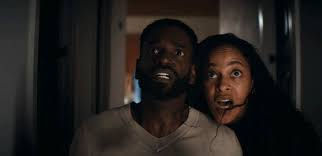
Kiara is a researcher of African spirituality with a focus on Vodun. She is married to Miles, who is an MMA fighter. The film begins with dreamy visuals of the two being in love, listening to their jazz, making promises to support each other, and being helplessly, madly in love. But that’s all in the past, the jazz has stopped (the record player is literally broken), and they have to face the music of a broken marriage—well, almost broken. Kiara is depressed as boxes are being segregated to go into separate households; Miles comes to visit (with his wedding ring still on his finger), and the two spiral into everything that went wrong, but of course without a resolve. Kiara, who was once an enigmatic author, has now turned into an alcoholic with no shape to her day, and Miles detests that. Seeing Kiara overcome with grief and fatigue, Miles offers to stay the night and pack his belongings on his own. This is probably a good idea (it seems at the moment), since before Miles came, Kiara was trying to drown herself in a bathtub, leaving a letter for Miles. However, the next morning when Miles is about to step out for the movers and packers, the windows and the doors do not open; they start closing in the face of Miles and Kiara. It is as if Kiara’s spell many years ago (a joke between them) has sealed the avenues for them to get away from each other. Together, much? The only difference is that it was happening with bodies, and this is happening with a house.
Kiara starts digging up into her memories, dreams, and of course vodun journals to figure out what is happening. She comes across a strange symbol related to a healing spirit from Benin, which is later recognized as Nyame Dua (or a healing tree stump that wards off evil). The film starts alternating visuals about Kiara’s alternate self dressed in spiritual garbs offering words of healing and advice, and simultaneously the spirits also turn hostile with both Kiara and Miles—showing that the torture that they are inflicting upon themselves is purely self-driven and masochistic. Kiara decides to do a salt circle ritual to summon the spirit, and after an ecstatic dance, the narrative opens up to the root cause of their broken marriage—the loss of a child. This is a little predictable for a plot, but one cannot really deny the heavy grief surrounding it.
Kiara and Miles had a son, Jeremiah, who died on his birthday falling into the pool in the backyard. Kiara, at that moment, was on a call about her book tour, and she recounts that she let J out of sight for just sixty seconds. Perhaps no one blamed her, but grief finds a way to drive its fangs in the cruellest ways. Kiara spiraled into being an alcoholic, became disillusioned with life, and eventually the marriage cracked under the heavy weight of the loss. But does it survive the blow?
Kiara and Miles seemingly get a closure and a flashback of what they were after they are shoved into the house to live as a couple under inescapable circumstances. This is almost that social media story about old couples’ therapies where couples who were forced to live together saw the beauty in their marriage once again and reconciled. When in the beginning, the dynamic looks somewhat like a toxic loop, Jeremiah’s death explains the unhealed pain that both of these were not able to process. It is a shared sense of grief and guilt, which was at the same time pulling these two and pushing them away. Miles’ approach is more practical and more time-centric; he wants to get the job done and refuses to face the demons, while once again, Kiara is the one picking up the emotional responsibilities by connecting with female ancestors and what not. Even in Together, it was the woman doing all the finding out. When will I see a man actively becoming spiritual to seek for answers and save a marriage? This question remains unanswered as Kiara assumes the role of a priestess that she is and starts performing a ritual. The ritual, summoning the healing spirit, is actually nothing but a propped-up mirror in front of their shared grief that bonds them together again. There is a visual of Jeremiah walking in and claiming that it was him who was not letting his parents estrange from each other. It sounds a little weak, almost corny, but it is a dead child after all which is surely to tug at heart strings. I cannot critique the logic behind it or debunk just whatever he says in general. If it works for Kiara and Miles, it works for me. Even in the fictional world, it took a wife and a child to fix this man, who is once again awed by the enigma of his spiritually slightly inaccessible wife.
In Stay’s ending, the two seemingly end up together—the concluding scene is ambiguous. It shows a pregnant Kiara being held by Miles. It may be a callback to a happy memory, or it could be that Kiara is really pregnant once again—in both cases it is a happy epilogue that binds the two together.
In its western representation, Voodoo is commonly believed to be a religion involving black magic, witchcraft, and the iconoclastic image of a pincushion doll being pinned as a method of torture. However, the original form of West African Vodun is an ancestral, spiritual practice dealing with the elements of the universe, crop cycles, and the worship of elderly oracles and spirits. In Vodun, it is believed that the maternal ancestors of a woman are always looking after the next generations—these spirits are guides, oracles, and familiar entities stretching out their spiritual lineage in the form of protection. The one that Kiara mentions here is called “Nyame Dua,” which looks like a tree stump. The stump is believed to be a stump of the god’s tree and is a symbol for protection. Now this symbol made me reflect on a natural phenomenon. While on a hike on a small island in the Indian Ocean among trees that are three hundred years old, I came across a broken tree. However, a lot was going on around the broken stump—there were colonies of ants going in and out, birds perched atop and resting, mushrooms springing out in luscious colors, and butterflies circling it. There was a board next to it that declared the stump as a snag—a snag is essentially a dead or dying tree that still stands and becomes home to a tiny ecosystem housing many creatures. The tree is dead, but life is not. A snag signifies a rebirth; it sparks up a beginning from what already has perished. The tree stump, or Nyame Dua in the film, reminds me of this snag—of how even when one life ends, there is a possibility for other things to begin from the ending.
Stay operates within the growing lineage of contemporary horror that refuses to be defined by the mechanics of jumpscares or ambient fear alone. It uses the supernatural as a metaphor for grief, guilt, and love intertwined. Kiara and Miles’ confinement is less about physical entrapment and more about emotional reckoning within a physical space that imitates the suffocating state of their marriage. Vodun becomes both a language of healing and a mirror for the festering wound of their inner rot. Even if the film treads familiar terrains like the dead child and the grieving couple, its attempt for transcendence through a symbolic telling elevates it slightly out of the ordinary.