Matt McCusker: A Humble Offering Review 2025 Tv Show Series Cast Crew Online
“Matt McCusker: A Humble Offering” (2025) arrives as one of the most unexpectedly thoughtful and self-aware comedy specials of the year, a performance that fuses raw humor with philosophical reflection and blue-collar honesty. Written and performed by comedian and podcaster Matt McCusker, this special—released through Netflix—marks his first major solo television project, and it perfectly encapsulates his peculiar comedic blend of goofball charm, masculine self-deprecation, and intellectual depth hidden beneath layers of absurdity. Unlike the many stand-up shows that rely on shock humor or celebrity cameos, “A Humble Offering” finds its strength in simplicity: a man with a microphone, a modest stage setup, and a voice that speaks directly to the contradictions of modern life. McCusker has long been known to fans of the “Matt and Shane’s Secret Podcast” as the philosophical jester of the duo—someone capable of talking about enlightenment, bad decisions, and suburban mediocrity with equal enthusiasm. In this special, he translates that persona into something cinematic and surprisingly moving.
The special opens with a minimalist staging choice—a bare, warm-lit backdrop and McCusker stepping into the frame without music or announcement. The audience cheers lightly, but he waves them down with a sheepish grin, muttering something about not wanting to “come off like I’m about to change anyone’s life.” This set the tone for what follows: humor grounded in humility, in the awareness that comedy isn’t about ego but about sharing an imperfect human experience. The title “A Humble Offering” itself carries a layered irony, since McCusker constantly teases his own ambitions. He jokes about being a “failed philosopher turned dirtbag dad” and how he’s trying to “find enlightenment between diaper changes and YouTube comments.” From the first five minutes, it’s clear this isn’t going to be a traditional hour of stand-up—it’s a hybrid of storytelling, confession, and satire that digs into the heart of what it means to grow up, screw up, and still find grace.
McCusker’s comedic style has always been conversational, and here he refines it into a rhythm that feels like an intimate hangout. His voice drifts between calm philosophical musings and quick bursts of irreverent energy, often punctuated by a mischievous grin that invites the audience to share in his ridiculousness. The first section of the special deals with his journey into fatherhood—a topic many comedians cover, but McCusker’s approach feels unique. He doesn’t just joke about sleepless nights or baby poop; he digs into how having a child forces you to confront the person you’ve become. One of the standout bits is when he describes staring into his newborn’s eyes and realizing that his kid “already has higher moral standards” than he does. The audience bursts into laughter, but McCusker leans in, saying, “It’s crazy how you can love something so much and still think, ‘I hope he never finds my podcast.’” This balance of self-awareness and absurdity gives the material both edge and tenderness, something few comedians manage to sustain.
From there, “A Humble Offering” shifts into McCusker’s observations on masculinity, spirituality, and modern identity. He pokes fun at men who “discover stoicism on TikTok” and then start giving their friends unsolicited life advice, joking that “Marcus Aurelius didn’t write his meditations to help you stop texting your ex.” These jokes are sharp but not mean-spirited; they reveal a performer who sees himself as part of the same human comedy he’s describing. McCusker’s humor has always flirted with the philosophical, and here he elevates it. He talks about experimenting with meditation retreats, only to end up getting kicked out for laughing during silence. In another moment, he describes trying to live by Buddhist principles while still eating junk food and watching violent YouTube compilations. “I’m trying to reach Nirvana,” he says, “but apparently it’s not in the comments section.” His delivery is effortless, moving from deadpan to exuberant within seconds, making even simple lines feel loaded with meaning.
What truly distinguishes the special is McCusker’s willingness to reveal vulnerability without losing comedic control. When he discusses addiction, his past mistakes, and the process of forgiveness, the audience can feel the honesty pulsing beneath the punchlines. He doesn’t overdramatize his story, nor does he seek sympathy. Instead, he dissects it with humor and perspective, showing how self-destruction can sometimes become a weird form of self-education. He jokes that rehab felt like “summer camp for grown men who finally ran out of excuses,” and the crowd erupts, but he doesn’t let the laughter erase the truth behind it. That’s the delicate balance McCusker strikes throughout—his comedy feels earned because it’s drawn from lived experience, not manufactured outrage or fashionable cynicism.
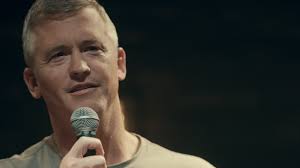
Visually, the special mirrors its thematic focus on humility and honesty. Director Mike Lavin keeps the camera close, often framing McCusker’s face and upper body to emphasize connection over spectacle. There are no flashy lighting cues or sudden cuts; instead, the camera lingers, allowing the audience to witness McCusker’s thought process as he riffs. Occasionally, the camera pans to the crowd, showing a diverse mix of fans—some laughing hard, others nodding quietly, as if relating to the subtext. This atmosphere of communal understanding is rare in modern stand-up, where irony often dominates sincerity. In “A Humble Offering,” McCusker builds a space where both can coexist—where humor becomes a spiritual exercise rather than a performance of superiority.
The pacing of the special is deliberate, and that works to its advantage. There’s a fluid, almost meditative rhythm to how McCusker transitions between bits. He doesn’t rush for punchlines; instead, he builds them slowly, layering each joke with context. This slow-burn style might test audiences accustomed to rapid-fire comedy, but for those willing to engage, it offers something more rewarding. The structure feels organic, as though we’re following McCusker’s stream of consciousness—yet it’s all meticulously crafted. Each tangent, from jokes about suburban dads trying to be “alpha” to riffs on ancient wisdom being reduced to “Instagram quotes with abs,” folds back into his central theme: humility. By the time he reaches the final segment, where he muses about gratitude, mortality, and what it means to offer something genuine in a performative world, the entire special feels like a full-circle meditation disguised as stand-up.
McCusker’s timing and tone are impeccable. He knows when to pause, when to undercut his own seriousness with a well-placed absurdity, and when to let silence speak. There’s a moment midway through where he recounts sitting in his backyard, high on life and cheap beer, watching the sunset and feeling like he finally understood the meaning of existence—until a neighbor started mowing the lawn. “That’s life,” he says, shrugging, “just when you think you’re enlightened, someone fires up a leaf blower.” It’s a perfect encapsulation of McCusker’s comedic philosophy: wisdom interrupted by reality, beauty interrupted by noise, and yet, somehow, it’s all funny.
The writing is sharp but never over-polished. McCusker’s charm lies in his looseness—he allows himself to wander, to stutter, to find humor in the imperfections of delivery. It feels human, unpretentious, and refreshingly unfiltered. In an era where comedy specials often feel overproduced or over-edited, “A Humble Offering” feels alive, almost like you’re watching a man discover his material in real time. That spontaneity gives it an authenticity that’s increasingly rare. The language is earthy and colloquial, sprinkled with the kind of regional quirks that make McCusker’s storytelling unique. He references Philly dive bars, weird childhood memories, and his working-class background, grounding the humor in a lived American reality that feels both specific and universal.
As the special approaches its conclusion, McCusker’s tone softens. The final ten minutes are almost poetic. He talks about learning to be present, to accept imperfection, to laugh at himself not as a defense mechanism but as a gesture of love toward the world. He ends on a story about giving a terrible wedding speech for a friend, fumbling through his words, and realizing afterward that no one cared about his delivery—they cared that he showed up. “That’s the best any of us can do,” he says. “Show up, say something honest, and hope it lands.” The audience applauds not with roaring laughter but with warmth, as though they recognize that the night has been more than a comedy show—it’s been a reflection on how to live.
“A Humble Offering” ultimately works because it lives up to its name. McCusker doesn’t posture as a guru or provocateur; he simply offers his thoughts, his jokes, his stories, and lets them fall where they may. In doing so, he captures something profound about the human experience—our constant striving for meaning, our endless capacity for foolishness, and our quiet longing for connection. The special isn’t just funny; it’s deeply humane. It reminds us that comedy, at its best, isn’t about dominance or outrage—it’s about humility, the ability to laugh at our own absurdity while recognizing the shared beauty in our flaws.
In a year crowded with comedy specials chasing viral clips and social media debates, “Matt McCusker: A Humble Offering” stands apart as an antidote to irony fatigue. It’s a show that doesn’t try to impress you—it tries to reach you. Through laughter, honesty, and a touch of spiritual curiosity, McCusker delivers a one-man performance that feels like a genuine act of communion. It’s one of the rare specials that leaves you laughing, thinking, and oddly at peace. By the end, his “humble offering” feels like a gift—one that lingers long after the lights fade and the laughter dies down.