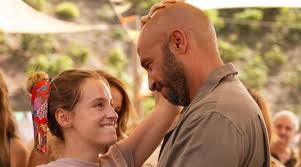
Mango 2025 Movie Review
From the outset, Mango presents itself as a familiar yet serviceable romantic drama: an ambitious career-woman, Lærke (Josephine Park), uproots her life to travel to Málaga, Spain, on a so-called “working vacation” with her teenage daughter Agnes (Josephine Højbjerg). Her real job is to convince Alex (Dar Salim), a former lawyer turned stubborn mango orchard owner, to sell his land so her Danish hotel-group employer (Weltzer) can build a luxury resort. The conflict is set: Lærke’s business objectives versus Alex’s emotional attachment to his orchard, and Lærke’s fractured relationship with her daughter versus the potential for real connection.
Visually, the film is one of its strongest cards. The palette of sun-lit Spanish countryside, the mango orchard as a character in itself, and the lush Mediterranean setting do much to elevate what the script itself might otherwise leave flat. One review notes “sweeping shots of dusty mountain roads, golden hour sunsets, and the vibrant countryside. The finca … is a character in itself … the cinematography bathes everything in a sun-kissed glow.” This kind of visual treatworks well as escapism, and if you’re someone who enjoys location-driven ambience and the sense of “holiday in the movies,” Mango delivers.
Character‐wise, the film tackles three interlocking arcs: Lærke’s transformation from career-first, emotionally distant mother to someone who opens up; Agnes’s teenage disappointment (not getting into architecture school) and need for maternal attention; and Alex’s resistance to selling his land out of loyalty to past tragedy (the orchard, his late wife’s memory) and a belief in community over profit. The standout reviews emphasise that while the plot is predictable, the performances lift it. For instance, one review calls Alex “quiet warmth and sincerity,” and Lærke’s arc “relatable regret and discontent.” The mother‐daughter relationship is given enough space to evolve—both characters start off irritating in their obliged vacation together, but gradually shift towards understanding.
In terms of pacing and structure, the film shows both promise and weaknesses. The setup takes its time, and the first act is judged by some as “trite” and the characters overly familiar. As one reviewer states, “the first act is spent watching Lærke and Agnes squabble… It seems obvious from the beginning that Lærke and Alex will fall in love, and an inevitable miscommunication will test their love … and they eventually figure out a way for everyone to get what they want.” The advantage is that the film doesn’t wait until the very end to begin the emotional shift: Lærke recognises that what she’s tasked with doing might be morally wrong a little earlier, and this allows the middle act to breathe and build something interesting. One review remarks “the middle part of the journey is enjoyable and leads to a satisfying conclusion.”
However, the third act is where the film struggles. What could have been a cumulative emotional payoff gets undermined by convenience and a sense of rush. As noted in one critique, “the last act … is lazy, but the ending still feels earned.” Another review is harsher: “painfully derivative rom-com … plays out and ultimately ends in exactly the manner you’d expect it to … the miscommunication … every major conflict feeling frustratingly easy to resolve … the ultimate payoff is dampened.” So while the journey has enjoyable moments and good intentions, by the end the film leans heavily on formula.
Thematically, there is some substance. On one level the film explores the cost of ambition and the guilt of parental neglect—Lærke’s professional life has come at the expense of her daughter, and this setting (a remote orchard, off the beaten tourist track) forces her to reckon with what she’s been missing. Agnes, for her part, is dealing with disappointment and the sense of being overlooked. Meanwhile, Alex’s refusal to sell speaks to themes of belonging, heritage, and the worth of intangible values (memory, community) versus purely financial gain. The dynamic of “corporate hotel development vs. local life and environment” is a contemporary tension if not a radical one. The film’s setting in a mango orchard is almost metaphorical: a place of rootedness, of slow growth, of nature’s rhythms versus corporate time. That said, many critics argue these themes are lightly treated rather than deeply interrogated—making them pleasant frosting rather than philosophical core.
One aspect that works particularly well is the chemistry (or at least the growing connection) between the leads. The way Lærke and Alex move from antagonism to mutual respect provides the emotional backbone for the film. Park’s portrayal of a woman whose life is efficient but emotionally arid is effective; Salim as Alex brings a grounded calm. Their dialogue and silent moments register more than some of the more obvious plot beats. Additionally, the mother-daughter arc is fairly credible: Agnes’s pain isn’t melodramatic, and though the film uses some cliché (teen sulk, misadventures on holiday) it also allows for true progression—Agnes and her mother begin to meet each other halfway, and the forced “vacation” becomes something real. One review: “Lærke even loosens up rather stupendously … both she and Agnes are rather irritating at first … but they have independent experiences in Málaga … they start to open up without even having to have an overly obvious conversation about it.”
Where the film falls short is in its narrative ambition and originality. As the title suggests, there is a hint of whimsy (why “Mango”?), but the film doesn’t fully explore any deeper allegorical potential. Some critics find the title too on-the-nose and the tropes too worn: “You could give it some points for novelty, but really the mangoes aren’t that important … they’re instead just a backdrop for a deeply predictable rom-com.” The script is criticized as “flavourless gruel” in parts and “predictable.” In a genre that thrives on comfort, this is not fatal, but for viewers who crave something surprising or bold, Mango may under-deliver.
Another issue is tone. The film oscillates between light comedic touches (fish‐out‐of‐water mother and daughter in Spain, mild culture clash) and more serious family/emotional stakes (grief, sacrifice, identity). While the balance is mostly handled, the transitions sometimes feel uneven. The late‐act rush means that the resolution of some arcs (especially the business/hotel development vs orchard owner dimension) feels hastily assembled rather than organically earned. The commentary that “the characters are checking their watches to see how much of the runtime is left before deciding whether or not they’ll act like reasonable human beings” is scathing but gets at the heart of the problem.
From a streaming-release standpoint (it premieres on Netflix November 7, 2025) the film fulfills a “light watch” niche: accessible location, middle‐of‐the‐road drama with romantic promise, and the comfort of a happy‐ending. According to one review, “a six‐out-of-10 perfectly fine barely passable movie thanks to its agreeable performances and pretty scenery. So STREAM IT I guess, because there are far worse things to watch.” The key word is “barely” — the film is competent, pleasant, but not exceptional.
It’s worth pointing out that the film engages in character growth rather than merely plot mechanics. The moment when Lærke begins to see the moral dimension of her task—the pressure to sell the orchard and build a resort—earlier than expected gives the film some credit. Rather than prolonging the antagonism for purely dramatic effect, Mango allows this realization to happen relatively early and uses the middle act to focus on relational development. As one review states: “Rather than wait until the midway point … for Lærke to realize … it dawns on her pretty early on … This also happens before Lærke and Alex start to admit their feelings for one another.” That allows the central relationships—mother/daughter, Lærke/Alex—to breathe and evolve in a way that feels slightly less mechanical than many formula rom-coms.
The supporting cast and subplots add texture. Agnes’s interaction with Paula (Alex’s sister-in-law) is noted as more compelling than some of the mother/daughter scenes. The ex‐husband of Lærke appears also in a tender supporting role, softening some of the initial tension. These elements give Mango a dimension beyond “business deal + romance” though they are not deeply mined.
On the question of pacing and runtime, the film’s approximate length (around 96 minutes) allows it to maintain a breezy feel, which works for the streaming audience. It doesn’t overstay its welcome, though the hurried ending suggests the filmmakers sacrificed some depth in order to close the story neatly. Some of the narrative threads—especially the hotel development negotiation—are resolved with a bit of convenience. One review laments: “the characters … could so easily have avoided the strife if Lærke was just forthright … nothing in her personality that should indicate she would keep vital business information from Alex … the blowout before the happy ending feels worse than average.”
In terms of audience appeal, the film will likely resonate with viewers who enjoy “feel-good” romances set against picturesque backdrops, with moderate emotional stakes and a gentle tone. If you’re expecting subversion, or genre‐breaking experimentation, you may find Mango wanting. For example one critic warns: “I genuinely thought … it’d be a deceptive title laced with some hidden meaning. But no—it’s genuinely a movie about mangoes … The leads lack chemistry, and the mother‐daughter bonding plot … is tired from the off.” So expectations have to be calibrated.
One further merit: the use of setting as more than just decoration. The mango orchard functions as a metaphor for rootedness, growth, nurturing, legacy and nature versus commerce. Alex’s loyalty to the farm is tied to past trauma and memory; Lærke’s detachment and focus on career reflect the uprooted present. The environment underscores their internal states and gives the “vacation/work trip” setup a thematic resonance. The film does not over-do this metaphor, which is both good (it feels natural) and limiting (it could have pushed further). But it’s a bonus in an otherwise standard narrative.
In summary, Mango is a competent, visually pleasant romantic drama with solid performances, particularly from Dar Salim and Josephine Park, and a mother/daughter subplot that adds emotional texture. Its scenic setting gives it an immediate charm, and the decision to begin character growth in the middle rather than delaying it is a wise choice. On the flip side, the film is hampered by a predictable script, a somewhat rushed final act, and a lack of narrative ambition. For those looking for an unchallenging, warm-hearted escape on Netflix, Mango is certainly a valid choice; for those wanting something edgy, unique or deeply provocative, it may fall short. If I were to give a verdict: a 6/10 — enjoyable, but not memorable.