French Lover 2025 Movie Review
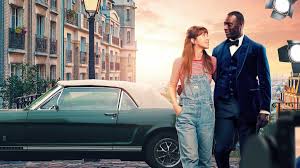
French Lover emerges as a glossy, star-studded entry in the contemporary romantic comedy genre, with ambitions to capture both the whimsy of classic love stories and the pressures of modern fame. Directed by Nina Rives from a screenplay co-written with Hugo Gélin and Noémie Saglio, the film centers on the improbable romance that develops between Abel Camara, a celebrated, world-famous actor, and Marion, a down-on-her-luck waitress trying to rebuild her life after personal setbacks.
From the outset, the film is drenched in cinematic polish. Paris is more than a backdrop—it’s presented as a character: café terraces, riverside strolls, glowing streetlamps, and polished interiors abound. The cinematography by Renaud Chassaing lavishes attention on architectural details and soft lighting, aiming to evoke the romantic ideal viewers often associate with French love stories.The production design and costume work lean heavily into charm and aesthetics, creating a world in which the characters’ struggles feel at once grounded and slightly heightened. Yet as the film progresses, one senses a tension between style and substance: the visual allure occasionally threatens to outpace the emotional logic.
Omar Sy takes on the role of Abel Camara, a man whose very name is synonymous with stardom. As a former child prodigy turned household celebrity, Abel embodies many paradoxes: adored yet isolated, confident yet insecure. Sy brings his trademark charisma and accessibility to the role: he is magnetic onscreen, capable of oscillating between showmanship and vulnerability. However, the script often demands little of him beyond charm and comedic timing, so deeper emotional nuance is inconsistently mined. Sara Giraudeau plays Marion with warmth and quiet reserve. Marion is a more conventional “everywoman” figure—a woman facing divorce, handling multiple odd jobs, and trying to regain footing after adversity. Giraudeau imbues Marion with enough dignity and subtle humor that the audience cares about her arc, though the screenplay’s reliance on familiar tropes sometimes limits her agency.
The chemistry between Sy and Giraudeau is credible in many moments, particularly in scenes that allow them to relax or banter, away from the glare of cameras and the constraints of their public personas. In those quieter interludes, French Lover flirts with something more authentic—two people bridging emotional distance, revealing hidden wounds, or simply finding solace in one another. Yet in more high-stakes or theatrical scenes, the exchange sometimes feels overly familiar: declarations of love, misunderstandings, dramatic reveals—these beats roll out in predictable fashion, often without the narrative propulsion needed to make them feel fresh.
The film’s third-act complications hinge largely on the inherent tensions between celebrity and normalcy. Abel’s world is one of constant exposure, pressure, and expectation, which clashes with Marion’s yearning for ordinariness and emotional safety. This divide is the film’s best thematic engine—how love survives, or is threatened by, external scrutiny, the demands of image, and the compromises required when two people come from vastly different spheres of life. But while the premise promises a critique of celebrity culture, the film seldom commits to biting commentary. The conflicts remain safe; the turning points feel engineered rather than organically earned.
In supporting roles, the cast tries to deepen the film’s emotional and comic textures. Pascale Arbillot plays a literary agent (or perhaps a manager) whose sharp wit injects some edge and skepticism about the film industry’s illusions. Alban Ivanov appears as Abel’s mischievous friend, offering comic relief and occasional moral friction. These characters sometimes add welcome pressure on the leads, though their backstories never quite break through the surface. In sum, the film is less about ensemble complexity than about the central pair’s trajectory.
Where French Lover most strongly resonates is in its quieter, metaphorical gestures. A scene in which Marion wanders alone through Parisian streets late at night, or Abel momentarily rejecting the camera’s glare to speak plainly to Marion, carry more emotional weight than more overt dramatic confrontations. These moments hint at the vulnerability beneath the public masks—reminding viewers that what draws people together is not spectacle, but a few fragile, honest instants. But those moments are rare, and the film too often retreats into romantic comedy formulas: miscommunications, deadlines, contrived crises, and grand gestures that risk feeling like clichés.
The pacing is generous—but maybe too generous. With a runtime of approximately 2 hours and 2 minutes the film luxuriates in its romantic set pieces and Parisian interludes, sometimes at the expense of forward momentum. Subplots involving Marion’s divorce or Abel’s internal struggles are introduced, then sidelined, then resurrected—never fully explored in a way that impacts the overall arc as strongly as one might hope. The screenplay’s structural looseness gives room for mood and aesthetic indulgence, but also leads to uneven emotional payoff.
Among the film’s more frustrating aspects is how readily it falls back on romantic clichés. The “star meets ordinary person” trope has been used many times, and for French Lover to stand out, it needed either sharper character work or a twist on expectations. The film occasionally flirts with subversion—questioning whether Abel’s world can truly adapt to normal life—but more often embraces the comfort of formula: the moment of crisis, the half-truth, the reconciliation, the final public display of love. As a result, the ending, while satisfying on a superficial level, feels safe—less a culmination of emotional growth than a reward for perseverance. Viewers who crave surprises or deeper conflict may find themselves wanting.
Critics have not been especially kind. For instance, in The New York Times, Ben Kenigsberg describes French Lover as participating in a kind of insult—not toward the leads, or the public, but the viewers—because “so little has been demanded.” the film’s reception is minimal, with few reviews to speak of at the time of writing.The film’s ambitions—to echo the airy romantic charm of Notting Hill while rooting itself in modern celebrity’s contradictions—are clear, but its execution keeps it from breaking through as more than a well-crafted, occasionally charming romance.
French Lover does succeed in large part as escapist fare. It’s well cast, visually pleasing, and carries enough emotional sincerity to engage viewers predisposed to rooting for lovers from different worlds. For those who appreciate films where ambiance, aesthetic, and star appeal dominate, it offers a pleasant ride. The marriage of Sy’s charisma and the romantic veneer of Paris gives it an appeal that few rom-coms nowadays attempt at this scale.
Yet the film’s greatest shortcoming is its reluctance to risk deeper friction. The tension between fame and authenticity, the compromises one must make in love, the sacrifices of public life—these all lurk in the margins, but are rarely probed with real dramatic weight. Had French Lover more daring narrative decisions—perhaps deeper fallouts, more asymmetric sacrifices, or more unresolved complexity—it might have transcended the genre shell. Instead, it remains comfortably within safe boundaries. In a film that seems intent on seducing the viewer with glances and settings, its heart is too often locked behind conventional beats.
In summary, French Lover is a polished, visually attractive romantic comedy with strong leads and occasional emotional sparkle, but it falls short of being a memorable or transformative entry in the genre. Its beauty lies in its moments—not in its structure. Fans of romantic escapism will likely enjoy it, especially for the star power of Omar Sy and the seductive promise of Paris. But for viewers seeking a rom-com that challenges its characters and lingers in the mind after the credits, French Lover may ultimately feel like a lovely, but lightly tethered fantasy.