Five Nights at Freddy’s 2 2025 Movie Review
The 2025 release of Five Nights at Freddy’s 2 arrives with the heavy weight of expectation, following the commercial success of the first film and a fanbase eager for deeper lore, scarier animatronics, and a more faithful adaptation of the game’s unnerving atmosphere, and what the sequel delivers is a darker, more emotionally complex, and far more confidently crafted entry that demonstrates how director Emma Tamara (taking over for Emma Tammi, though clearly inspired by her tone) has developed a more mature grasp of the franchise’s psychological core while still leaning into its neon-soaked, horror-arcade aesthetic. Set several years before the events of the first film, the story plunges into the origins of the infamous Freddy Fazbear’s Pizza—but this time focusing on the 1987 location that game fans will immediately recognize as the “FNaF 2” setting—and reconstructs a narrative that stitches together the tragedy of the Missing Children, the mythos of the Puppet, and the corporate neglect that defines Fazbear Entertainment’s sinister legacy. Instead of repeating the confinement-based tension of the first film, which revolved around the night guard’s limited movement and slow-burn dread, this sequel uses its prequel framework to widen its scope, giving us a living, breathing pizzeria full of families, employees, and eerie backstage hallways that convert into nightmare territory once the lights go out. In doing so, the film manages to be both more expansive and more claustrophobic—an unusual but effective mix—because every colorful daytime scene hides clues about the horrors waiting to unfold, and every nighttime sequence feels like a desperate attempt to survive a building designed to swallow people whole.
Where the first movie followed Mike Schmidt, Five Nights at Freddy’s 2 shifts its focus to Jeremy Fitzgerald (portrayed with a surprisingly restrained vulnerability by Finn Wolfhard, in one of his strongest post-Stranger Things performances), who starts his job at the newer Fazbear location just as signs of supernatural interference slowly begin to permeate his night shifts. Jeremy is written not as a reluctant hero or a hardened survivor but as a teenager trying to pay his rent, which makes his slow unraveling all the more believable. The screenplay smartly balances his terror with pockets of humor and awkwardness, allowing him to feel like a real kid rather than a horror-movie archetype. Tammy Davis, playing a newly introduced character named Marla—an overworked day-shift supervisor who suspects something is wrong but can never quite articulate what—adds emotional weight to the daylight side of the narrative, grounding the story in workplace dynamics that feel strangely authentic. But the standout performance is undoubtedly the child actor cast as the Puppet’s human origin (credited only as “E. Harper” to maintain mystery), whose silent, masklike expressions and subtle gestures give the film an eerie, sorrowful heart; the Puppet sequences radiate an uncanny sadness that elevates the material beyond simple jump scare territory.
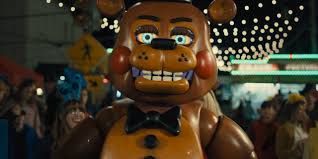
The animatronics themselves—Toy Freddy, Toy Bonnie, Toy Chica, Mangle, Balloon Boy, the Puppet, and the brief but thrilling appearances of the Withered animatronics—are some of the best practical-effects-meets-CGI hybrids seen in a mainstream horror film in years. Blumhouse clearly listened to fans who wanted more physicality and weight from the robot characters, and the result is spectacular: every metallic creak, servo shift, and desynchronized blink feels tactile, giving the animatronics a monstrous mechanical presence that simultaneously reflects and exaggerates their game counterparts. Mangle, in particular, is a highlight—its tangled form rendered in disorienting, almost spiderlike movements that make its chase sequence one of the most memorable moments of the entire film. The Puppet’s design, meanwhile, leans into uncanny-valley minimalism: a smooth, masklike face with slow, jerky motions that transform its appearances into quiet but chilling set pieces rather than loud jump scares. The filmmakers know that the Puppet is scarier when it barely moves, and this restraint pays off.
As for the horror, Five Nights at Freddy’s 2 is undeniably more intense than its predecessor, with a willingness to embrace more visceral and stylized scares while still staying within the PG-13 boundary that made the franchise broadly accessible. The movie rarely relies on pure jump scares; instead, it builds sequences around anticipation, misdirection, and the eerie feeling of being watched. One standout moment is Jeremy’s first encounter with Toy Bonnie wandering offstage—shot from behind a wall of blinking and buzzing arcade machines, the glowing eyes flickering intermittently through the gaps as the soundtrack dampens into an almost suffocating quiet. Another memorable sequence unfolds entirely within the air vents, where the camera follows Jeremy’s crawling form as Mangle’s distorted radio sounds echo around him, creating a sense of dread that rivals some of the best scenes in modern horror cinema. And although it never crosses into R-rated gore, the film does not shy away from implying the brutality of the animatronics; the violence is suggested through shadows, off-screen angles, and clever sound design that lets your imagination fill in the gaps. This approach actually heightens the horror, as the unseen becomes far more terrifying than the overly explicit.
Plot-wise, the film tightens its narrative threads more effectively than the first entry, weaving lore elements into a cohesive structure that both die-hard fans and casual viewers can appreciate. The sequel boldly tackles the backstory surrounding the Missing Children Incident without fully revealing every detail, choosing instead to hint, suggest, and foreshadow in ways that enrich the mythos while leaving room for future installments. The introduction of the Puppet as a kind of guardian spirit—one whose vengeance is tied to the establishment’s corruption—adds emotional depth that was somewhat lacking in the first movie, giving the franchise a thematic center grounded in grief, injustice, and the lingering pain of forgotten victims. Even William Afton’s presence, though limited, is impactful; his scenes are sparse but chilling, treating him less as a mustache-twirling villain and more as a shadowy, calculating presence whose influence permeates the entire pizzeria like a rot just below the surface. By showing less of him, the movie makes him far more terrifying.
The film’s biggest strength, however, lies in its atmosphere. Gone is the glossy, slightly sanitized tone of the first movie; in its place is a grimier, more dreamlike mood where the neon-blue and pink lighting of the Toy animatronics clashes against the dim, fading browns of the pizzeria’s aging infrastructure. This contrast creates a visual identity that is both nostalgic and nightmarish, reminiscent of abandoned malls and rundown family entertainment centers of the late ’80s and early ’90s. The analog tech motifs—flickering monitors, glitching security cameras, old CRT screens—add an almost liminal flavor to the environment, making the pizzeria feel like a haunted space trapped between eras. The sound design further elevates this atmosphere: distorted children’s laughter, warped music box melodies, and subtle mechanical hums become part of an ambient soundscape that maintains tension even during quieter scenes.
Editing is tighter this time as well, with pacing that gradually accelerates as Jeremy’s situation grows more desperate. The final act is a chaotic but emotionally resonant sequence involving the Puppet, the Withered animatronics, and the revelation of the pizzeria’s darkest secret—delivered through a beautifully executed montage that blends nightmare imagery with flashes of memory in a way that mirrors the game’s “death minigames.” The climax feels massive, frightening, and strangely tragic, culminating in a bittersweet ending that connects meaningfully to the events of the first film without feeling like a forced franchise setup. Instead, it feels like the natural start of something larger, hinting at future sequels while giving this chapter its own sense of closure.
If the movie has flaws, they are mostly small: some exposition-heavy dialogue in the second act slows momentum, and viewers unfamiliar with the games may feel slightly overwhelmed by the influx of new animatronics and characters. A few comedic beats land awkwardly, and the film occasionally assumes a level of lore knowledge that casual viewers might not possess. But even these moments don’t significantly detract from the overall experience. In fact, for fans of the franchise, the density of detail is part of the charm—it rewards careful attention and multiple viewings.
In the end, Five Nights at Freddy’s 2 is a rare sequel that surpasses its predecessor by embracing the darker, stranger, and more emotionally potent elements of its mythology. It respects the source material without being shackled by it, finding fresh ways to reimagine iconic characters and horror mechanics while delivering a gripping narrative that stands on its own. It is a film that understands the franchise’s beating heart: not just killer animatronics and spooky pizzerias, but stories of loss, corrupted innocence, and the ghosts left behind when institutions fail the people they were meant to protect. With confident direction, standout performances, chilling animatronic designs, and a more refined approach to storytelling, Five Nights at Freddy’s 2 emerges as a compelling, atmospheric, and surprisingly emotional entry in the growing saga—one that will satisfy longtime fans and intrigue newcomers while setting the stage for a third installment with even greater potential lurking in the shadows.