Eleanor the Great 2025 Movie Review
Eleanor (June Squibb) has a best friend. In fact, she’s had the same best friend for the past seven decades of her life. With both of their husbands long dead and kids well out of the nest, Eleanor and Bessie’s (Rita Zohar) lives don’t just revolve around each other, they’re woven into each other. They don’t just share an apartment in Florida, they share a bedroom, with their neat twin beds laying side by side, complete with matching headboards. They do everything together, sorting bills and clipping coupons and going on walks, and in the dark of certain nights, telling each other the worst things they can remember about their lives.
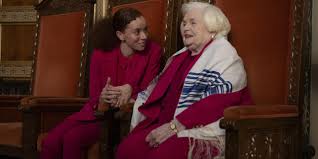
Suffice it to say, this relationship has worked out. So, what happens when the inevitable happens? Such is the set-up of Scarlett Johansson’s feature directorial debut, “Eleanor the Great,” which tenderly, if trippingly examines what happens after we lose the most important person in our lives, and then take halting steps toward finding someone, if not as important, but just as special to help fill the hole left behind. All of this is neatly tucked into the general (and widely reported) plotline of the film, which follows Eleanor as she decamps for New York City and strikes up a brand-new friendship with adorable college student Nina (the delightful Erin Kellyman).
But that’s not really what “Eleanor the Great” is about.
Written by Tory Kamen, “Eleanor the Great” hinges on the early charm of its relatively feel-good premise — inter-age friendship, what a concept! — before piling on the ever-darker twists and turns. That’s not to say the film isn’t funny or sweet, but that there is something much more profound and uncomfortable at its heart, and one that poses a tricky challenge for first-time filmmakers Johansson and Kamen. It does not always land, but the attempts to navigate the complications that are central to the film are just as compelling when they don’t work, perhaps even more so.
Here’s what brassy Eleanor discovers when she returns home to New York City to live with her adult daughter Lisa (a lovely Jessica Hecht) and her good-natured grandson Max (Will Price in a very underwritten role): trying something new at any age is hard, maybe even impossible when you’ve got a broken heart. So while Eleanor is willing to humor Lisa and head to the local Jewish community center to join a singing class, she’s also definitely going to roll her eyes at it, and probably going to just step right out the door, all the better to pretend she’s above it and not, in fact, terrified to try it.
And when another nice lady, about Eleanor’s age, attempts to guide her into one of the JCC rooms, Eleanor is just curious enough and just confused enough to go with her. It’s not the singing class room. It’s a support group for Holocaust survivors and, as we’ve learned early on, Eleanor is not a Holocaust survivor. But Bessie was, so when Eleanor pretends to be one, just lightly taking on Bessie’s own memories to share with the group (Johansson cast many actual Holocaust survivors for these roles), it’s not malicious. And when shining-eyed student journalist Nina, who is sitting in on the group to write a paper about them, takes instantly to obvious star Eleanor, the lonely transplant lets herself believe her own stories. What could it hurt? We will find out, and so will Eleanor and Nina.
Initially, Eleanor’s lie is, well, it’s kind of funny. We can see, by way of Kamen’s sharp writing, Johnasson’s sure-handed directing, and Squibb’s layered performance how this might happen. It’s harder to see how she might get out of it, especially as her bond with Nina grows. And lingering over every interaction between Eleanor and Nina? A two-pronged beast: the threat that Eleanor’s deception will be revealed, and the knowledge that these two would have been able to bond even without Eleanor’s lie.
Both Eleanor and Nina are defined (and confined) by the worst thing that’s ever happened to them: well, Nina by the worst thing that’s ever happened to her (the still-fresh death of her mother), and Eleanor by the worst thing that’s ever happened to the person she loves most in the world (and, arguably, to the entire world itself). If you’re able to see how alike those two positions are, you’re likely to enjoy the thornier aspects of “Eleanor the Great” and the bigger questions that Johansson and Kamen pose in a seemingly amiable outing.
As Eleanor and Nina adventure around the city (Hélène Louvart’s warm, lived-in cinematography gives the entire film a cozy glow, like a glossy mid-budget studio feature of yore), Eleanor’s lies grow, and soon they involve still more people, like Nina’s father Roger (Chiwetel Ejiofor), a local news anchor who Eleanor has long crushed on. It’s a weird, unnecessary bit of serendipity, though the inclusion of Roger as a character is a smart one, allowing Kamen’s script to explore other sides of grief.
Eleanor, of course, knows this is all wrong. She goes to great pains to hide her lies and Nina from her actual family, and when her rabbi somewhat accidentally suggests that some lies are too important to worry about the question of deception (by way of a discussion of the story of Jacob and Esau that is somehow both too pat and perfectly positioned within the film), she visibly brightens. Perhaps she never needs to come clean! Perhaps what has come from her lie is more important than the lie itself!
But Eleanor has backed herself into an awful corner, and in some ways, so too has Johansson’s film, which is stuck trying to impart sage wisdom through the lens of a truly hideous (if well-meaning) lie. As such, the film’s tone tends to vacillate wildly, particularly in its final act, as we build to what we know must be coming and the hope it might lead all of us somewhere better. That Kamen’s script would attempt to marry these concepts with some grand-gesture stuff, real tear-jerking choices that also tend to read as quite cheesy, doesn’t surprise — after all, what’s more melodramatic than life itself?
It adds up to a fascinating, if often baffling first effort from Johannson and Kamen, one not afraid of big emotional wallops, but not always able to carry them into truly revelatory spaces. It’s a little predictable, a little bizarre, a little funny, and very sad, but it’s also an ambitious swing at what movies can still be (and what sort of stars can populate them), a message and an idea that we expect will lead both the director and writer into quite fruitful new chapters. It’s never too late to try something new, Eleanor and Nina seem to want to tell us, and even imperfect attempts have real value.