Dracula: A Love Tale 2025 Movie Review
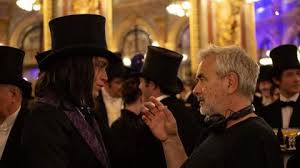
Robert Eggers’ “Nosferatu” has barely cooled down, and a new Dracula film is already in the works. This one comes from Luc Besson. Dracula wasn’t on Besson’s radar as an interesting subject, but he simply wanted to pick up another project with Caleb Landry Jones. On the set of their last collaboration, “Dogman,” Luc asked him what he would do next. They discussed great classic figures from history, as well as well-known monsters and horror characters. When they arrived at Dracula, both pairs of eyes lit up. The next collaboration was born.
The story is again based on Bram Stoker’s book “Dracula,” but with a focus on the bond our bloodsucker has with his wife. Interestingly, in the original story (from 1897), there’s no mention of love, or anything that reflects it, but of domination, dominance, and destruction. The woman was nothing more than a tactical target for Mr. Dracula to undermine a group of men who wanted to destroy him. However, it was Francis Ford Coppola who cast the bond in a truly romantic context. Luc Besson’s version expands on this, moving even further away from the delightfully sadistic monster of the original story. Furthermore, the origins of Dracula aren’t concretely depicted in the original story, as in the film adaptations by Coppola and Besson.
Prince Vlad and his beloved, Elisabeta, are living in a bubble of happiness when, from the east, a dark cloud approaches in the form of the Muslim Ottomans. Although Prince Vlad prefers to remain in the bedroom with his beloved, he has a Christian duty to stop the Muslim wave. Before leaving for the battlefield, he asks God, through his priest, to protect his wife in his absence. Unfortunately, at least in Prince Vlad’s opinion, God fails miserably in this task, which is sufficient reason to curse the latter. As most relationships are equally cursed, Vlad is also cursed and transformed into the notorious bloodsucker. After centuries of wandering, he finds his wife in Paris. He therefore does everything he can to win her back. But now she is promised to another, and he is no longer the same person he was centuries ago.
The film is a strange combination of horror and humorous tones. It’s as if, at times, the film doesn’t quite know what to do. Of course, a film doesn’t have to conform entirely to a genre. But when the atmosphere is chilling, a joke or a humorous note can disrupt the flow. The intense moments are beautifully filmed, and it’s clear that an experienced director is at the helm. The film’s aesthetic and music often recall Coppola’s “Bram Stoker’s Dracula,” and especially Dracula himself. It wouldn’t come as a surprise if Besson drew inspiration from this.
Of all the actors, two stand out: Caleb Landry Jones (‘Dogman,’ ‘Get Out’) and Christoph Waltz (‘Django Unchained,’ ‘No Time To Die’). Caleb, as Dracula, plays his role exceptionally well. There’s something in his eyes that raises serious doubts about his sanity. He emotes with a kind of attachment that dangerously borders on obsession. It won’t be surprising to learn that he’s the same in real life. Some roles are tailor-made for actors because, in their personalities, they already possess elements of the character. This isn’t to say that Caleb is a frequent consumer of O-negative, but that he simply portrays the monster with perfection. The tonality of his voice also reinforces the belief that Caleb is a blood freak who is fortunate enough to portray a character who is almost 100% identical to himself.
Christoph Waltz is a master actor, but only within specific genres. Although he plays his role very well, he seems to have the same emotional spectrum as in ‘Django’: serious with humorous edges. Therefore, the horror elements don’t really come to fruition. Of course, Christoph can’t be blamed for this, as he’s simply doing his job. Perhaps we’re victims of Tarantino’s ‘Django Unchained,’ where he left a dent in the cinematic universe.
Zoë Bleu’s performance as Elisabeta/Mina deserves special mention. She is the only daughter of Rosanna Arquette (and niece of Patricia Arquette) and grew up in a film family. While she doesn’t display exuberant acting, she has a cool facial expression that’s difficult to decipher. Whether this is a blessing in disguise, it adds something to her character. She has a certain curl in her upper lip that gives her a disdainful expression, as if the world exists for her pleasure and command. It goes without saying that her role as Princess Elisabeta suits her perfectly. The rest of the cast has less volume and weight in the story.
Another point that doesn’t really help the film are the special effects. They sometimes look a bit clunky. When these, too, are combined with the horror elements, it just doesn’t feel right. Confusion arises because the tone of the film changes.
“Dracula: A Love Tale” doesn’t offer much new information. This isn’t surprising, given the sheer number of Dracula films available. Luc Besson’s version focuses primarily on the love bond between Beauty and the Beast. Caleb Landry Jones’s performance is impressive, and some scenes are beautifully shot. However, the story often feels rushed, there are moments of comedy that detract from the film’s overall tone, and the quality of the special effects isn’t always up to par. The film is certainly enjoyable to watch, but if you’re a Dracula connoisseur, you might find it disappointing. The only way to know for sure is to see it.