Before We Forget 2025 Movie Review
In the opening frames of Before We Forget, Matias (Juan Pablo Di Pace), a middle-aged Argentinian filmmaker, sits in a dimly lit editing suite, burdened by a film that won’t come together. The unfinished footage is an emotional quagmire—raw, beautiful, but painfully incomplete. We learn quickly that the film he’s trying to finish is based on his adolescent friendship with Alexander, a Swedish classmate. Set in the late ’90s at a boarding school in Italy, their connection embodied youthful fascination, shimmering unrequited affection, and an intimacy that neither dared fully name. When Alexander abruptly leaves—expelled from school—the friendship fractures. And Matias is left to carry those tender, unspoken feelings in silence.
More than a decade has passed. Now, with that original film effort abandoned and Matias grappling with emotional inertia, a call to revisit his past arrives. This narrative voice-over reveals as much as it hides: the journey ahead will unfold through layers of storytelling, an intertwining of memory, longing, and creative struggle.
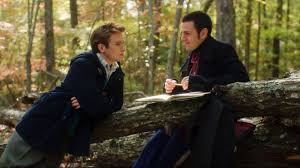
The first act skillfully balances two timelines. In near-monotone present-day scenes, Di Pace’s Matias is introspective, wavering—caught in an endless loop of self-doubt. The editing room becomes a confessional. “I’m just trying to finish it,” he whispers—though it’s as much about finishing a project as finishing the story of his youth. These moments are intercut with beautifully rendered flashbacks to 1997 aboard the UWC Adriatic campus, with younger Matias (Santiago Madrussan) and Alexander (Oscar Morgan) roaming stone courtyards and sunbathed pine groves. The contrast is visually striking: grey interior against vibrant outdoors, compressed adult thanklessness against youthful expansiveness.
Madrussan and Morgan radiate an easy, believable chemistry. They’re not playing out a melodrama but capturing the ineffable rhythms of teenage affection: warm glances over classroom desks, shy breakfast-sharing by stone benches, the courage and awkwardness of first emotional exposure. Those silent dents of longing and curiosity are what anchor the flashback sequences, making each smile and shy exchange feel lived-in and vital.
The film’s visuals are picturesque: rolling Italian hills, ivy-swathed villas, and sunlit amphitheaters. Cinematographer Andrés Pepe Estrada layers amber and olive tones to evoke nostalgia, but without sentimentality. We feel the caress of youth, not the gloss of artificial memory. This is crucial: the aesthetic never cheapens the emotion. Rather, it underscores the untouchable beauty of those days, when a sunrise could feel like a cosmic signal.
Back in the present, Matias returns to Duino, Italy—the same coastal town—and reunites with Alexander (now played by August Wittgenstein). The meeting is not dramatic. There’s no overt confrontation, no titanic clash of unresolved history. Instead, they talk about art, editing, memory. The awkward pauses seem natural; their warmth is tentative, layered with decades of assumptions, half-truths, and withheld emotional currency. It’s enough that they speak—they needn’t say everything.
Di Pace’s direction here is gentle, almost invisible. Scenes unfold quietly: Matias and Alexander walking along cliffs, observing golden light dance across the Adriatic; editing suites where reels of film are re-viewed with a different emotional lens. There’s craftsmanship in this restraint.
Flashbacks occasionally intrude into present-day scenes—a gust of wind recalls laughter; the twist of an old film reel triggers recollection. These stylistic choices underscore an enduring theme: memory is imperfect, subjective, magical, and painful. The film demonstrates that reconstructing the past—literally and metaphorically—is both courageous and destabilizing.
Narratively, the meta-layer of Matias making a film about Matias offers emotional complexity. We watch a filmmaker struggle to see the final cut, to condense a teenage relationship into a coherent story, to decide what to amplify and what to leave unseen. Are they friends or lovers? Do they need closure or confession? The film resists simple answers, preferring instead to depict the tension of influence and interpretation.
Supporting roles add texture: Araceli González plays Matias’s mother in the flashbacks, embodying a kind yet emotionally reserved figure; Krista Kosonen appears as a friend linked to both Matias and Alexander, someone caught between two worlds; Fabio Mazzei, Sarah Parish, and others play boarding school staff and acquaintances who seem to sense the undercurrents without grasping them. Their presence enriches the emotional tapestry, suggesting a communal life lived just outside the frame of affection.
The pacing is unhurried—some might say leisurely. At 108 minutes, Before We Forget doesn’t rush its emotional revelations. Moments of tension or tenderness are stretched to full breath: the silence of a shared coffee after years apart; the way Alexander pauses on a hilltop and lights a cigarette, gazing at the memory-soaked horizon. These pauses matter. They allow the audience to feel the weight of absence, and to linger in the ineffable space between unspoken love and fragile friendship.
There are choices here that might challenge some viewers. The framing device—Matias’s editing journey—occasionally takes screen time away from the emotional core. Critics of the film note that while the flashbacks sparkle, the voice-over and ‘film-within-a-film’ apparatus lacks some emotional punch Yet this structure is integral to the film’s thesis: memory is not a neutral medium. It’s narrative. It’s construction. And as Matias edits, he is re-editing himself and his past. He is both hero and historian, wanting honesty but terrified of re-opening wounds.
The screenplay, by Di Pace and Estrada, resists clichés. There’s no sudden confession-of-love scene, no sweeping music cue. Instead, emotions compress beneath surface calm. Dialogue is restrained. When Matias gently asks Alexander “Have you ever thought about us?”, the question is simple; the subtext immense. It’s in the long stretches of silence where the film finds its truth.
At its heart, Before We Forget is a meditation on the relationship between art and memory. As one critic put it, “the framing story… isn’t as compelling as the more emotionally involving sequences… but it’s also necessary” I agree. The meta-structure might feel slightly over-engineered to those craving emotional immediacy, but it’s what makes the film linger. It reinforces the idea that we are all, in some way, editors of our past—choosing what we remember, and what we leave behind.
The film’s emotional payoff is quiet yet potent. In the final sequence, Matias screens a near-complete cut of the film he’s been working on—not to Alexander, but to himself. We see moments of scratch-shot tenderness: a shared laugh, a look held too long, a dreamlike re-remembrance. It’s not happy or tragic—it’s honest. We, and Matias, feel the lack of resolution, but also something more: acceptance.
Despite its slow pace, the film’s power lies in its authenticity. In a genre often dominated by high-wattage confessionals, Before We Forget finds strength in the things left unsaid. It invites us into the internal logic of youthful love—where you know something matters long before you name it, and where the weight of unspoken feelings shapes you for life.
Visually ravishing, emotionally layered, and structurally ambitious, the film marks a strong debut for Di Pace and Estrada as feature co-directors. The influences—Call Me by Your Name, Almodóvar—are audible, but the voice here is personal. You feel that this story belongs to someone lived. It’s less an adaptation and more an excavation.
The silver lining: the cinematography, rural Italian settings, and dual timelines create a tapestry that’s as beautiful to watch as it is to feel. The coastal town of Duino becomes not just a backdrop but a character: place as memory, place as vessel for what can’t be undone.
If there’s a caveat, it’s that Before We Forget is not for those seeking sweeping romance or cathartic closure. It thrives in nuance, in the fog of memory, in minimalism. Some may find it “tedious” or “clunky” , but others will see its restraint as honesty. Personally, I found the silence between words just as eloquent as any confession.
In summary, Before We Forget is a film about memory and the half-uttered sounds of first love. It explores what it means to look back, to sift through emotion and experience, and to confront the stories we tell ourselves. It’s a delicate, layered film—one that lingers. In a landscape awash with grand gestures, this film offers the subtle beauty of understatement. And in its quiet emotional current, one discovers that true love doesn’t always demand completion—it only demands remembrance.