Angelheaded Hipster: The Songs of Marc Bolan & T. Rex 2025 Movie Review
It’s a sobering thought that Marc Bolan, immortalised by Bowie as The Prettiest Star, would have turned 76 this month. And a satisfying one that his talent is recognised more today than in his commercial heyday.
Back in the early Seventies, Bolan’s transformation from a hippy-drippy acoustic folkie with a Tolkien fixation to an electric warrior in make-up and glitter was a controversial one. The old hippy fans of Tyrannosaurus Rex felt betrayed and the denim-clad prog fans were scornful of singles bands like T.Rex – especially ones with chart-topping singles and hordes of female fans.
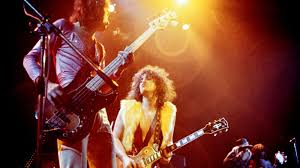
As Billy Idol recalls in the opening segment of this film, just the mention of their name as headliners of the Weeley Festival – England’s own Woodstock in August 1971 – prompted mass booing. “I’d never heard anything like that, 175,000 people booing someone,” recalls Idol (or Billy Broad as he was then). When, a few hours later, T.Rex came on, following an enthusiastically received set by Rod Stewart and The Faces, it happened again. But he won them over – and at the end he got a 15-minute standing ovation.
It was a turning point in Bolan’s career, as well as the biggest crowd he ever played to – rather than the 5,000 expected by Clacton Round Table when they organised their fund-raising festival in the village of Weeley (pop: 951) with the promise of 24-hour music alternating electric and acoustic acts day and night. Not that the progsters in their army greatcoats ever warmed to T.Rex, sticking staunchly to their ELP and Genesis double and triple albums.
AngelHeaded Hipster is the second film of the summer to revive memories of T.Rex, but unlike the recently released Bolan’s Shoes, this is a rockumentary, blending archive footage of T.Rex in their heyday, and the few available examples of Tyrannosaurus-era Bolan (“I do believe in unicorns, in tree spirits”), with reminiscences from those closest to him (Gloria Jones, his partner, and Rolan Bolan, their son) and his peers (Elton John, Ringo Starr), plus contemporary film of Bolan’s famous admirers (U2, Nick Cave) recording the titular tribute album.
It has to be said that the T.Rex footage, which fans will probably have seen before, is preferable to watching (and listening) to Bono and The Edge discussing their workaday plod through Get It On with producer Hal Willner (who has died since the footage was shot) or Joan Jett suck all the joy out of Jeepster by turning it into leaden LA rock.
Fast-forward – or rather backwards – to Bolan telling an interviewer: “We play for the kids who never saw the Beatles, never saw Hendrix. The average age of our audience is 15.” I was one of those kids. Bolan was my first pop idol. He started glam rock – on Top of the Pops in 1971 with Hot Love – while Bowie was still a long-haired hippy (a point made in the film by Elton John) and Slade were still a skinhead band. He was also, according to Joe Elliott of Def Leppard, one of the first beneficiaries of newly-introduced colour television, making an immediate impact with his colourful stage outfits. Elliott also points to the divisive nature of being a T.Rex fan in the early Seventies as he recalls being beaten up as a teenage fan because Bowie and Bolan were regarded as “poofs – and we just thought they were theatrical.”
Yet the average age of 15 may be higher than the reality among the fans whose adoration was predictably dubbed T. Rextasy by the tabloids: Beth Orton, who performs Hippy Gumbo, remembers Bolan being adored by (pre-)pubescent girls as young as nine to 13 because of his unthreatening girly looks – though she was obviously far from alone in finding him “sexy.”
When the two timeframes coalesce the film strikes gold, segueing from a young Bolan sitting cross-legged singing Cosmic Dancer with an acoustic guitar into Nick Cave’s gloriously baroque string-drenched version – the highlight of a patchy tribute album. “I always thought he was a better lyric writer than Bowie,” avers Cave controversially, because Bolan’s gloriously surreal nonsense verse (“I drive a Rolls Royce / Cos it’s good for my verse”) was much mocked at the time. But he’s right. “It was the use of language and imagery, these very simple but complex words. Marc Bolan seemed to invent a kind of language with his songs, a way of using words and images that was unique.”
There are insights into Bolan’s personality too: the shy, bookish East End boy expelled from school at 14 who transformed himself from a teenage male model and Mod-about-town via hardcore hippiedom (with a Tolkien obsession that stretched to renaming his bandmate Steve Peregrine Took) to the King of Glam, without ever losing the sense of childlike innocence that he kept to the end. Elton John recalls being nonplussed by Bolan informing him proudly: “I sold a million records this morning,” to which Elton offered the withering response: “Fabulous Marc, how great for you.” Another time, an interviewer asks him, inanely: “You’ve just become a father, do you feel different?” Bolan responds with that impish grin: “I’m still waiting to feel different. I’m still waiting to grow up.” He gave the same message when interviewed in 1972 by Russell Harty, who asks him whether he ever thinks about what he might be doing when he’s 50 or 60. Bolan shakes his head. “Never think of that… I don’t think I’ll live that long.” He was right: on 17 September 1977 he met his end, in a car crash, at the age of 29. I was devastated: my first dead pop star.
Some of the clips, especially those of songs not included on the tribute album, make compelling viewing. Snarky Puppy perform The Slider on a rooftop in Brooklyn, giving us a prime example of Bolan’s surreal lyrical invention: “I have never, never kissed a car before. It’s like a door / I have always, always grown my own before. All schools are strange.” But for me the highlight is Macy Gray’s reggae version of Children Of The Revolution – again inexplicably omitted from the final cut – but, like most of the other songs, it’s frustratingly truncated to cut to an interview; ditto the wonderful vintage version of Life’s A Gas, Bolan duetting with Cilla Black (yes, Cilla!) before cutting abruptly, and bathetically, to Lucinda Williams’s weary, wounded take on the song.
There’s some interesting background about the competition between Bowie and Bolan, who first met when they were hired by their first manager, Les Conn, to paint his Soho office; an encounter that began badly when Bolan introduced himself as “King of the Mods” and informed Bowie: “Your shoes are shit.” As their careers began to take off in parallel (at one point Bolan invited the lesser-known David Jones to support his band and Bowie performed a disastrous mime), they drifted apart – Cameron Crowe thinks Bowie was jealous of Bolan’s earlier stardom – but repaired the rift when both became superstars.
Watching this film serves as a reminder of just how closely their careers were intertwined, and to what extent Bolan, rather than Bowie, was the innovator: a year before Bowie’s much-heralded transition to soul music with Young Americans, Marc was making a soul and disco-influenced album, Zinc Alloy And The Hidden Riders Of Tomorrow (not the most subtle riposte to Ziggy Stardust And The Spiders Of Mars) featuring two drummers, two sax players and two “black chicks.” Bolan announced that it would be his Blonde On Blonde; T.Rex fans, less open to new directions than Bowie’s, didn’t like it at all.
Bolan was an early adopter of punk too: he went to see The Ramones, loved their energy, and when he got his own TV show – Marc – he invited punk bands like The Jam to perform. The last episode recorded days before his death featured an appearance by Generation X, whom he introduced by saying: “They’ve got a new singer called Billy Idol who’s supposed to be as pretty as me.” The show ended, aptly and poignantly, as the credits rolled with Bolan jamming with his old pal and rival Bowie, happy smiles all over both their faces.
AngelHeaded Hipster ends on an even more emotional moment, with evidence that Bolan’s legacy stretches far beyond those classic singles, as a group of African children at the Marc Bolan School of Music & Film in Sierra Leone – founded by his partner Gloria Jones, who now lives there – sing his hit Children Of The Revolution. It’s a reminder that he was, after all, far more than a pretty face.