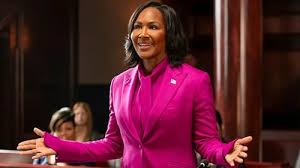
Miss Governor Review 2025 Tv Show Series Cast Crew Online
Part 2 of Miss Governor—formerly titled She the People—lands on Netflix August 14, 2025, picking up the satirical mantle of Southern politics with renewed ambition, following Terri J. Vaughn’s Antoinette Dunkerson, Mississippi’s historic first Black lieutenant governor, now inching toward the governor’s chair amid chaos, comedy, and systemic resistance; a shift that inspires both anticipation and scrutiny. The narrative opens with Governor Harper debilitated by a heart attack, setting a promising stage for Antoinette to officially step in—only for her ascent to be derailed by the entrenched powers of white patriarchal politics. Her bid to leverage photographic proof of Harper’s condition, using Basil’s ingenuity (disguised as a janitor), backfires spectacularly when her daughter leaks the images—prompting public scandal and undermining her credibility, illustrating how even well-intended subterfuge risks compounding the marginalization of Black women in power The arc then crescendos amid a Southern Governors’ Retreat, where Jones-like satire finds bite: Antoinette’s attempt to forge alliances with other conservative governors stalls—particularly with Louisiana’s Twyman Hill, whose open bigotry forces her retreat, even as she attempts to reroute a proposed pipeline away from low-income communities—a compassionate act that inadvertently endangers an endangered bird sanctuary and alienates environmental and Deaf communities alike, launching protests that complicate her political calculus
Through all this, the show generates its sharp comedic energy with a beloved ensemble—Shamika, Basil, family, and inner‑circle schleps delivering punchy comedic beats (“I want community!” quips stand out) in the face of absurd political theater Antoinette’s own judgment transforms into self-sabotage as her romance with her bodyguard Michael (“Merman”) becomes the center of a deposition hearing: lawmakers rail against her personal conduct, but Henry—her former chief of staff turned unexpected ally—exposes how Jed Bonds orchestrated attempts to undermine her by assigning meaningless tasks to push her out, shifting the tone of the hearing from scandal to procedural mockery of power plays—allowing the hearing to be indefinitely postponed Victorious yet vulnerable, Antoinette almost tastes the governorship—but in a spiteful twist, Jed revives Governor Harper from the hospital, trotting out a medically frail, disoriented patriarch to reclaim the office, reinforcing how the system would rather cling to a broken white man than empower a competent Black woman In the finale, Antoinette’s emotional collapse—another reminder of the toll of fighting for legitimacy—leaves viewers mired in frustration, even as the door remains open for Season 2 and her struggle continues
Visually and tonally, Part 2 amplifies Tyler Perry’s signature blend—Southern flair, outrageous costumes, deeply comedic dialogue, and melodramatic set pieces (fashion, pipeline protests, the odd bird‑costumed activist)—yet there’s an underlying emotional register as Antoinette’s ascent turns into a test of self under micro- and macro-political pressure That blend of earnest ambition and satirical edge, though effective, divides critics; while The Daily Beast sees potential for both comedic and dramatic growth as the series deepens over Part 2, Decider suggests that silliness sometimes overpowers political stakes On Rotten Tomatoes, critics give Season 1 a middling 60%, with observations that its comedic elements can undercut otherwise serious commentary, though the premise—a Black woman navigating entrenched Southern political systems—retains its power
Among fans, responses remain polarized but passionate: IMDb comments from Part 1 hold echoes here—some celebrate the colorful, energetic ensemble and Terri J. Vaughn’s grounded performance; others criticize the drawn‑out comedic skits, underwritten characters, and over-reliance on stereotype-laden humor
The tonal balancing act continues into Part 2: comedy pervades even the high-stakes hearings and social satire, which for some undercuts narrative momentum, while for others it’s the core charm: Perry’s brand of satire, where power is personal and politics is absurd.
Ultimately, Miss Governor Part 2 doubles down on its satirical vision: Antoinette comes close to true power, only for systemic gatekeepers to yank it away—offering a biting commentary on how efforts to rewrite the rules can be fragile in the face of longstanding patriarchal structures. Its comedic delivery—fashion, familial chaos, office drama, activist hijinks—makes the show accessible and entertaining; yet the emotional stakes are real, and Antoinette’s breakdown leaves wedge‑like tension between laughter and empathy. As Season 1 concludes, her arc ends unresolved but all the more compelling: a study in how legitimacy is both earned and denied, how satire can cut deep, and how the price of power is often personal. Should Netflix greenlight a second season, there’s ample ground for her redemption—or reinvention—as she continues navigating the labyrinth of Southern politics with both humor and heart.