Alien: Earth Review 2025 Tv Show Series Cast Crew Online
When Noah Hawley turned “Fargo” into a TV series, he approached the beloved Coen brothers’ film as a “state of mind” — a familiar world to play in, rather than a specific story to retell.
With “Alien: Earth,” the showrunner takes a similar tack: latching onto the sweaty, slimy, murky aesthetic of Ridley Scott’s horror classic, as well as the expansive yet pointed imagination of James Cameron’s sequel, to fashion a new narrative as strange as it is fitting. While not a strict homage to either film (lacking the eerie grace of Scott’s exacting horror show and the linear propulsion of Cameron’s action flick), Hawley’s freaky first season (all of which was screened for this review) similarly foregrounds a keen appetite for discovery and a healthy fear of the unknown; a drive toward what we don’t know and a respect for what we don’t understand. “Alien: Earth” doesn’t always keep its footing (at least, not as surely as “Fargo” tends to), but it’s a fascinating and frightening extension of an oft-confined space.
The proliferation of the “Alien” franchise — from Scott’s prequels “Prometheus” and the exquisite “Alien: Covenant,” to disavowed sequels and spinoffs like “Alien: Resurrection” and “Alien vs. Predator” — turned a once-in-a-lifetime serpent into just another snake. To be clear, I miss David, our solar system’s preeminent mad android scientist, and I’d love to see Scott complete his prequel trilogy, but the Xenomorph has been manhandled by more klutzy fingers than you’ll find on a face-hugger, and recent attempts to restore its grandeur felt like little more than fan service. Another spaceship. Another alien. Another (very bloody) game of hide and seek.
“Alien: Earth” looks backward, sure — it’s set two years ahead of the original “Alien” — but it does so without the restrictions commonly found in prequels. Like the old adage about a tree in a forest implies: If a person screams in space and no one can hear them, does it matter? Maybe a little bit, but Hawley’s series is focused on Earth, where there’s a whole mess of shit happening, even compared to the disastrous reality we’re living through now.
The opening script informs us Donald Trump’s wet dream has come true: There are no more governments, only corporations — five of them, to be precise — each of which controls different parts of the world (not to mention the moon and a few nearby planets). There’s Threshold, Lynch, Dynamic, Prodigy (“the new one,” as one crew member calls it), and Weyland-Yutani, the O.G. evil company that sabotaged Ripley’s inaugural trip home. Sixty years ago, they chartered a research vessel to travel to deep space, snag as many nasty creatures as they could, and bring them home for “further study.”
Wouldn’t you know it, but their return home doesn’t go according to plan, and the USCSS Maginot crash-lands in a city owned and operated by Prodigy, not Weyland-Yutani. This sparks the interest of Prodigy’s founder, Boy Kavalier (Samuel Blenkin), a shit-stirrer at heart who invokes the timeless law of “finders keepers” to lay claim to the displaced spaceship and, more importantly, whatever precious cargo it’s carrying.
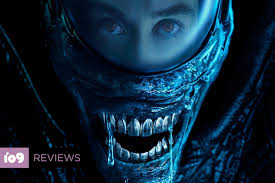
What’s lurking inside is exactly what you expect — almost. Much like how “Fargo” (the series) repositions its leading lady, Marge Gunderson (Frances McDormand), “Alien: Earth” reimagines its own star. The Xenomorph is still our story’s inescapable incarnation of death — the universe’s uncaring response to our desperate fight to survive — but H.R. Giger and Carlo Rambaldi’s iconic extraterrestrial killing machine isn’t a solo act anymore. It’s one of nearly a half-dozen creatures with sinister intentions toward mankind. They take a backseat on the evil bus to a megalomaniacal trillionaire (Boy Kavalier), his corporate peers (mostly unseen), and their twisted flunkies (oh my God, so many flunkies), but they prove to be exactly as memorable as scaredy cats like me wish they weren’t: haunting in their disgusting treatment of frail human bodies, as well as their utter disregard for acute human suffering.
Despite the new need to clarify which alien you’re referring to whenever you shout, “Goddamnit, that alien is about to do something fucking gross again,” the series’ most intriguing new invention is its main character, Wendy. Played with impressive clarity by Sydney Chandler, Wendy is a child whose consciousness was transferred to the body of an adult. As a human, she was sick, dying, frail. As a “hybrid,” she’s a synthetic being with superhuman abilities who may actually be immortal.
She and her fellow hybrids still act and think like children (a few performances, mainly from Jonathan Ajayi and Adarsh Gourav, evoke gleefully bleak humor in their embodiments of big kids), but they’re repeatedly thrust into adult situations — like, say, retrieving a zoo of deadly aliens from a spaceship embedded in a residential skyscraper. Said retrieval is made that much more complicated by the presence of Wendy’s brother, Hermit (Alex Lawther), at the crash site. He’s a medic enlisted in whatever kind of army Prodigy has organized, and he’s still under the impression his little sister died from her incurable illness. Imagine the surprise on his face when he finds out otherwise — assuming, you know, that same face isn’t first greeted by an alien.
If Wendy is our hero, Hermit is as close to an audience surrogate as we get, and his bravery and fear, curiosity and confusion are helpful touchstones as “Alien: Earth” embraces discomfort at every turn. There’s the queasy ethical conundrum of “saving” a terminal child’s life by accelerating them into adulthood. There’s the nausea invoked by how closely the show’s vision of a capitalist technocracy mirrors our current society. And then, of course, there’s the revolting attacks by the actual aliens.
The series can be difficult to watch, particularly for anyone with extra sensitivities toward children in various states of peril, but it’s also not without its fun. Timothy Olyphant’s Kirsh is a worthy successor to Michael Fassbender’s David and the other rabble-rousing androids. As Boy Kavalier’s right-hand synth, he’s responsible for training the hybrids, which means Olyphant gets to play the annoyed babysitter, clearly yet exasperatedly repeating the 22nd-century version of, “If you don’t stop screwing around, I will pull this car over.” Much like “Alien: Covenant” benefited from letting David go full-on Dr. Moreau, Season 2, if it’s greenlit, would benefit greatly from fully unleashing Kirsh.
Babou Ceesay as Morrow, a cyborg and sole survivor of the crashed ship, is also quite enjoyable as a twisted, teeth-gnashing pseudo-villain, and seeing “The Babadook’s” Essie Davis play a surrogate mama for a slew of tortured “children” (she’s in charge of the synths’ “emotional well-being”) brings an extra layer of dread to her increasingly upsetting scenes.
Where “Alien: Earth” slips up is in a few tonal missteps, one worrisome creative leap, and with the alien itself. Shot in medium-wide shots and too often shown in slo-motion, there’s an inelegance to the “perfect organism” during its many action scenes. Not only do its movements, decisions, and presentation invite too many questions as to why it kills who it does (and when), but the Xenomorph’s inconsistent capturing also undercuts a few bold narrative developments later on. By the end of the season, the titular Alien is almost an afterthought — for better, certainly (pushing forward, while uncomfortable, is often necessary when it comes to nostalgia), but what’s worse is needlessly so. (The Xenomorph is still terrifying, when handled deftly.)
The few “good guys” in “Alien: Earth,” when not literally trapped by an alarming array of monsters, are also caught between the resurgence of a dangerous past and the emergence of a formidable future. What cost are we willing to pay to survive? And what does survival even look like after the final tab is covered? The “Alien” franchise is made up of heroes whose victory comes without a reward beyond their own continued breathing, and you can see Hermit slowly recognizing the same fate as his best-case scenario. Seemingly, there’s no way out. Extinction is the only evident endpoint — for humans, at least.
Maybe, just maybe, the children will save us. Otherwise, it’s adapt or die. And in “Alien: Earth,” the question becomes: Is there even a difference?