Soul Patrol 2026 Movie Review
Soul Patrol is a deeply moving documentary that brings an overlooked chapter of American military history into focus. Directed by J.M. Harper, the film follows the surviving members of the Vietnam War’s first all-Black special operations team as they reunite decades after serving together in one of the conflict’s most dangerous assignments. More than a conventional war documentary, it is an intimate account of brotherhood, memory, racial injustice, and the emotional consequences of carrying a war home. The film asks a difficult question: can confronting the past finally bring peace to those who have spent a lifetime living with it?
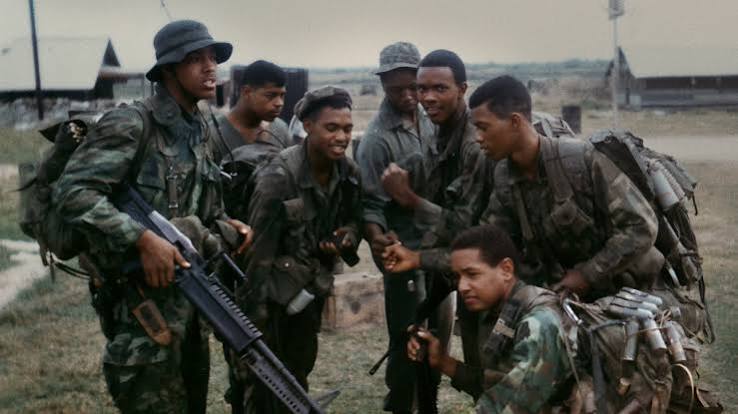
The documentary centres on Team 2/6 of Company F, 51st Infantry, an elite Long Range Reconnaissance Patrol unit deployed deep behind enemy lines. These soldiers undertook dangerous missions in Vietnam while navigating a second, less visible conflict: the racism and inequality they faced as Black Americans serving a country that was still denying them equal rights at home. Their experiences reveal a contradiction at the heart of the war, as young men were sent abroad to fight in the name of freedom while their own communities continued to struggle for justice.
At the emotional centre of Soul Patrol is veteran Ed Emanuel, whose memoir inspired the film. Emanuel’s story provides a personal entry point into the larger history, tracing his transformation from a young man entering military service to a soldier shaped by combat, loss, and complicated questions of identity. His memories are not presented as a simple heroic journey. Instead, they reveal the uncertainty and moral confusion of a young Black soldier trying to understand what he was fighting for, who he was fighting against, and what his country expected of him.
Harper structures the documentary around a reunion of the surviving members of the unit. The gathering becomes more than a nostalgic meeting between old friends. It is a space where memories that have remained buried for decades begin to surface. The men share stories of danger, fear, grief, anger, and moments of unexpected connection. Their conversations are often painful, but the presence of others who lived through the same experiences gives those memories a different weight. The film’s most powerful scenes emerge when the veterans listen to one another, allowing shared history to become a form of emotional support.
This reunion structure gives Soul Patrol its intimate atmosphere. Rather than relying entirely on a chronological account of military operations, the film moves between past and present, showing how the war continues to exist in the lives of those who survived it. The veterans are older now, but the memories remain vivid. Their reflections suggest that the end of a military deployment does not necessarily mark the end of a war’s consequences. For some, the struggle to understand what happened has continued long after the battlefield disappeared from view.
The documentary’s use of archival material is one of its greatest strengths. Harper draws on personal Super 8 footage, photographs, audio recordings, and other materials to reconstruct the team’s experiences. These images give the film a sense of immediacy that conventional historical footage cannot always provide. The past is not simply described by people looking back; it is brought into the present through fragments of lived experience.
The archival footage also helps restore individuality to a history that can otherwise become abstract. Military documentaries often discuss units, strategies, and casualties in broad terms. Soul Patrol repeatedly returns to the people behind those categories. The soldiers were young men with families, beliefs, fears, ambitions, and different understandings of what military service meant. Their personal records preserve traces of lives that might otherwise have been reduced to a footnote in the larger history of the Vietnam War.
The film’s examination of race gives its historical material a particularly urgent dimension. The veterans’ experiences cannot be separated from the civil rights struggle unfolding in the United States during their service. The documentary explores the painful contradiction of fighting for a nation that did not consistently recognize their humanity. Their military duties required courage and discipline, yet their return home did not guarantee acceptance, respect, or the sense that their sacrifices had been understood.
This tension gives the film more than historical value. It asks viewers to consider how national narratives are constructed, whose service is celebrated, and whose experiences are overlooked. The story of the Soul Patrol challenges the familiar image of the Vietnam veteran by placing Black soldiers at the centre of the account. Their experiences complicate simple ideas of patriotism, duty, and sacrifice. They could feel pride in their service while also questioning the political and social conditions that sent them to war.
The documentary is especially effective when it allows those contradictions to remain unresolved. The veterans do not all remember events in precisely the same way, and their reflections are not always neat or reassuring. Their feelings about the war, their country, and their own decisions are complex. The film understands that historical truth is not always a single statement that can be delivered at the end of a story. Sometimes it is a difficult conversation that continues across a lifetime.
The title Soul Patrol itself carries an important layer of meaning. The film explores the name’s history and the different ways it was understood by members of the unit. What might appear to be a straightforward label becomes connected to questions of identity, camaraderie, and the language used to describe Black soldiers. The documentary’s willingness to examine the meaning of the name adds depth to its portrait of the team. Brotherhood is not presented as something automatic or uncomplicated; it is something the men have continued to negotiate and preserve.
Harper also uses reenactments to illustrate certain memories. These sequences can make the veterans’ stories more immediate, especially when the original footage is incomplete. However, the recreated scenes are not always as compelling as the documentary’s direct testimony and archival material. The veterans themselves are often more expressive and affecting than any dramatic reconstruction could be. Their faces, pauses, and changing emotions communicate the lasting impact of their experiences with an authenticity that is difficult to reproduce.
That contrast reveals both the ambition and the limitations of the film’s approach. Soul Patrol wants to make history immersive, but its most powerful material is often also its simplest: the men sitting together, remembering, disagreeing, and supporting one another. The documentary does not need to dramatize every event to make its emotional consequences clear. The veterans’ own voices provide the strongest connection between the past and the present.
The film’s treatment of trauma is another major strength. It recognizes that the consequences of war do not always appear as dramatic moments of crisis. They can emerge through anger, isolation, damaged relationships, guilt, or the inability to discuss painful memories. The reunion gives the veterans an opportunity to speak about experiences they may have struggled to share elsewhere. Their openness makes the film feel less like an exercise in historical explanation and more like an act of collective reckoning.
At times, the documentary’s focus can feel narrow. Its central group is compelling, but the wider political and historical context sometimes receives less attention than the subject deserves. The film raises questions about military recruitment, racial inequality, the civil rights movement, and the American role in Vietnam, yet some of these subjects are explored only briefly. Viewers looking for a comprehensive account of the war or a detailed political analysis may find themselves wanting more.
The limited attention given to the veterans’ families is another missed opportunity. The film makes clear that trauma affects more than the people who experience combat directly, but the perspectives of spouses and loved ones could have expanded its emotional reach. Their experiences might have shown how the veterans’ memories and struggles shaped everyday life across decades. Still, the documentary’s central focus remains understandable: it is primarily a portrait of the men who served together and the bond that has helped them endure.
The film’s pacing is generally reflective, allowing the conversations to unfold without forcing every moment toward a dramatic conclusion. Its 100-minute runtime gives the veterans space to tell their stories, though some sections could have been more tightly shaped. The documentary occasionally moves between personal recollection and broader commentary without fully developing the connection between them. Even so, its strongest moments are powerful enough to sustain its emotional impact.
J.M. Harper’s direction shows a clear respect for the people at the centre of the film. Rather than treating the veterans as historical subjects to be explained, he gives them room to speak in their own voices. The film’s visual and editorial choices support that approach, combining personal archives with contemporary interviews and a reunion setting that feels both ordinary and emotionally charged. Harper’s work earned the U.S. Documentary Directing Award at the 2026 Sundance Film Festival, a recognition that reflects the documentary’s distinctive approach to its subject.
Ultimately, Soul Patrol is less concerned with delivering a definitive statement about the Vietnam War than with preserving the memories of men whose experiences have too often been overlooked. It honours their courage without simplifying their choices, and it acknowledges their brotherhood without pretending that shared trauma automatically heals every wound. The film’s emotional power comes from the veterans’ willingness to revisit difficult memories and from the recognition that their stories deserve to be heard.
As a documentary, Soul Patrol is both a historical recovery and a moving portrait of survival. Its occasional limitations in scope and reenactment do not diminish the importance of the testimony at its centre. The veterans’ stories reveal the human cost of war, the contradictions of American ideals, and the enduring value of friendship among people who have endured the unimaginable together.
Soul Patrol is a stirring, thoughtful, and often heartbreaking film. It gives overdue attention to a group of Black soldiers whose service deserves a larger place in public memory, while reminding viewers that the effects of war can last long after the fighting ends. Its most lasting achievement is not simply uncovering a hidden chapter of military history, but allowing the men who lived it to reclaim their voices, their experiences, and their place in the story.