Jo Koy: Blue in the Face 2026 Movie Review
Jo Koy: Blue in the Face is a 2026 Netflix stand-up comedy special that demonstrates why Jo Koy remains one of the most recognizable and emotionally expressive comedians working today. Released on September 15, 2026, the 56-minute special is his sixth Netflix comedy event and was filmed before a sold-out audience at Stockton Arena in Stockton, California. Directed by Shannon Hartman, the special combines Koy’s familiar observational humor with stories about family, Filipino-American identity, embarrassing childhood experiences, his beloved dogs, and the lasting influence of his late stepfather. What makes Blue in the Face stand out is not that it reinvents Jo Koy’s comedic style, but that it allows him to use that style in a more personal, reflective, and emotionally open way. The result is a performance that moves between loud physical comedy and unexpectedly touching storytelling without losing the loose, conversational energy that has defined his career.
The title Blue in the Face feels appropriate for a comedian whose delivery often depends on intensity, facial expressions, dramatic pauses, and the sensation that he is almost overwhelmed by the absurdity of his own memories. Koy has always been an energetic storyteller, but here that energy is balanced by a sense of maturity. He is no longer simply recounting family chaos for easy laughs; he is examining how those experiences shaped him. His comedy continues to come from everyday situations, yet the special repeatedly suggests that ordinary memories can carry surprising emotional weight. The setting in Stockton also adds meaning to the performance. The city has historical importance for Filipino-American communities, and choosing it as the location gives the special a subtle connection to Koy’s cultural background and personal history. Rather than making representation feel like a separate message, he folds it naturally into his storytelling.
One of the strongest qualities of Blue in the Face is Koy’s ability to transform embarrassing experiences into highly visual comedy. His story about a childhood dental disaster is an example of how he takes something painful, awkward, and humiliating and turns it into a sequence of escalating jokes. Koy does not simply describe what happened; he recreates the panic, confusion, and ridiculousness of the moment through his voice and body language. His expressions often become as important as the actual punchlines. This is classic Jo Koy territory: the story begins as something relatable, then grows increasingly exaggerated until the audience is laughing at both the situation and the way he performs it. The humor works because he understands that childhood embarrassment is universal. Almost everyone remembers a moment when something went horribly wrong in public, and Koy knows how to make that memory feel both personal and familiar.
His material about working at McDonald’s also provides some of the special’s funniest observations. Koy looks back at his early working life and the low pay he received, using that experience to comment on generational attitudes toward work, money, and responsibility. The jokes are not presented as a serious economic argument; instead, he uses his own history as a comic playground. His descriptions of being young, broke, and trying to survive are funny because they contain the kind of practical desperation many people recognize. The story also allows him to bring his mother into the narrative, and as always, Koy’s portrayal of his family is one of his greatest strengths. His mother is not merely a supporting character in his comedy. She represents authority, fear, honesty, and the unavoidable consequences of doing something stupid as a child. Koy’s ability to shift into different voices and attitudes makes these family stories feel almost like miniature theatrical scenes.
The Filipino-American element of Blue in the Face is another important part of the special. Koy has spent much of his career discussing his upbringing and cultural identity, but he does not treat these subjects as educational lectures. Instead, he presents them through food, family expectations, childhood memories, language, behavior, and the strange cultural differences that become obvious when someone grows up between worlds. His humor comes from recognition rather than explanation. Audiences who share similar backgrounds may see themselves in the stories, while viewers unfamiliar with those experiences can still understand the emotional truth behind them. Koy’s approach makes cultural comedy feel lived-in rather than manufactured. He is not trying to prove a point with every joke; he is simply showing how identity becomes part of daily life.
The middle section involving his dogs is arguably the most playful portion of the special. Koy discusses the loyalty and personalities of his dogs, Kingston and Winston, and then begins imagining their thoughts and behavior. What could easily have become a simple collection of pet jokes turns into an extended performance built around character acting. Koy gives the dogs distinct personalities, allowing him to explore their imagined reactions to people, food, affection, and household situations. The comedy is deliberately silly, but it works because of how sincerely he seems to love the animals. His affection makes the material warmer than a standard observational routine. He is not laughing at dogs from a distance; he is celebrating their strange, dependable, and often ridiculous nature.
The dog segment also reveals something about Koy’s broader comedic philosophy. He frequently contrasts the unconditional loyalty of pets with the complications of human relationships. Dogs, in his telling, do not hold grudges, overanalyze conversations, or create unnecessary drama. They simply love you, especially if food is involved. The premise is familiar, but Koy’s performance gives it momentum. He physically acts out the dogs’ personalities and builds the routine through repetition and escalation. Some viewers may find the extended personification excessive, but fans of his animated delivery will likely enjoy it. It is the kind of bit that depends less on a clever single punchline and more on the pleasure of watching a comedian fully commit to an absurd idea.
What makes the special more substantial, however, is the way it eventually moves toward Koy’s late stepfather, Sergeant Fred Harrison. This is where Blue in the Face becomes more than a collection of energetic stand-up routines. Koy speaks about his stepfather’s importance in his life, particularly as someone who entered his world during a difficult period and became a source of stability, guidance, and friendship. The story is rooted in the experience of growing up in a blended family, but it expands into a tribute to a man whose influence remained powerful long after his death. Koy’s affection is obvious, and the emotional honesty of the material gives the closing section a different kind of intensity.
The story of trying to take his stepfather to a baseball game while he was dealing with serious health difficulties is especially effective because Koy does not present grief as a solemn monologue. Instead, he finds humor inside the tension, discomfort, and absurdity of the situation. This is difficult material to perform successfully. If handled too lightly, it could seem insensitive; if handled too seriously, it could lose the comedic voice that makes the story his own. Koy finds a middle ground by allowing the audience to laugh while still understanding the pain underneath the memory. His physical imitation of his stepfather, including the details surrounding his oxygen equipment, becomes both funny and deeply human. The joke does not erase the sadness. It gives the sadness a form that can be shared.
That balance between comedy and grief is arguably the defining feature of Blue in the Face. Koy has often been open about using humor to process difficult experiences, and this special makes that philosophy especially visible. The emotional section is not separate from the comedy that came before it. Instead, the earlier stories about his mother, childhood, work, and dogs prepare the audience to understand how he views family and loyalty. By the time he reaches his stepfather, the audience is not simply hearing a tribute to a stranger. They are hearing about another important figure in the family world Koy has spent years building through his specials. The emotional payoff works because the comedy has already established a sense of intimacy.
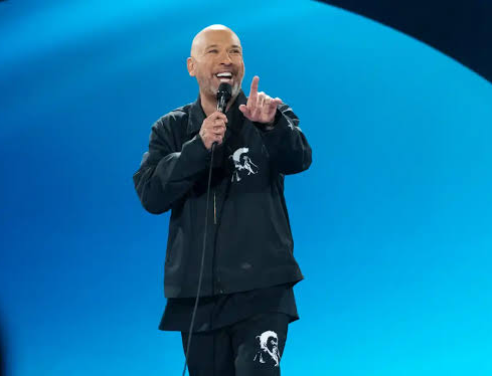
Koy’s stage presence remains one of his biggest advantages. He is expressive, physical, and unafraid to laugh at his own material. Some comedians maintain a controlled, detached persona, but Koy often appears genuinely delighted by the stories he is telling. That enthusiasm can occasionally make his delivery feel overly animated, but it also gives the special its warmth. He performs as though he is reliving the memories in real time, reacting to them alongside the audience. His laughter, pauses, gestures, and exaggerated expressions create the feeling of an informal conversation that happens to be taking place in front of thousands of people. This style will not appeal equally to everyone, but it remains unmistakably his.
The special is also notable for how little it depends on elaborate production tricks. The focus remains on Koy, his storytelling, and the audience’s response. The Stockton setting provides atmosphere, but the material carries the performance. There is no need for complicated staging because Koy’s voice and physicality are enough to create different characters and situations. This simplicity is a strength. It allows the emotional transitions to feel natural rather than engineered. The audience can move from laughing at a ridiculous childhood story to listening closely during a tribute to his stepfather without feeling that the special has changed into an entirely different program.
Still, Blue in the Face is not without limitations. Viewers who are already familiar with Koy’s previous Netflix specials may find that many of his themes remain recognizable. Family stories, cultural observations, exaggerated character voices, and personal memories have long been central to his work. The special does not dramatically alter that formula. Some routines may feel extended beyond their strongest initial premise, particularly for viewers who prefer tightly structured joke writing over long-form storytelling. His humor is also highly performance-driven, meaning that people who do not enjoy loud delivery or exaggerated physical comedy may find certain sections less effective. Koy’s approach is deeply dependent on personality, and that can make the experience subjective.
However, familiarity is not necessarily a weakness when the storytelling remains engaging. Blue in the Face succeeds because Koy understands his audience and knows how to turn his established comedic identity into something emotionally richer. He is not attempting to become a completely different kind of comedian. Instead, he is showing how the same subjects—family, work, culture, pets, and personal embarrassment—can take on new meaning as a person grows older. The special feels like the work of a comedian reflecting on his life while still enjoying the ridiculousness of it. That combination of reflection and silliness gives it a stronger emotional foundation than a routine collection of disconnected jokes.
The pacing is generally effective, moving from lighter stories into more personal material while maintaining a clear sense of progression. The early sections establish Koy’s familiar energy, the dog material provides a long comedic centerpiece, and the final story gives the special its emotional conclusion. This structure makes the performance feel more like a complete narrative than a random sequence of stand-up bits. The ending is particularly memorable because it allows Koy to honor his stepfather without abandoning his comic instincts. It is funny, sad, affectionate, and slightly uncomfortable in the way real memories often are.
Ultimately, Jo Koy: Blue in the Face is a heartfelt and entertaining stand-up special that succeeds through personality, cultural authenticity, and emotional openness. It may not radically reinvent the comedian’s formula, but it demonstrates how effective that formula can be when he has meaningful material to explore. The best moments come when Koy stops trying merely to deliver a punchline and instead allows a story to develop through voices, gestures, memories, and emotional contradictions. His comedy remains broad and energetic, yet the special is grounded in genuine affection for the people and experiences that shaped him. For longtime fans, it offers another familiar but worthwhile performance. For newcomers, it provides a clear introduction to his blend of family humor, physical storytelling, and personal reflection. Blue in the Face is ultimately a reminder that comedy can be loud without being shallow, sentimental without becoming overly serious, and deeply personal while still making a room full of strangers laugh together.