Don’t Say Good Luck 2026 Movie Review
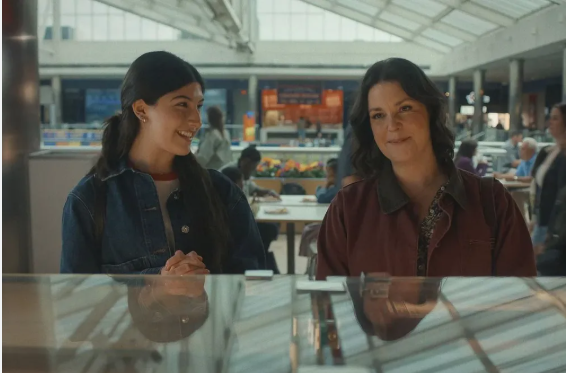
Don’t Say Good Luck, the 2026 Netflix coming-of-age dramedy directed by Julia Hart, is the kind of movie that wears its heart openly and asks its audience to do the same. Starring Sunny Sandler as Sophie Birenbaum and Melanie Lynskey as her mother, Elizabeth, the film combines the familiar world of high-school theater with a much heavier story about illness, family, ambition, and the fear of losing someone you love. Released on Netflix on August 14, 2026, the movie has already attracted attention for Sunny Sandler’s performance and for the emotional chemistry between Sandler and Lynskey. What makes Don’t Say Good Luck interesting is the way it places a seemingly ordinary teenage dream—a student hoping to shine in a school musical—next to an extraordinarily painful family reality. The result is a sweet, sentimental, sometimes predictable film that nevertheless succeeds because its central performances feel genuine.
At the center of the story is Sophie, a sixteen-year-old theater enthusiast who is determined to make an impression in her school production of Waitress. She is not presented as the stereotypical overconfident musical-theater kid. Instead, Sophie is shy, uncertain, and still discovering what she is capable of. When she gets the opportunity to play the leading role, the achievement represents much more than simply winning a part in a school show. It is a moment when she can finally step outside her insecurities and prove something to herself. Unfortunately, just as Sophie’s life seems to be moving in an exciting direction, her family is confronted with devastating news: her mother’s cancer has returned. The film’s central conflict therefore comes from the collision between Sophie’s growing independence and Elizabeth’s desire to protect her daughter from the emotional burden of her illness.
This contrast between the bright world of theater and the darkness of illness is the film’s strongest idea. Onstage, Sophie is supposed to project confidence, emotion, and control. At home, she is suddenly surrounded by uncertainty. The theater becomes both an escape and an uncomfortable reminder of what is happening in her personal life. Rather than making the musical merely decorative, Julia Hart uses it as an emotional mirror for Sophie. The songs and rehearsals give the teenager a language for feelings that she does not always know how to express directly. This is especially effective because teenage emotions can already feel enormous even without a life-changing family crisis. Don’t Say Good Luck understands that adolescence is a period when a school audition, a friendship, a crush, or a performance can feel like the most important thing in the world, while adult problems such as cancer can suddenly make those concerns seem painfully small.
Sunny Sandler is the biggest reason the movie works. As Sophie, she gives the character an appealing mixture of nervousness, enthusiasm, vulnerability, and determination. Her performance does not depend on exaggerated emotional displays. Instead, she often communicates through small reactions and moments of hesitation, which makes Sophie feel like a believable teenager rather than a perfectly constructed movie protagonist. Critics have particularly praised Sandler’s sincerity and her ability to carry the emotional center of the film. The Associated Press noted that her performance has warmth and charm, even while suggesting that some of her softer delivery might work better on screen than on a stage. That observation actually fits the movie’s broader approach: Don’t Say Good Luck is less interested in presenting Sophie as a flawless performer and more interested in showing her gradually becoming comfortable with vulnerability.
The most powerful relationship in the movie, however, is between Sophie and Elizabeth, played by Melanie Lynskey. Lynskey brings an extraordinary amount of tenderness to the role without turning Elizabeth into a simple symbol of suffering. She is a mother trying to protect her child, but she is also a person dealing with fear, uncertainty, and the knowledge that she may not be able to control what happens next. The decision to keep her illness from completely overshadowing Sophie’s opportunity creates the film’s emotional tension. Elizabeth does not want her daughter to look back on her breakthrough performance and remember only the moment when her family received terrible news. That motivation is loving, but it also creates complications because secrecy can become its own form of emotional distance. Lynskey’s performance gives these contradictions weight. In a recent interview, she discussed how motherhood and her own understanding of the role helped her connect with Elizabeth’s perspective.
The movie’s handling of cancer is therefore both its greatest strength and one of its limitations. On one hand, it gives the story genuine emotional stakes. The illness is not simply a plot device designed to make the audience cry; it changes the way Sophie sees her mother, her future, and even her own happiness. On the other hand, the screenplay sometimes approaches the subject with familiar emotional shortcuts. The basic structure—a young person dealing with a parent’s illness while attempting to enjoy an important milestone—is hardly new. Several critics have pointed out that the film relies on recognizable sentimental devices and does not always explore its themes as deeply as it could. The emotional beats are often easy to anticipate, and viewers familiar with coming-of-age dramas may know exactly where some scenes are heading.
Still, predictability is not necessarily fatal to a movie like this. Don’t Say Good Luck is clearly designed as an emotional crowd-pleaser rather than a radical reinvention of the teen drama. Its goal is not to shock viewers with unexpected narrative turns but to make them care about its characters. In that respect, the film is largely successful. Its strongest scenes are the quiet ones, particularly those involving Sophie and Elizabeth. The movie understands that grief often begins before an actual loss occurs. Sophie is forced to confront the possibility of a future without the person who has always been part of her everyday life, while Elizabeth must watch her daughter grow up under circumstances neither of them can control. That emotional tension gives the story more maturity than its high-school setting might initially suggest.
The theater storyline provides the film with much-needed energy. Rehearsals, auditions, rivalries, friendships, performances, and teenage crushes keep the movie from becoming relentlessly depressing. Stephanie Beatriz plays the school’s discerning theater director, adding humor and authority to the production scenes, while other familiar performers, including Steve Buscemi, Bebe Neuwirth, and Jon Lovitz, provide additional personality. The supporting cast is strong, although some characters feel underused. There are moments when the movie seems capable of becoming a sharper satire of high-school theater culture, but it ultimately chooses emotional sincerity over comedy. That choice is understandable, although it means the film occasionally feels less distinctive than it might have been.
One of the movie’s most interesting qualities is its relationship with Waitress, the musical Sophie is preparing to perform. The choice is thematically appropriate because the stage material itself concerns complicated emotional experiences, personal dreams, and difficult circumstances. Sophie is effectively performing a story while living through her own version of emotional upheaval. The musical therefore becomes a reflection of her life rather than merely background entertainment. When the film reaches its major performance moments, the payoff feels earned because the audience has seen how much personal meaning the production has acquired for Sophie. The climactic use of “She Used to Be Mine” is especially designed to deliver the emotional punch that fans of musical theater will expect.
Visually, Don’t Say Good Luck does not appear interested in making its high-school environment excessively stylized. Instead, it favors a warm, accessible presentation that fits its family-drama tone. The ordinary settings make the story feel closer to everyday life, which helps prevent the cancer storyline from becoming too melodramatic. Julia Hart’s direction keeps the attention on the characters rather than overwhelming the story with visual flourishes. This is a sensible choice because the emotional material requires space to breathe. The film’s strongest visual moments are not necessarily the most elaborate ones but those that capture Sophie alone, uncertain, or trying to process information she is not ready to accept.
The screenplay, credited to Laura Hankin, Julia Hart, and Jordan Horowitz, is similarly straightforward. The writing understands the emotional architecture of the story, but it occasionally takes shortcuts. One example noted by Decider is the use of a butt-dial as an important mechanism for Sophie discovering information about her mother’s illness. A device like this can feel convenient because it moves the story forward without requiring a more complicated confrontation. It is not enough to ruin the movie, but it illustrates the larger problem: Don’t Say Good Luck sometimes reaches for the easiest route to an emotional scene instead of finding the most natural one.
That said, the simplicity of the screenplay can also be part of its appeal. The film is easy to follow and does not bury its themes under complicated plotting. It is fundamentally about a girl trying to have one of the biggest moments of her young life while confronting the possibility that her family is about to change forever. The story remains accessible to teenagers, parents, musical-theater fans, and viewers who enjoy emotional family dramas. Netflix itself describes the movie as a heartfelt, bittersweet teen and theater story, and that description is accurate.
Another important factor is Sunny Sandler’s status as Adam Sandler’s daughter. It would be impossible to discuss the movie without acknowledging that context, particularly because Adam Sandler and Jackie Sandler are among the producers. That naturally invites questions about nepotism and whether Sunny has been given opportunities because of her family connections. However, the film itself provides a stronger answer than any debate about Hollywood privilege: she has to carry the emotional center of the story, and she does so convincingly. Her performance is not perfect, and the movie does not suddenly establish her as a fully formed dramatic actor, but it demonstrates genuine potential. The praise she has received from critics is therefore significant because it suggests that her appeal is not based solely on her surname.
The movie is also helped enormously by Melanie Lynskey. Without Lynskey’s emotional precision, Elizabeth could easily have become an overly sentimental character whose primary function was to make the audience cry. Instead, Lynskey gives her humor, frustration, warmth, and restraint. Her scenes with Sunny Sandler are the heart of the film, and their chemistry makes the family relationship believable. The emotional impact comes not simply from the fact that Elizabeth is sick but from the feeling that Sophie and her mother genuinely love each other. That distinction matters. The audience is moved because of the relationship, not merely because the screenplay announces that something tragic is happening.
Ultimately, Don’t Say Good Luck is a movie that succeeds more through sincerity than originality. It does not reinvent the coming-of-age genre, and its combination of teenage theater, first love, family conflict, and illness contains plenty of familiar ingredients. Some secondary storylines are thin, certain emotional turns are obvious, and the screenplay occasionally pushes the audience toward feelings it has already earned naturally. Yet the central performances compensate for many of those weaknesses. Sunny Sandler gives Sophie an appealing vulnerability, while Melanie Lynskey provides the emotional depth that keeps Elizabeth from becoming a cliché.
The film is therefore best approached on its own terms. If you want a sharply written, unpredictable drama that offers a completely new perspective on cancer and adolescence, Don’t Say Good Luck may disappoint you. But if you are looking for a warm, bittersweet Netflix movie about family, theater, growing up, and learning how to live with uncertainty, it is an easy recommendation. It is sentimental, but not empty; predictable, but not entirely formulaic; and emotionally direct without becoming completely manipulative. Most importantly, it gives Sunny Sandler a substantial opportunity to establish herself outside the shadow of her famous father.
Don’t Say Good Luck ultimately understands something simple but powerful: sometimes the biggest moments of growing up happen when life refuses to wait for you to be ready. Sophie wants to sing, perform, fall in love, and enjoy her success like any other teenager, but circumstances force her to confront adulthood earlier than she expects. Her mother’s illness makes every ordinary moment more meaningful, while the theater gives her a place where fear can be transformed into expression. That combination makes the film emotionally effective even when its storytelling is conventional. At around the length of a typical streaming drama and rated PG-13 for thematic material, language, teen drinking, and sexual references, it is aimed squarely at viewers who can appreciate a coming-of-age story with serious emotional stakes.
In the end, Don’t Say Good Luck is not a perfect movie, but it is a sincere one. Its greatest achievement is not the originality of its plot but the authenticity of its central mother-daughter relationship. Sunny Sandler and Melanie Lynskey give the film its emotional pulse, while Julia Hart’s direction keeps the story grounded in the messy intersection of teenage dreams and adult realities. The movie may occasionally lean too heavily on familiar tearjerker conventions, but its warmth makes it difficult to dismiss. For musical-theater fans, families looking for an emotional drama, or anyone interested in seeing Sunny Sandler take on a more demanding leading role, Don’t Say Good Luck is worth adding to the Netflix queue. It may not leave audiences with a revolutionary message, but it leaves behind something equally valuable for this kind of film: the feeling that love, ambition, fear, and hope can exist in the same moment.