Aileen: Queen of the Serial Killers 2025 Movie Review
“Aileen: Queen of the Serial Killers,” the 2025 psychological crime drama, dives headlong into the terrifying and tragic life of Aileen Wuornos with a blend of haunting realism, emotional turmoil, and chilling moral ambiguity. Directed by Karyn Kusama, who has already proven her mastery in dissecting complex female psyches through films like Jennifer’s Body and The Invitation, this latest retelling of Wuornos’s story refuses to sensationalize her crimes or romanticize her pain. Instead, it positions itself as a study in humanity’s darkest corners—where abuse, trauma, and rage merge into something both pitiable and monstrous. The film’s release has reignited interest in one of America’s most infamous female serial killers, but more importantly, it has sparked new conversations about gender, violence, and how society chooses its monsters. With an astonishingly raw performance by Jodie Comer, who fully immerses herself into the tortured mind of Wuornos, “Aileen: Queen of the Serial Killers” isn’t just another biopic—it’s a searing experience that challenges viewers to see the person behind the monster, without ever excusing the horrors she committed.
Set primarily in late 1980s Florida, the film begins with Aileen’s early years of homelessness, prostitution, and emotional instability, painting a vivid picture of a woman shaped by lifelong abandonment and exploitation. The opening act moves through a bleak, neon-soaked landscape of highway motels and rundown bars, using visual decay to mirror Aileen’s own internal disintegration. Kusama’s direction captures not just the heat and grit of Florida but the claustrophobic desperation that fills every interaction Aileen has with strangers—men who leer, mock, and use her until she finally snaps. The cinematography by Bradford Young infuses the film with a documentary-like authenticity, where even moments of quiet are filled with dread. Unlike Monster (2003), which told a somewhat romanticized version of Aileen’s relationship with Tyria Moore, this film strips away sentimentality. It’s colder, starker, and more honest in showing how her violence was born not out of a single relationship or trauma but out of an entire lifetime of systemic neglect.
The screenplay, written by Gillian Flynn, is unflinching in tone yet deeply empathetic in understanding the fractured logic that governs Aileen’s decisions. Flynn gives her a voice that is uneducated yet painfully aware, weaving monologues that reflect both bitterness and yearning for love. Through sharp, darkly poetic dialogue, the film allows Aileen to narrate fragments of her past, each memory sliding into the next like shards of broken glass. We see glimpses of her abusive childhood, her time as a drifter, and her futile attempts at finding human connection—all while the narrative keeps returning to the killings that made her a legend of criminal folklore. The murders themselves are portrayed with restraint; Kusama refuses to glorify or dramatize the violence. Each killing is shot in muted tones, with an emphasis on Aileen’s emotional aftermath rather than the act itself. This choice grounds the film in psychological realism and allows viewers to confront the uncomfortable truth: that Aileen’s rage was both personal and symbolic, a reaction to decades of exploitation by a patriarchal world that discarded her long before she ever pulled a trigger.
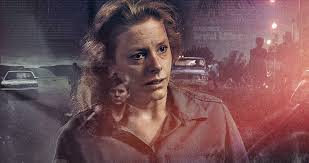
Jodie Comer’s performance is nothing short of extraordinary. Transforming her body and voice with remarkable precision, she disappears completely into the role of Aileen Wuornos. Gone is the poised elegance of her Killing Eve days; in its place is a woman who twitches, stumbles, and lashes out, perpetually teetering between vulnerability and fury. Comer brings such raw intensity to her portrayal that it feels less like acting and more like channeling—a descent into a damaged psyche that’s simultaneously repulsive and heart-wrenching. What makes her performance particularly haunting is how she captures the contradictions that defined Aileen: her need for affection, her distrust of intimacy, her violent impulses, and her distorted sense of justice. Comer’s eyes—often wide, darting, and filled with fear—convey more emotion than words ever could. In one unforgettable scene, when Aileen looks into a motel mirror after her first murder, her expression flickers from horror to relief to blank resignation, encapsulating the entire tragedy of her existence in a few seconds of silent acting.
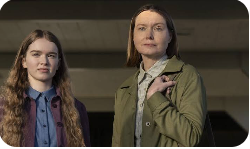
The supporting cast is equally strong, particularly Margaret Qualley as Selby, the young woman who becomes Aileen’s lover and confidante. While the relationship in Monster was portrayed as romantic and tragic, here it is more transactional, fueled by loneliness rather than passion. Qualley’s performance adds another layer of complexity to the film’s depiction of female dependence and manipulation. She is both Aileen’s escape and her downfall—someone who loves her conditionally, only when it’s convenient, and ultimately contributes to her unraveling. Their scenes together are some of the film’s most emotionally charged, balancing tenderness with quiet menace. The dialogue between them is written with restraint but layered with subtext; every gesture, every silence, hints at betrayal or desperation.
Musically, the film is a masterpiece of mood and minimalism. The score by Hildur Guðnadóttir builds on eerie cello notes and haunting ambient tones that seep under the skin. Rather than accompanying the violence, the music often contradicts it—gentle melodies playing over horrific imagery, creating an unsettling dissonance that mirrors Aileen’s fractured perception of reality. The sound design deserves equal praise; the constant hum of highway traffic, distant thunder, and the rustling of motel curtains become recurring motifs, turning everyday sounds into reminders of Aileen’s inescapable isolation.
Kusama’s direction also excels in capturing the sociopolitical undertones of Aileen’s story. Through careful framing and subtle symbolism, she exposes the hypocrisy of a society that consumes violence for entertainment but refuses to acknowledge the systemic abuse that breeds it. News clips and talk-show segments punctuate the narrative, showing how the media turned Aileen into a caricature—a “crazy prostitute killer”—while ignoring the circumstances that led to her downfall. The film doesn’t justify her actions, but it forces viewers to reckon with their own complicity in the spectacle of true crime. In one particularly powerful scene, Aileen sits in her prison cell watching her own trial coverage on TV, her face flickering in sync with the distorted image onscreen—a metaphor for how her identity has been hijacked by the media.
The film’s pacing is deliberate, almost meditative, allowing moments of silence to speak louder than dialogue. Every frame feels purposeful, each movement heavy with meaning. Yet, the final act of Aileen: Queen of the Serial Killers hits like a gut punch. The execution scene is not shot for shock value but for reflection. Instead of showing the physical act, Kusama focuses on Aileen’s final words, delivered in Comer’s trembling voice: “Maybe I was born bad. Or maybe the world made me that way.” The line lingers, not as an excuse but as a philosophical question—one that the film refuses to answer. The screen fades to black, and for several seconds, there is only silence, forcing the audience to sit with the discomfort.
What makes Aileen: Queen of the Serial Killers so powerful is its refusal to fit neatly into any genre box. It’s not a horror film, though it terrifies; it’s not a biography, though it’s grounded in fact; it’s not even entirely a crime drama, though it explores multiple murders. It’s an examination of brokenness—of a woman destroyed by life long before she destroyed others. The film succeeds where many others fail: it neither glorifies nor demonizes its subject but instead presents her as a symptom of deeper social decay. It exposes how the American dream, when denied, can twist into something nightmarish.
From a technical perspective, the film is near flawless. The cinematography captures Florida’s humid despair in a palette of washed-out yellows and bruised blues. The editing by Thelma Schoonmaker balances realism with lyrical flow, giving the film a rhythm that feels like a fever dream. The costume design and makeup work are equally remarkable, transforming Comer into a figure nearly indistinguishable from the real Wuornos. The film’s production design recreates the late-’80s landscape with uncanny precision—dingy motels, greasy diners, cheap cigarettes, and cracked mirrors that all serve as visual metaphors for decay and self-destruction.
By the time the credits roll, Aileen: Queen of the Serial Killers leaves you drained, unsettled, and profoundly moved. It’s a brutal yet necessary piece of filmmaking that dares to look at evil not as a sensational story but as a consequence of humanity’s failures. In Aileen Wuornos, the film finds not a hero or a villain, but a tragic reflection of a society that failed to save her from herself. Kusama’s direction, Flynn’s script, and Comer’s performance converge to create something unforgettable—a masterpiece that lingers long after it ends. Whether viewers leave with empathy or horror, one thing is certain: Aileen: Queen of the Serial Killers forces us to confront the uncomfortable truth that monsters are not born; they are made, often by the very world that condemns them.