The Perfect Neighbor 2025 Movie Review
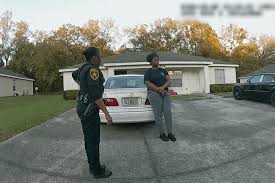
The film opens with a disclaimer – that the following footage is culled from two years’ worth of police body cam footage – and then a 911 call: “Somebody got shot,” a panicked voice says. It’s June 2, 2023. The camera shows the point-of-view of a Marion County Sheriff driving to the scene. The officer sees people waving by the side of the road, jumps out, grabs equipment from the passenger side and runs to a person lying prone in the grass. Cut to an overhead establishing shot of a working-class neighborhood in Ocala; the audio we hear is of police detectives speaking to children about the differences of telling the truth and lies, and that today, the focus is going to be on the truth.
Subtitle: Feb. 22, 2022. Susan Lorincz called the police to the aforementioned neighborhood to lodge a complaint. The neighbor kids are being loud, she says. They play in the empty, grassy lot next to her home – an empty lot with NO TRESPASSING signs on it. She claims the kids are trespassing. But she doesn’t own the lot. A man in the neighborhood does, and he says it’s fine that they play there, and in fact, he joins them sometimes. Across the street from Lorincz lives Ajika Owens. Her children are among those who play football in the lot. There’s a back-and-forth about Owens allegedly throwing one of the trespassing signs at Lorincz. As officers chat casually with friendly neighbors, we learn that this kind of thing happens regularly. Lorincz is “always messing with people’s kids.” “She thinks it’s her property.” Owens doesn’t take kindly to this woman shouting at her children, nor should she. The neighbors and police reach a reasonable conclusion: They’re just kids being kids. They could be doing far worse things than playing games and being loud. But this is not tolerable to Lorincz.
Similar confrontations occur on Aug. 10. And Dec. 22. And March 14, 2023. And May 22. It’s the same story every time – Lorincz calls to air out her histrionic grievances, the police deescalate, the neighbors shrug it off as classic get-off-my-lawn crankiness – but with a few varying details. Lorincz calls the kids racist epithets and the r-word, for playing too close to her truck, for being loud in the lot that she doesn’t own. They call her “a Karen.” One cop mutters to his partner that Lorincz is a “psycho.” Cops tell all involved parties that they’re tired of responding to these unnecessary calls. We return to the scene on June 2, 2023. We see Ajika’s son in a doorbell camera: “Call 911!” he shouts, hyperventilating. “She shot my mom!” Ajika’s pulse is faint as first responders arrive, treat her and put her in an ambulance as her children – the ones old enough to understand what’s happening – weep in the arms of their adult neighbors. There was an incident over a roller skate in Lorincz’s yard. She yelled at the kids and called the cops. Owens angrily knocked on Lorincz’s door. Lorincz pulled a pistol and shot through the door. And now it’s the wee hours of June 3, 2023 and we watch as her children are informed that their mother is dead.
Once it gets past the core tragedy of the narrative, The Perfect Neighbor broadens its POV to include TV news reports and footage from the police interrogation room, where authorities questioned Lorincz the night of the shooting, and a few days later when she was officially arrested and charged with manslaughter. Gandbhir adds bits of third-person footage so the narrative flows logically and key pieces of information are conveyed, but roughly 95 percent of the film is presented as observation from a unique combination of objectivity and subjectivity – the cameras move only with the people or vehicles to which they’re attached, and what they capture is raw and ragged reality.
This is a daring and experimental form of documentary filmmaking for one reason: Gandbhir is presenting these events from the perspective of the law itself. And that law is a stand-your-ground law made famous by the killing of Trayvon Martin in 2012, where deadly force is legally permissible if one can, per Wikipedia, “reasonably believe it to be necessary to defend against certain violent crimes.” On the surface, we see events unfold from the perspective of the police themselves, who in this case are pretty much performing their duties honorably. They de-escalate situations and treat people with respect, kindness and patience; their rapport with citizens is easygoing, conversational and empathetic.
But burrow deeper and it sure seems like the stand-your-ground law handcuffs the police themselves. Did they do enough to prevent this tragedy? They had to let her go after her initial questioning, and the implication is, this specific law is to blame. The film is a convincing argument for critical assertions that this specific law permits people like Lorincz to harbor racism – she’s White, the majority of her neighbors are Black, and nobody of any creed or color in the neighborhood steps up to support her – and manufactured rage until it reaches an explosive boiling point. Evidence pointed to Lorincz’s awareness of the law previous to the shooting; did she arm herself and pull the trigger knowing that this law might protect her?
The can of worms The Perfect Neighbor smashes open poses this question and a bevy of other issues. Lorincz seems troubled by some sort of unexplained mental illness; in an early scene, she tells police somewhat incoherently that she was once sexually assaulted, and it fuels her fear. In an interrogation scene, detectives pin her down on logical discrepancies in her story, resulting in her abject refusal to be cuffed and taken to jail. “There’s only one reality where time exists,” one of the detectives tells her. But it’s clear that her fraught reality differs from those of her neighbors – she saw a threat, everyone else saw children whooping it up outside on a warm summer day. Who does the stand-your-ground law protect?
Ganbhir broadens a little further deep into the film, showing protesters demanding Lorincz be arrested in the days after the shooting, and capturing the Rev. Al Sharpton speaking at Owens’ funeral. We learn that Owens’ oldest son lamented his inability to perform CPR and save her – he’s maybe 10 or 12 years old. He and his three siblings no longer have a mom. Lorincz is serving a 25-year sentence. The law is still on the books.