Black Phone 2 Review 2025 Tv Show Series Cast Crew Online
Black Phone 2, directed by Scott Derrickson and written by Derrickson alongside C. Robert Cargill, is a sequel to the 2021 horror hit The Black Phone. Set in 1982, four years after the original events, the film returns us to the traumatized Finney Blake (Mason Thames), now 17, who survived the ordeals with The Grabber—and whose life remains deeply scarred. His younger sister Gwen (Madeleine McGraw), around 15, begins being tormented by supernatural visions, mysterious phone calls in her dreams, and other frightening phenomena connected both to The Grabber and her family’s past.
One of the biggest achievements of Black Phone 2 is how it expands the story world while being willing to alter the tone and scope. The original film’s horror was more confined—part basement thriller, part supernatural mystery. In contrast, the sequel moves outward: a winter camp in a snowstorm, visions under frozen lakes, and a threat that feels more metaphysical and surreal.This expansion brings both great moments and some challenges.
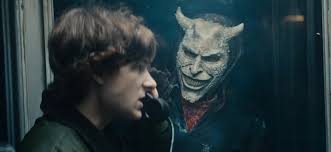
Visually, the movie is strong. Cinematographer Pär M. Ekberg, working with Derrickson, leans into an ’80s aesthetic—grainy home‐movie style visuals in the nightmare sequences, the silence and cold of snow, the disorienting geometry of the phone booth scenes. Critics have praised these moments for evoking dread and dream logic rather than pure jump scares. The horror here often comes from atmosphere and image more than cheap tricks. Gwen’s visions—of mutilated children under ice, or hearing calls from beyond in dream states—are genuinely unsettling. The film doesn’t shy away from gore in key moments.
Performance‐wise, the cast largely succeeds. Mason Thames shows a believable trauma in Finney—anger, despair, the struggle to move forward. Madeleine McGraw, as Gwen, anchors much of the emotional core, especially in sequences where she begins to connect her visions to her mother’s past and to the mystery of Alpine Lake camp. Ethan Hawke returns as The Grabber, now less constrained by mortal limitations and more supernatural, more menacing—drawing comparisons in reviews to Freddy Krueger.
But Black Phone 2 is not without its flaws. Perhaps the most common criticism is that the middle portion drags: there’s quite a bit of exposition, sections where characters must explain the rules of the supernatural threat or the family’s backstory in explicit detail. These moments somewhat undercut the tension, because the movie is at its best when it trusts the audience’s imagination rather than spelling things out. Some reviewers also feel the religious / spiritual elements—especially Catholic imagery, themes of faith and good vs. evil—are used in powerful iconographic ways but not always explored deeply. That is, they add texture and stakes, but sometimes feel more symbolic than fully integrated into the characters’ arcs.
Pacing is also uneven: the film takes its time building dread, which works often, but then later shifts into more conventional horror set pieces. The climax—set on ice, in snow, with ghostly presences—is well conceived and visually striking, but some might find that the set up doesn’t always maintain its grip.
In terms of how it fits into the broader horror genre and sequel culture, Black Phone 2 manages something rare: it doesn’t simply rehash the original. It changes location, plot structure, character focus (Gwen takes a more active role), and even shifts the nature of The Grabber’s threat to something more supernatural. Critics largely agree the sequel surpasses the original in several respects—ambition, scope, and frequency of scares. For example, Rotten Tomatoes shows an 82% score from critics.Many early reviews, including from Bloody Disgusting, highlight that the sequel goes bigger, darker, and is scarier. Yet not everyone is entirely convinced: for some viewers, the first film’s tighter, simpler structure had a purity of fear that the second, in stretching itself, can’t always replicate.
In terms of theme, Black Phone 2 continues to explore trauma—how a survivor (Finney) lives afterwards, nearly paralyzed by memory, anger, shame. The sibling bond between Finney and Gwen becomes central: Gwen’s visions are not just spooky; they are emotional conduits into their shared family history and Finney’s buried guilt. The film also foregrounds spiritual belief: faith isn’t just window dressing but a sort of weapon or armor against evil in some of the key sequences. While that doesn’t always land perfectly, it gives the horror something beyond shock and gore—it gives it stakes.
A big question with sequels is whether they are necessary. In The Black Phone, the ending felt relatively conclusive, so reviving The Grabber in a supernatural sense could feel contrived. But Black Phone 2 largely sidesteps this by making the threat more metaphysical, infusing the lore with personal connection (family, history, guilt) rather than simply resurrecting for the sake of kill scenes. The danger is elevated—not just because The Grabber is more powerful, but because Finney and Gwen are fighting something that is also internal, something tied to their identities. In that sense, the film earns its continuation.
What Black Phone 2 does especially well is balancing homage with originality. There are frequent nods to classics: the idea of evil reaching into dreams, supernatural vengeance, winter camps, supernatural cabins—these are horror staples. Some critics and viewers point out that the film sometimes leans a little too heavily on those references (especially A Nightmare on Elm Street)—the danger being that it feels derivative. But by weaving in personal trauma, sibling dynamics, and a creative visual texture, the movie often transcends pure imitation.
Finally, Black Phone 2 works well as both crowd horror and something more thoughtful. It delivers enough terrifying set pieces, creepy imagery, and visceral moments for genre fans who like to be scared. At the same time, there are layers—visions, spiritual concerns, emotional wounds—that give the film more to chew on than simple horror. It’s not perfect: its thematic ambitions sometimes outrun its structure, pacing issues and expository moments detract; some character arcs are less fully fleshed than they could be. But overall it feels like a worthy follow‐up that doesn’t simply do what the first did, only more. It reaches and, for many, succeeds in its reach.Black Phone 2Finally, Black Phone 2 works well as both crowd horror and something more thoughtful. It delivers enough terrifying set pieces, creepy imagery, and visceral moments for genre fans who like to be scared. At the same time, there are layers—visions, spiritual concerns, emotional wounds—that give the film more to chew on than simple horror. It’s not perfect: its thematic ambitions sometimes outrun its structure, pacing issues and expository moments detract; some character arcs are less fully fleshed than they could be. But overall it feels like a worthy follow‐up that doesn’t simply do what the first did, only more. It reaches and, for many, succeeds in its reach.
In conclusion, Black Phone 2 is a strong sequel that mostly justifies its existence. It’s more ambitious, more atmospheric, and often more terrifying than its predecessor. While it stumbles here and there—especially when the plot demands overt explanation or when the new mythology becomes a bit busy—it keeps the emotional core intact. For those who loved the first movie, this one expands what The Grabber mythos can be; for newcomers, it offers enough visceral horror and intriguing mystery to make it worth a watch. It may not be flawless, but it’s a sequel that earns its place rather than feeling like a cash grab, and it may well be one of the stronger horror films of late 2025.