Play Dirty 2025 Movie Review
A crude, formulaic, and timelessly existential collection of paperback crime novels that were published under the pseudonym of Richard Stark, Donald E. Westlake’s “Parker” franchise is the only series of books that has ever been adapted into Jean-Luc Godard and Jason Statham movies (“Made in USA” and “Parker,” respectively), both of which feel equally true to the ruthless concision of their source material. Ditto John Boorman’s violently elliptical “Point Blank,” John Flynn’s sociopathically affectless “The Outfit” (a Quentin Tarantino favorite), and Brian Helgeland’s senselessly butchered “Payback.”
Needless to say, Westlake’s hardboiled anti-hero is as durable as they come, his conscience blank enough to be the perfect canvas for anyone hoping to make a heist movie without a heart; anyone hoping to revel in the take what you can steal nihilism of a world where everyone is a criminal, and being a good thief is more righteous than being an easy target.
Shane Black is much too humane a storyteller to seize on the page-turning soullessness of the Stark books (“Lethal Weapon” might as well be “It’s a Wonderful Life” when compared to the stony timbre of the “Parker” series), but few people in the history of modern Hollywood have better understood the Christmas spirit of cops and robbers who don’t give a fuck about anything beyond the final score of whatever game they’re playing. Few people have mined as much entertainment from the contrast between high stakes and low morals — from how the life-and-death concerns of a big heist or an elaborate conspiracy might ultimately just reinforce the sense that nothing matters, and nobody gets out alive.
Black has turned the headshot into a one-liner, the one-liner into a shrug, and the shrug into a profound statement on why a character like Parker has resonated across more than a half-century of American crime. So while his seemingly inevitable take on the character is much sweeter and more fun than Westlake would have ever hoped to see, the signature humor that Black pumps into “Play Dirty” — the laughs he gets from blasting extras in the head, hurling goons off Manhattan rooftops, and pushing a shit-eating celebrity cameo in a hilariously unexpected direction — manage to reflect their own degree of the devil-may-care ethos that have made the Parker novels so enduringly cathartic.
A CGI-soaked, straight-to-streaming throwback to the multiplex crowd-pleasers that once made Black the highest-paid screenwriter on the planet, “Play Dirty” may be too diluted to milk all that much from its “movies used to be like this” nostalgia, but it’s hard to argue with the spiritual ’90s-ness of a crime comedy that features a crucial supporting performance from Gretchen Mol.
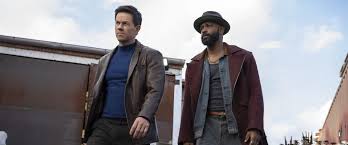
That spirit manages to survive a patently modern star turn from Mark Wahlberg, whose incapacity for nuance and self-reflection is well-served by a role that has little interest in either. Wahlberg is an obvious downgrade from executive producer Robert Downey Jr., who was originally set for the part, but his “fuck anyone who tries to big-time me” Boston affect suits the character just fine, and he deserves some credit for being one of the few actors who can convincingly lead a funny car chase, shoot a semi-innocent bystander in the head, and then hand his widow a $10,000 stack of cash all without having to change the expression on his face.
And that’s precisely what happens in the first 10 minutes of “Play Dirty” (which isn’t inspired by a specific Stark novel, but rather distilled from the essence of the entire series), as a bank heist goes south when a rent-a-cop decides to get involved… even though his wife is riding shotgun and their daughter is sitting in the backseat. The getaway chase — a vintage Black setpiece, despite how crummy it looks — steers directly into the middle of a horserace at the local track, complete with a hilarious cutaway of a weathered gambler throwing away his bet ticket and computer-generated equines flying in every direction as Wahlberg zigzags through the mayhem with his all-purpose squint.
Our heroes make a clean-ish getaway, but the hot new member of the crew has an agenda of her own, and manages to waste everyone but Parker in her bid to steal the loot for herself. Zen (Rosa Salazar, terrific as the kind of two-timing femme fatale you like more than any of the other main characters) needs seed money for a heist she’s planning at the U.N., where she hopes to steal her country’s greatest treasure away from the dictator who’s putting it on display, and then use the profits to fund a revolution (again, “Play Dirty” is begrudgingly about things in a way that the “Parker” novels seldom were). By the time Parker catches up with Zen, she’s already invested all of the cash in the job, which means that Parker will have to team up with her if he has any hope of getting it back. Adding fuel to the fire: The dictator is trying to steal the treasure for himself in order to play the victim, and the crew he’s hired for the score — a group of corporatized goons known as The Outfit — just so happen to be Parker’s mortal enemies.
Personality goes a lot further than plot here, and so who’s who and why they’re shooting at each other is really only worth discussing as a loose framework for how and why this movie is able to mash together so many fun characters. None of the characters in Black, Anthony Bagarozzi, and Charles Mondry’s script hold a candle to the ones that made the likes of “Kiss Kiss Bang Bang” and “The Nice Guys” so much more than the sum of their genre riffs (“Play Dirty” is spread too thin to give its cast the runway they need to create something truly original), but everyone here is having fun and is on the same page.
LaKeith Stanfield is an easy standout as Parker’s best friend Grofield, a passionate actor who moonlights as a criminal to fund his dead-end theater company — some of the movie’s heartiest chuckles come from the joy Grofield takes in getting to ham things up as part of the heist. Keegan-Michael Key and Claire Lovering have less to do as the crew’s resident masters of disguise, but they’re both able to match the confidence that Black imbues in this kind of material, and their role in the film’s centerpiece subway derailment has a lot of fun messing with expectations. Tony Shalhoub is on auto-pilot as the exasperated leader of The Outfit, but he and his incompetent underling (a mercilessly abused Nat Wolff) share good schtick without stepping on Salazar’s toes as Parker’s biggest threat and fiercest comic rival. Even without sharing so much as a single kiss, they kill people together with such mutual enthusiasm that you can see them ending up happily ever after.
Is this that kind of movie? It’s possible, despite the stoniness of the source material. Per Black tradition, “Play Dirty” is full of twinkle and Christmas cheer, and while its various setpieces are all effectively comic without straining for laughs, the film’s warmest moments tend to be the interstitial acts of violence, where Parker and Zen can trade barbs in between executing a few highly emotive henchman (Black’s fondest staple). This is a “Parker” reboot for the whole family, provided that everyone in the family has been completely desensitized to rampant violence — and who among us hasn’t?
More to the point, it’s a “Parker” reboot with an eye toward franchise potential, which is something about it that would’ve made Westlake happy (he only allowed productions to use that name if they agreed to produce a whole series of films based on his books). And while this isn’t quite the stuff of vintage Black, it’s close enough that I wouldn’t mind seeing him crank another one out every two years for the next decade.