The Legend of Hei 2 2025 Movie Review
In the rich, evocative world of The Legend of Hei 2, the filmmakers MTJJ and Gu Jie reshape a simple tale of magical beings into a sweeping allegory about conflict, identity, and the fragile peace between species. Picking up after the first film’s quieter conclusion, the sequel boldly stretches its wings across new narrative fronts, effectively morphing what was once a tender reflective story into a spiritual and geopolitical odyssey. With the spirit world and humanity on the brink of war, suspicion falls on Wuxian, target of both political machinations and interpersonal betrayal. Hei and his senior fellow apprentice, Luye, must navigate this fractured landscape to uncover the true culprit—and in doing so, confront not just external villains but the inner turmoil that arises when trust fractures. This quest is as much about ideological reconciliation as it is about familial loyalty.
The animation stands on a plane of its own. In an era dominated by hyper-realistic CGI, Hei 2 remains unapologetically committed to traditional 2D aesthetics, supplemented lightly by 3D elements for depth and dynamism. What distinguishes the film is not merely the choice of medium but the artistry within. The production spanned six years, crafting over 200,000 hand‑drawn frames (genga), with nearly 2,400 distinct shots. Notably, the action sequences defy standard animation norms: many are rendered at 24 genga per second instead of the usual 12, creating an almost hyper-real fluidity in motion—particularly striking in the airborne combat scenes choreographed with consultation from aeronautical experts
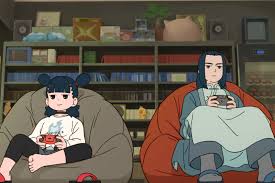
Alongside this technical prowess is the cultural tapestry woven into every scene. Mythic creatures mingle with modern conveniences—Nezha gaming on a handheld console, spirits scrolling through smartphones, and fantastical guild halls echoing the architecture of Cangnan County, complete with local dialects, Minnan accents, and Cantonese tea‑house vibes. These elements are not kitsch; they reflect the film’s deliberate incorporation of living folk culture into fantasy. Luye’s design, for example, spanned over 200 drafts as creators sought to capture her blend of steely bitterness and fragile inner yearning—an embodiment of trauma, resilience, and acceptance
The voice work deserves its own commendation. Shan Xin and Liu Mingyue reprise Hei and Wuxian with performances reflecting paternal warmth and childlike earnestness, while Zhu Jing grounds Luye with austere calm that softens at just the right moments. The performances collectively form an emotional mosaic, each character voice a thread in the film’s thematic weave
Narratively, what emerges is both a detective story and a meditation on moral ambiguity. Rather than presenting a binary conflict, the story invites us into the perspectives of spirits and humans alike. Neither side is inherently virtuous, and shades of gray abound. Critics in China praised the film precisely for this refusal to draw neat moral lines, instead offering an expansive empathy that trusts the viewer’s judgment The political subtext is unmistakable: war leaves no victors, and collective trauma transcends species boundaries. One CTV reviewer wrote of the film’s “oriental fantasy” sensibility elevated by mature visual storytelling; Sanlian Lifeweek lauded the action as the “pinnacle” of domestic production yet noted that the human-spirit conflict lacks clear motivation—more gloss than substance on occasion
“It’s no longer just ‘cute’—this time there are massacres led by Luye and others,” and while “the conflict between right and wrong remains in Hei’s hands,” there’s a compelling emotional montage reminiscent of Millennium Actress For all its strengths, the film isn’t beyond critique. Some viewers on Letterboxd suggested the moral center remains too dependent on Hei’s passive arbiter role—a reliance that might strain credulity if the series continues without narrative evolution Another reviewer compared aspects of the film metaphorically to a “wuxia-style police drama” with implausibly competent protagonists and caricatured “technologically superior” humans depicted as overly saber‑cutter villains
Yet these critiques underscore one of the film’s boldest choices: it doesn’t simplify. The enemies are complicated, the allies flawed, and the setting warns that even the most whimsical realms hide pain—and hope. That duality is perhaps the film’s beating core. Its international prospects grew quickly when GKIDS acquired North American rights and scheduled a release for September 5, 2025; theatrical runs followed across Southeast Asia, Canada, and Japan
Given its cultural specificity and ambitious visual voice, the film’s crossover appeal is notable. It’s a story deeply rooted in Chinese mythology and vernacular life—yet its themes of belonging, resistance to war, and cross‑cultural empathy seem inherently universal. “At its heart, The Legend of Hei 2 is about connection, resilience, and identity—themes that transcend borders,” declared Wang Jingjing, VP of COL Group (which holds majority ownership in HMCH)
Ultimately, The Legend of Hei 2 transcends the bounds of a traditional animated sequel. It’s an ambitious cinematic tapestry—a detective odyssey, a coming‑of‑age journey, a cultural celebration, and a philosophical rumination—all drawn (quite literally) in vibrant strokes of 2D ink. While some narrative threads betray their haste or selective plausibility, the overall experience is immersive, moving, and bold enough to challenge assumptions of what animation—especially Chinese animation—can achieve.
The emotional resonance lies in its characters: Luye’s stoicism cracking under the weight of past trauma, Hei’s unyielding hope despite overwhelming odds, and Wuxian’s quiet strength tested by betrayal and suspicion. Thematically, the film asks: What does it mean to choose peace when the world seems rigged for war? How do you trust, and whom do you trust, when identities don’t fit neat categories? These aren’t questions easily answered in 120 minutes—or 200,000 frames—but the film invites the audience to linger in the ambiguity, in the tension, and in the possibility of healing.
In summary, The Legend of Hei 2 is a rare sequel that doesn’t merely continue a story—it deepens it. Through breathtaking animation, layered storytelling, and thematic ambition, it stakes a claim as one of the most accomplished domestic animated features of 2025. Whether as cultural artifact, emotional narrative, or artistic milestone, its impact lingers long after the credits roll—and that is its greatest triumph.